Saturday, June 29, 2013

Good News For Art Lovers

The Metropolitan Museum of Art Extends Hours


Great Hall, The Metropolitan Museum of Art 
Photo: Brooks Walter, The Metropolitan Museum of Art

Beginning Monday, July 1, 2013, The Metropolitan Museum of Art will be open on Mondays. Locals and out-of-towners will be able to experience the Museum's treasures seven days a week. This equates to an additional weekly 7 1/2 public viewing hours.

Lines for "Alexander McQueen: Savage Beauty" exhibition, 
Photo:  AP, Gothamist Daily Web Site

Judging from past and current crowds, Mondays hours are a gift to all visitors.

Take note of the Museum's new schedule:

Main Building
Monday - Thursday 10:00 a.m.-5:30 p.m.
Friday and Saturday 10:00 a.m.-9:00 p.m.
Sunday 10:00 a.m.-5:30 p.m.
Closed:  Thanksgiving Day, December 25, January 1, and the first Monday in May

The Cloisters
Open 7 Days a Week

March–October 10:00 a.m.-5:15 p.m. 

November–February 10:00 a.m.-4:45 p.m. 

Closed: Thanksgiving Day, December 25, and January 1

Interior of the Thomas J. Watson Library
Photo: Metropolitan Museum of Art, Google Images

The Museum’s libraries will also increase their hours.  The Thomas J. Watson and Nolen Libraries will be open on Mondays starting July 1. This means an additional day of research time at Watson and Nolen. All services will be available on Mondays, including paging, access to electronic resources, digital scanners, and reference assistance.  See the following new hours:

Watson Library
Monday - Thursday 10:00 a.m. - 5:15 p.m.
Friday 10:00 a.m. - 6:00 p.m.
Saturday 10:00 a.m. - 2:00 p.m.
Closed:  Closed on national and staff holidays, including Election Day and the day after Thanksgiving; the library closes at 3:00 p.m. on the Fridays before holiday weekends.

Nolen Library
Monday - Sunday 10:00 a.m. - 5:00 p.m.
Closed:  National and staff holidays, including Lincoln’s birthday, Election Day, Veterans Day and Thanksgiving weekend; the library closes at 3:00 p.m. on Fridays before holiday weekends.


Visit the Museum on a Monday soon before the new schedule gets well-known.  You may find yourself communing with artworks solo.

Friday, May 31, 2013

Four Good Reasons To Visit The MFA Boston Now


There is always a good reason to visit the Museum of Fine Arts Boston (MFA). The Museum’s superb holdings of some 450,000 objects are encyclopedic in scope. Nevertheless, three noteworthy temporary exhibitions and gallery reopenings with special loans make this a particularly opportune time to be there.

Michelangelo Buonarroti (1475 - 1564), Madonna and Childc. 1524, 
black chalk, red chalk, red wash, white heightening, ink, 
21 1/10 x 15 3/5 in. (54.1 x 39.6 cm),
Casa Buonarroti, Florence
Photo:  Museum of Fine Arts, Boston, MA

For a full day, begin with the Michelangelo drawing show: Michelangelo: Sacred and Profane, Master Drawings from the Casa Buonarroti (Gallery 154). This intimate single-room exhibition presents 25 Michelangelo drawings of architectural (14) and figural (11) subjects. This viewer can not recall a larger grouping of the artist’s architectural drawings ever in the US. The exhibition makes obvious why Michelangelo’s drawings were always highly valued. Creative ideas pour forth. Concepts are worked and reworked or left alone as the artist moved on to other interests. Transformations occur through pencil, chalk, wash and ink.

Michelangelo Buonarroti (1475 - 1564), Cleopatra,
c. 1524, black chalk, 9 1/10 x 7 1/5 in. (23.2 x 18.2 cm),
Casa Buonarroti, Florence
Photo:  Museum of Fine Arts, Boston, MA

Some of the artist’s most famous works are here such as his black chalk drawing of Cleopatra. The Egyptian queen is depicted at the moment of the snake's deadly bite to her breast. The drawing was Michelangelo’s gift to his close friend Tommaso de’Cavalieri, a young Roman nobleman.

Michelangelo Buonarroti (1475 - 1564), Grotesque Head (Cleopatra Verso),
c. 1524, black chalk, 9 1/10 x 7 1/5 in. (23.2 x 18.2 cm),
Casa Buonarroti, Florence
Photo:  Museum of Fine Arts, Boston, MA

On the back, the outline of Cleopatra becomes a grotesque female head. This “verso” drawing was uncovered in 1988 when a backing on the paper was removed. Scholars have debated its authorship. The face and shoulder outline appear awkwardly drawn. One cogent theory suggests that Cavalieri drew it. He was the first owner of the work. Michelangelo may have provided drawing lessons to the younger man and one result could have been this unattractive head (see William E. Wallace, The Woman Behind Michelangelo’s Cleopatra, Art News, April, 2013).

The Madonna and Child, another celebrated representation, is nearby. The drawing is a virtual showcase of the artist’s technical range. Black and red chalk, red wash, lead white and ink make the fully realized body of the Christ child seems to pop out of the paper’s surface. The Madonna’s unforgettable subtle expression of sadness and otherworldly gaze movingly implies her son’s future passion.

A lingering look at the Sacrifice of Isaac rendered with black and red chalk along with pen and ink, reveals a lightly sketched ram among thick bushes in the lower left corner. The black chalk Risen Christ makes clear Michelangelo’s experiments with the placement and bend of the figures’s legs. The architectural designs are significant. Several are studies for the unfinished façade of the Church of San Lorenzo (never completed) as well as the Laurentian Library and New Sacristy which were part of the San Lorenzo complex. Michelangelo’s work plainly anticipates the seventeenth-century Baroque architectural style of Bernini and Borromini. 

Spend time looking. You may not have the opportunity to see these drawings again.


Rembrandt Harmensz. van Rijn (1606-1669), Portrait of Aeltje Uylenburgh,
1632, oil on panel, 29 1/16 x 21 15/16 in. (73.7 x 55.8 cm),
The Rose-Marie and Eijk van Otterloo Collection
Photo:  Museum of Fine Arts, Boston, MA

The Museum’s main Dutch and Flemish gallery (Gallery 242) and neighboring smaller gallery (243) have been reopened this month after an almost year-long renovation. Hung alongside the museum’s own holdings are seventeen paintings from the acclaimed seventeenth-century Dutch and Flemish collection of Rose-Marie and Eijk van Otterloo. The new installation makes a good case for the MFA to be the ultimate recipient of van Otterloo collection. The couple plan to make a decision in the next two years as to the future home of their 70 paintings, 20 pieces of furniture and 10,000 books which had belonged to the eminent Dutch and Flemish art historian Egbert Haverkamp-Bergemann. The van Otterloos want their collection to remain intact. Thus, should they decide against the MFA placement, now is the time to see how their art and the museum’s own mingle in mutual enhancement. 

On view is their early Rembrandt, Portrait of Aeltje Uylenburgh. Painted when Aeltje was 62 years old and the artist 26, the work is considered one of Rembrandt's finest paintings in private hands. The sitter’s white starched collar and fur trimmed dress take your breath away.  Saskia van Uylenburgh, a cousin of Aeltje, would soon become the artist’s wife.

Gerrit Dou (1613-1675) , Dog at Rest, 1650,
oil on panel, 6 ½ x 8 ½ in. (16.5 x 21.6 cm) 
The Rose-Marie and Eijk van Otterloo Collection
Photo:  Museum of Fine Arts, Boston, MA

A favorite of mine is the van Otterloo’s Dog at Rest by Gerrit Dou. The artist was a pupil of Rembrandt and this painting’s canine owes much to an etching by the master. Unlike his teacher’s bravado brushstrokes and thickly applied paint, Dou’s paintings are smooth surfaced. The artist’s hand is not apparent. Dou and his followers are known as the Fijnschilders (fine-painters), a school of painting characterized by highly finished, true-to-life, small- scale work. The Dog at Rest is good example of this style. The texture of all objects are meticulously detailed. The dog’s hair is painted so accurately you can almost feel the fur.
Salomon de Bray (1597-1664), Study of a Young Woman in Profile,
1636, oil on panel, oval 10 ½ x 8 in. (26.7 x 20.5 cm),
The Rose-Marie and Eijk van Otterloo Collection

Other van Otterloo paintings include those by Jacob Isaacksz van Ruisdael, Aelbert Cuyp , Jan van der Heyden, Hendrick Avercamp, Jan Baptist Weenix. Willen Claesz Heda and Salomon de Bray. De Bray’s Study of a Young Woman in Profile is particularly valued for seventeenth-century profile portraits are rare. The label explains that the panel was probably a study of a professional model’s head intended for use in other works. The same woman appears in a painting by one of de Bray’s contemporaries.

Although the MFA’s own Dutch and Flemish works merit attention, on this visit plan to concentrate on the van Otterloo loans. The outcome of their bequest is uncertain.

Installation view of Triumph of the Winter Queen.
Photo:  Museum of Fine Arts, Boston, MA

The Triumph of the Winter Queen: Allegory of the Just by Gerrit van Honthorst’s is displayed in the Loring special exhibition gallery (Gallery 276).  The almost 10 feet by 15 feet canvas has been recently conserved.  The 1636 is painting is on loan to the MFA anonymously.  It is a complex iconographic allegory.  Elizabeth Stuart, daughter of James VI and I, King of Scotland, England and Ireland and his wife Anne of Denmark, was nicknamed the "Winter Queen”.   In 1613, Elizabeth married Frederick V, Elector of the Palatinate.  The couple became King and Queen of Bohemia for less than a year (one winter), 1619-20.  They were ousted by the Holy Roman Emperor Ferdinand and took exile in The Hague where Elizabeth remained for the rest of her life.  In 1632, Frederick died.  Elizabeth subsequently commission this large scale work from Honthorst, a leading portrait painter in the Netherlands and abroad.  The painting depicts herself, her husband, and all their children in a setting imbued with symbolic historical and political allusions. The who’s who in the painting and its meanings are explained in a nine-minute film which supplements a series of informative wall texts.  The Hanoverian British monarchs, including the present queen, are Elizabeth Stuart’s descendants.  

Installation view of  Samurai!: Armor from the Ann and Gabriel Barbier-Mueller Collection
Photo:  Museum of Fine Arts, Boston, MA

Samurai!: Armor from the Ann and Gabriel Barbier-Mueller Collection (Gund Gallery LG31) is a splendid exhibit of Japanese arms and armor from one of the world’s most important collections of samurai art. The approximately 14o objects on display make for a very different show than the Metropolitan Museum of Art’s comprehensive samurai exhibition that took place in 2009-2010. The Boston show is smaller, from one collection and focuses on the extreme spectacle of samurai garb and accouterments. Human and horse mannequins make the material come to life. Objects are given ample space to be studied individually, in the round. Yet, the pieces are close enough to one another for visual comparison. These works were made to distinguish rank, wealth and identity. The variety of textures, patterns and symbols astonish. Most are fearsome looking. Some are beautiful. Some are even humorous. All are remarkable. 

Go to Boston’s Museum of Fine Arts now.


Michelangelo: Sacred and Profane, Master Drawings from the Casa Buonarroti
April 23, 2013 - June 30, 2013 

Triumph of the Winter Queen 
February 14, 2013 - July 21, 2013 

Samurai!: Armor from the Ann and Gabriel Barbier-Mueller Collection 
April 14, 2013 - August 4, 2013

465 Huntington Avenue, Boston, MA 
Hours:
Monday and Tuesday 10 a.m. - 4:45 p.m., Wednesday - Friday 10 a.m. - 9:45 p.m. 
Saturday and Sunday 10 a.m. - 4:45 p.m. 
Closed New Year's Day, Patriots' Day (third Monday in April), Independence Day, Thanksgiving, Christmas Day

Tuesday, April 30, 2013

Not For Milk: Dairy Art Centre


Photo: Hillary Ganton 

The Dairy Art Centre, a new not-for-profit art center in London's Bloomsbury district, opened to the pubic on April 25. Frank Cohen, the British businessman and art collector along with the Danish art advisor and collector Nicolai Frahm transformed a 12,500 square foot former milk depot into a showcase for art, music and dance. Cohen and Frahm want to create a space for a variety of events where people, not necessarily involved with the arts, will mix. Plans include a bar, lounge, music and bookstore and outdoor cinema. The art will focus on artists the founders consider influential but ignored. Works for exhibitions may come from their own or other private collections, galleries, museums or made specifically for the site. It is a strategy in flux. 

The inaugural show, Quicksand John M Armleder, is devoted to the Swiss multimedia conceptional and installation artist John Armleder. The artist has filled the Dairy’s irregular, casual gallery spaces and outdoor sculpture yard with works from the founders’ collections as well as new paintings and installations designed for the art centre. Armleder curated the exhibition.  The result is an engaging mixture of wall paintings, mixed media pieces, “Furniture Sculpture,” “Pour” and “Puddle” paintings, neon combines, sculptures and canvas paintings.

 
John Armleder, Convallaria Majalis, 2003, 
mixed media on canvas, 9.8 x 18.7 ft. (300 × 570 cm)
Photo: Dairy Art Centre Website 

Armleder’s art is one of accumulation and appropriation. He remakes progenitors’ works in a radical way. Abstract expressionism turns into “Pour” and “Puddle” paintings.  Minimalism’s purity and fascination with industrial material become a riot of form. Decorum turns into rowdiness.  He does takes on Op and Pop art as well as Duchamp’s ready-mades. Viewers recognize influences. Dan Flavin, Jackson Pollack, Andy Warhol, Damien Hirst are a few of his forebears.  The old is turned into the new.  The past is rediscovered.

   
Outdoor Yard, Dairy Art Centre, London 
Photo: Hillary Ganton 

One complex visual and sound installation takes over “The Fridge,” a room that was once the former  dairy’s refrigerated space. Industrial wall shelves are platforms for the artificial and the real. Natural flowers mix with fake. Stuffed toy animals are placed next to taxidermic ones. Videos and sound tracts distract and attract. Piles of art books invite perusal but are closed and cannot be read. There is an exuberance in the accumulations of things - a celebration of life. Yet, the flowers wilt and the animals are dead. Among life’s cheerfulness lurks death. All is thought provoking. 

If this first show is an example of what is to come, the Dairy is ensured success.  Bravos to Frank Cohen and Nicolai Frahm.*

*For an interview with Frank Cohen by BloombergBusiniess reporter Frarah Nayeri, April 16, 2013, go to "Art Collector Cohen Opens Gallery in Milk Depot."  Source:  BloombergBusiness

Quicksand 
John M Armleder
Spring/Summer 2013 

7a Wakefield Street, London
Hours:
Tuesday - Friday 10:00 a.m. - 6:00 p.m. 
Saturday and Sunday 11:00 a.m. - 5:00 p.m.

Saturday, March 30, 2013

Up Close And Personal With A Renaissance Master

Piero della Francesca in America


Piero della Francesca (1411/13-1492), Saint Augustine, 1454-1469, 
oil and tempera on poplar panel, 52.4 x 23.8 in. (132 x 56.5 cm), 

The Frick Collection’s exhibition, Piero della Francesca in America, is the first exhibit in the United States devoted to the Renaissance master. Four of the seven paintings on display are from the Frick’s own collection - the museum has the largest holdings of Piero’s work outside of Europe. All the paintings on view were made for the artist’s home town, Borgo San Sepolcro. Six of the known eight panels from the altarpiece created for San Sepolcro’s Church of Sant’Agostino are united for the first time since the polyptych was taken apart after 1555. Accompanying them is the rarely lent “Virgin and Child Enthroned with Four Angels” from the Sterling and Francine Clark Art Institute. The exhibition will not travel.

More to come.


Piero della Francesca in America 
February 12, 2013 to May 19, 2013
1 East 70th Street, Manhattan, New York
Tuesday through Saturday, 10:00 a.m. to 6:00 p.m. 
Sundays, 11:00 a.m. to 5:00 p.m. 
Closed Mondays and holidays

Thursday, February 7, 2013

“Let Me Entertain You, Let Me Make You Smile...I’m Very Versatile” The Bronzes of Alexander Calder


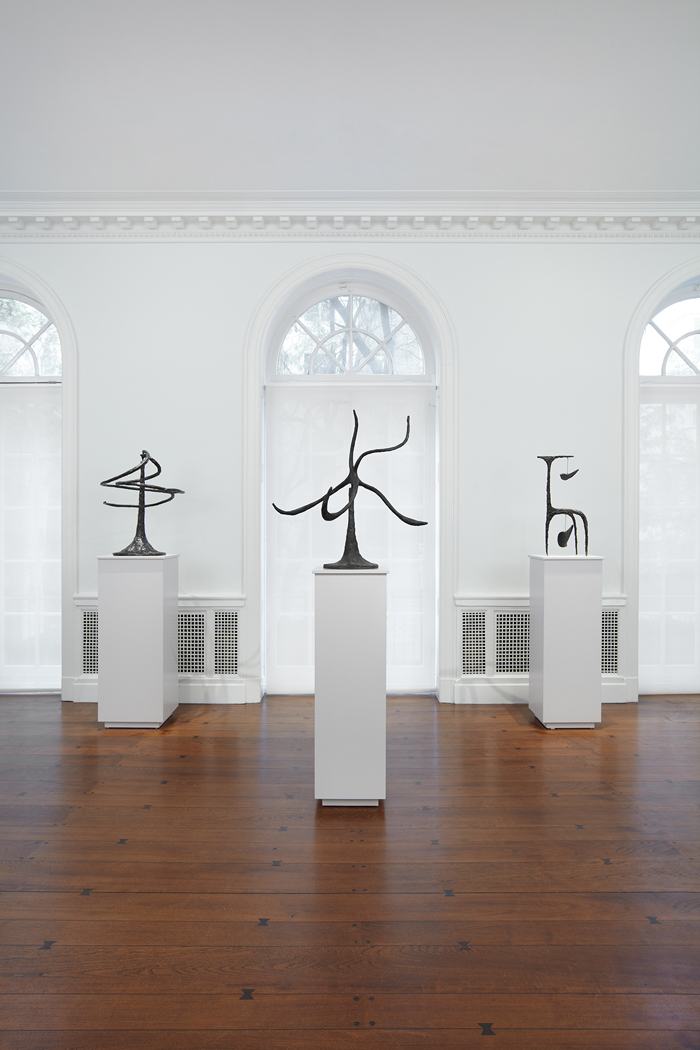
Installation view of Calder: The Complete Bronzes, First Floor, Front Gallery 
From left to right: 
Fake Snake (Snake on Table), 1944, bronze, 44 x 13 1/2 x 15 in. (111.8 x 34.3 x 38.1 cm) 
Acrobats (II), 1944, bronze, 20 x 13 1/2 x 9 1/2 in. (50.8 x 34.3 x 24.1 cm) 
Tightrope Worker (Woman on Cord), 1944, bronze, rod, and string. 22 x 30 x 15 1/2 in. (55.9 x 76.2 x 39.4 cm) 
Dancer, 1944, bronze, 27 x 23 3/4 x 17 3/4 in. (68.6 x 60.3 x 45.1 cm)
© 2012 Calder Foundation, New York / Artists Rights Society (ARS), New York

An exhibition of bronzes and plaster models by Alexander Calder (1898-1976) presents a different side of this well-known artist. Calder worked in bronze only twice, in 1930 and between 1943 and 1944. The exhibit, Calder: The Complete Bronzes, makes a case for the importance of these works. Although not all the bronzes are included, there are over thirty on view along with thirteen of their plaster models. Private collection restrictions prevented a few from traveling.

These works are not the artist’s familiar cut sheet metal and wire mobiles or stabiles. They can’t be set in motion with a slight breath; and, they are not monumental.

About a third are articulated with a variety of joints, hooks, posts and holes. Some appear to balance precariously. Since parts can move, a “what if” game ensues. Shift one section this way or that and another may or may not follow. Take the Dancer with billowing breasts. Hinged in four pieces, her struggling arabesque may be adjusted. Tip the extended leg upward and twist the torso to extend an arm en avant. The Tightrope Worker may gently sway on the rope as limbs are altered. Two acrobats, Acrobats (II), one astride the standing partner’s head, astound. How does he do it? A Snake curls down, around, up and out yet remains firmly shelf based. Movement is conjecture. Spectators may not touch.

Installation view of Calder: The Complete Bronzes, First Floor, Front Gallery 
© 2012 Calder Foundation, New York / Artists Rights Society (ARS), New York

Three shelves display eighteen toy-like bronze and plaster figurines. A voluptuous woman has her feet in the air in an uninhibited posture; another female lies languidly stretched out on the ground. A strong man raises a barbell, knees bent under the weight. An acrobat, using only one arm, strains to hold another. A hissing cat arches his back. A cow, elephant, donkey and two horses add to the animated menagerie.

Pieces have a tactility and, at times, sensuality not ordinarily associated with the artist. Designing with fast drying plaster, Calder did not disguise his touch. Impressions of modeling were left. The influence of Matisse and Picasso is clearly discerned. Some sculptures appear to be direct descendants of the artist’s miniature circus, Cirque Calder, a portable, performance affair made in Paris in the late 1920s.


Excerpts of Calder performing the "Circus" from a film by Jean Painlevé, Le Grand Calder, 1927, 1955 by WhitneyFocus
Video:  YouTube

In the first floor back gallery, bronzes are paired with their plaster prototypes. Close observations reveal slight dissimilarities.

Installation view of Calder: The Complete Bronzes, First Floor Back Gallery 
From left to right: 
The Flower, 1944, bronze 24 x 20 1/2 x 18 1/2 in. (61 x 52.1 x 47 cm) 
The Flower, 1944, plaster, 24 x 20 1/2 x 18 1/2 in. (61 x 52.1 x 47 cm) 
The Vine, 1944, bronze, 26 x 40 x 16 1/4 in. (66 x 101.6 x 41.3 cm) 
The Vine, 1944, plaster, 26 x 40 x 16 1/4 in. (66 x 101.6 x 41.3 cm) 
© 2012 Calder Foundation, New York / Artists Rights Society (ARS), New York

Compare the plaster and bronze Vine. Note the variation in the double-leaf top component where it connects to work’s stem: the top leaves turn upward in the plaster version and downward in bronze. Changes made, perhaps, to accommodate the nature of differing materials.

Installation view of Calder: The Complete Bronzes, Second Floor Rotunda
On One Knee, 1944, aluminum, 43 1/2 x 40 x 26 in. (110.5 x 101.6 x 66 cm) 
© 2012 Calder Foundation, New York / Artists Rights Society (ARS), New York 

On One Knee is the show’s only aluminum sculpture. Placed in the rotunda on the second floor, it splays across a pedestal casting wondrous shadows on the gallery’s wall. Reminiscent of Giacometti and Picasso, this complex figure intrigues. Speculations as to intent come forward. Made of several parts, the now seemingly immobile joints may or may not have been the artist’s desire. Wear and tear takes its toll.
Installation view of Calder: The Complete Bronzes, Second Floor Front Gallery 
From left to right: 
The Helices (Double Helix), 1944, bronze, 31 1/2 x 31 1/4 x 24 in. (80 x 79.4 x 61 cm) 
Starfish, 1944, bronze, 34 1/4 x 35 1/2 x 22 in. (87 x 90.2 x55.9 cm) 
Upstanding T (The "T"), 1944, bronze, 36 3/8 in. (36.375 x 92.4 cm)
© 2012 Calder Foundation, New York / Artists Rights Society (ARS), New York 

The rear second floor gallery requires viewers’s restraint for the overwhelming desire is to touch, spin or prod. The Helices (Double Helix), Starfish, and Upstanding T (The "T") are especially enticing. They call out for motion. Here is Calder at his best morphing an inert material into lightness and flight.

It would seem Calder was destined to become an artist. His father and grandfather were successful sculptors. (See ArtWithHillary, January 2013) His mother was a painter. His sister held art classes in her home and helped establish a university museum. Calder was talented and very smart. He attended and graduated from San Francisco’s equivalent of New York’s Stuyvesant High School and earned a mechanical engineering degree from the demanding Stevens Institute of Technology in New Jersey. Celebrated for his sculptures and the invention of mobiles, his prodigious artistic output also included paintings, drawings, prints, gouaches, jewelry, costumes, stage designs, chess sets, book illustrations, an autobiography, the decoration on two planes and an automobile.

The bronzes may, however, suggest more than other works Calder’s paternal ancestry. His father and grandfather worked in bronze. Their artistry was traditional, realistic, solidly grounded. Calder took their medium of choice and reworked it in a completely different manner. He formed the material into something expressive, gravity defying. He abstracted the real world and left his imprint visible. See the Calder bronze show.

Calder: The Complete Bronzes
October 25, 2012 - February 9, 2013

Mnuchin Gallery* 
45 East 78 Street, Manhattan, New York 
Hours: Tuesday - Saturday, 10 a.m. - 5:30 p.m. 


 *Calder: The Complete Bronzes opened in October, 2012 at the L&M Arts which became the Mnuchin Gallery as of January 2013.  L&M Arts has made a significant contribution to New York’s art scene with outstanding, often museum quality shows.   From L&M Arts Web site: “After seven years of working very successfully together as the founding partners of L&M Arts, we have decided to branch out on separate endeavors beginning January 2013. While we no longer will partner in New York City, we are extremely pleased to announce our continued affiliation as L&M Arts, Los Angeles. Mnuchin Gallery will continue its program at 45 East 78th Street and Dominique Lévy Gallery will open at its new premises at 909 Madison Avenue in 2013. Thank you for your continued support. We look forward to seeing you soon. Dominique Lévy & Robert Mnuchin”

Wednesday, January 16, 2013

Do You Know Me?

Who am I?


Alexander Stirling Calder  (1870–1945), Man Cub
1901–2, cast 1922, bronze, 45 x 15 x 14 in. (114.3 x 38.1 x 35.6 cm), 
Photo: Hillary Ganton

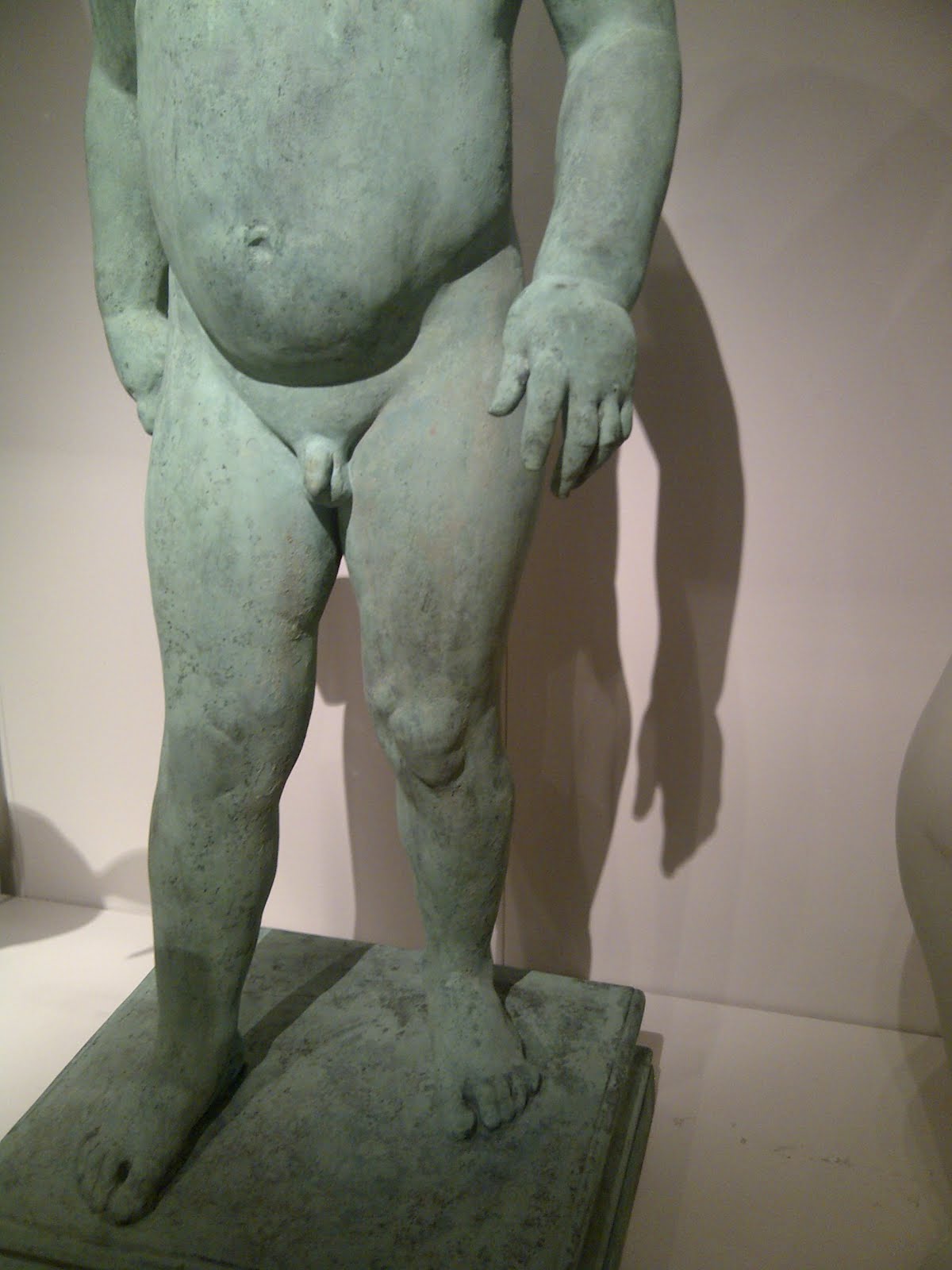
A life-size bronze boy steps forward on the mezzanine level of the Metropolitan Museum of Art’s American Wing. The child is nude. Full-cheeked and pudgy, his cuddly appearance belies a determined look and concentrated gaze. The sculpting is of the highest quality. Joints and digits are well-defined. The formation of each toe is individualized.


Alexander Stirling Calder (1870-1945), Detail of Man Cub,
1901-2, cast 1922, bronze, 45 x 15 x 14 in. (114.3 x 38.1 x 35.6 cm) 
Photo: Hillary Ganton


Flesh appears soft and pliant. Mussed hair, swelling chest and belly completes the lifelike semblance. Hellenistic realism is brought to mind.


Alexander Stirling Calder (1870-1945), Detail of Man Cub,
 1901-2, cast 1922, bronze, 45 x 15 x 14 in. (114.3 x 38.1 x 35.6 cm) 
Photo: Hillary Ganton

The child’s right arm extends back as if to protect a half-hidden orange clutched in hand. You can almost hear him say, “It’s mine!” As a traditional symbol of purity, the orange may allude to the unsullied innocence of youth. Still, it could simply be the boy’s favorite fruit. Whatever, the orange is the child’s precious possession. The artwork’s specificity yields the impression of a particular person. He seems to be a focused yet playful lad, maybe a bit mischievous. 

Who is he?  Take a look at the boy some thirty-four years later.


Calder in his New York City storefront studio, winter 1936, 
Photo: Herbert Matter

The bronze statue is a portrait of four-year-old Alexander “Sandy” Calder, the famous American artist acclaimed for his kinetic sculptures called mobiles. It was done by his father, Alexander Stirling Calder, a successful Philadelphian sculptor known for large public projects. Calder called the work, Man Cub. A title that could relate to the barrel-chested child’s resemblance to a little bear. The word cub, however, has an archaic meaning alluding to an undeveloped, uncivilized youth. This usage, according to the Oxford English Dictionary, goes back to 1601, Shakespeare’s Twelfth Night, v.i.167:

                               O thou dissembling cub! what wilt thou be
                               When time hath sow’d a grizzle on thy case?

The sculptor was aware no doubt of this connotation. He grew up in the nineteenth century when Shakespeare was part of the popular culture. The Bard’s words and plays were commonly used in secondary education. Youths were compared to young bears who, apocryphally, were thought to be born formless and afterward licked into shape by their mothers. Did not Calder, the father, shape a likeness of his son from an amorphous substance?  


The original Man Cub, 1901-1902, was modeled in plaster.  In 1918 the Metropolitan Museum of Art included it in an exhibition of American sculpture and commissioned the artist four years later to cast the work in bronze. Calder made the Museum’s bronze with a distinctive blue-green patina as if had long been exposed to the elements like an object from antiquity.  This finish contrasts with an earlier black and glossy cast completed between 1905 and 1906 in Philadelphia.  No matter the surface variation, the sculpture’s delight with and pride of his offspring is obvious.


Alexander Stirling Calder (1870-1945), Man Cub,
1901-02, bronze with black patina; sand cast in 1905-6,
48 3/4 x 15 1/4 x 13 3/4 in. (123.825 x 38.735 x 34.925 cm),
Pennsylvania Academy of the Fine Arts, Philadelphia, Pennsylvania


“Sandy” became the third generation of talented, well-known sculptors in the Calder family. All were named Alexander Calder. The youngest was Alexander Calder called “Sandy” (1898 - 1976). His father was Alexander Stirling Calder (1870 - 1945); and, his grandfather was Alexander Milne Calder (1846 - 1923), the creator of the towering statue of William Penn on top of Philadelphia’s City Hall. The son of a tombstone carver, the eldest Calder had immigrated to Philadelphia from Scotland in 1868.

“Sandy” Calder is said to have received his pet name because he looked like Santa Claus. The more likely sobriquet's genesis is the Scottish nickname for Alexander which is Sandy. References to Calder or Alexander Calder generally denote Alexander “Sandy” Calder. More about his work in a future blog. 

Go see Man Cub. It’s in Gallery 774, the Henry R. Luce Center for the Study of American Art*, glass case 109, object J.

For those interested, a mobile and necklace by Alexander “Sandy” Calder and another bronze by Alexander Stirling Calder are currently on display in galleries 920, 909 and 768 respectively. The latter artwork is a 1921 foot-high statuette called Scratching Her Heel.  It has the same weathered finish and foundry mark as Man Cub.  Both works were acquired by the Museum in 1922.  From any angle, the statuette has a graceful fluidity.  Don’t overlook it.

*Some words about the Luce Center: this section of the American Wing (Gallery 774) is a visible art storage and study area for works not presently on view in the main galleries. American fine and decorative art objects fill row upon row of glass vitrines. Minimal labeling encourages close observation. Desk top monitors and wall mounted touch-screen panels provide information for further investigation. This area offers a treasury of discoveries as well as a quiet respite from the often congested main Museum venues.
1000 Fifth Avenue (at 82nd Street) 
New York, NY 
Hours: 
Tuesday–Thursday: 9:30 a.m.–5:30 p.m. 

Friday and Saturday: 9:30 a.m.–9:00 p.m. 
Sunday: 9:30 a.m.–5:30 p.m.
 
Closed Monday (except Holiday Mondays), Thanksgiving Day, December 25, and January 1

Friday, June 22, 2012

Tomb Carvings Shed Light On A Lesser-Known Chinese Dynasty


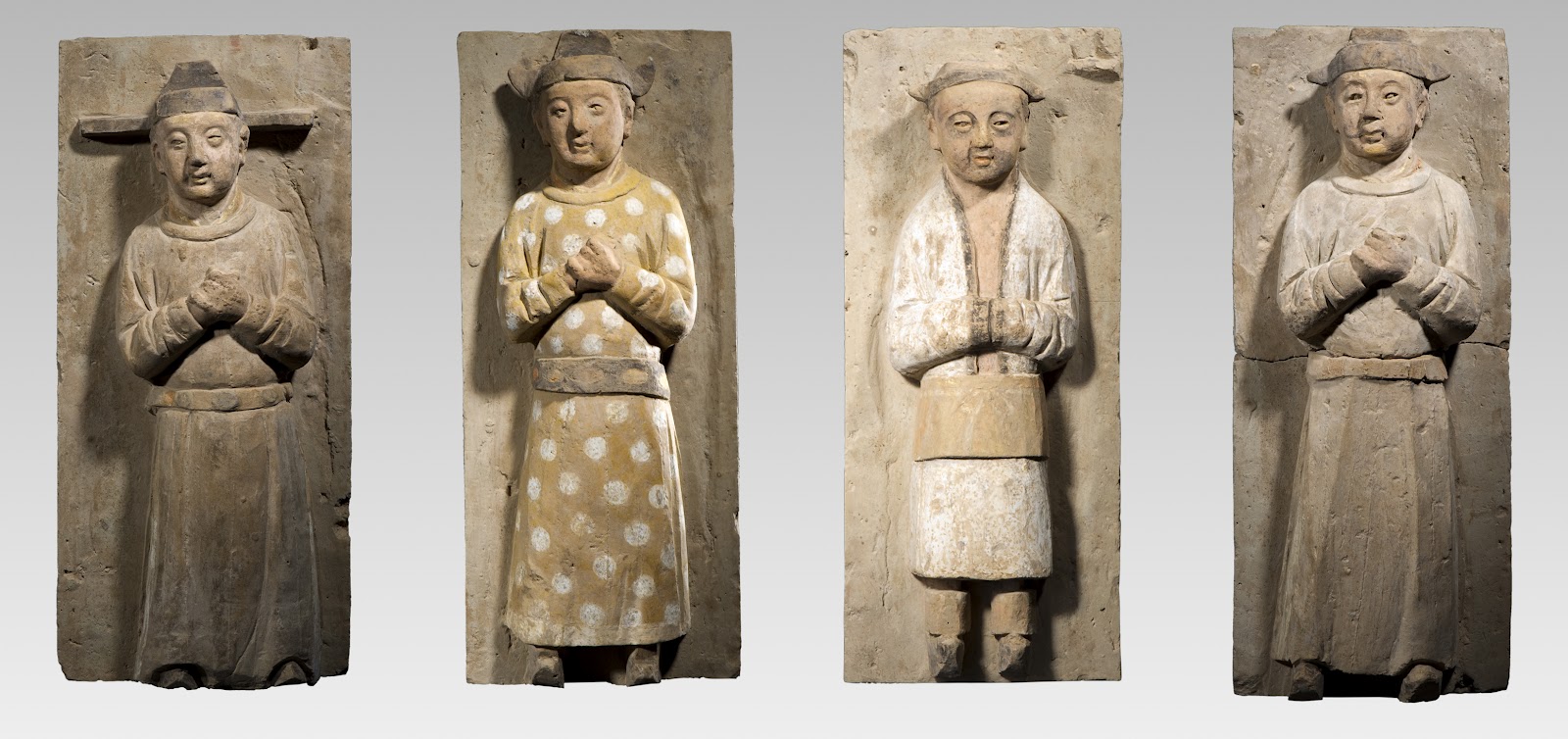
Actor Figures, Detail from the South Wall of Brick-Carved Tomb,
Jin dynasty (1115–1234), brick with pigments,
Unearthed at a Chemical Factory, Jishan county, Shanxi province in 2009,
From left to right Heights: 18.7, 18.9, 18.9, 19.7 in. (47.6, 48, 48, 50 cm),
Shanxi Museum, Taiyuan, China
Photo: Courtesy of Shanxi Museum

Something special awaits those who visit the China Institute’s exhibition, Theater, Life, and the Afterlife: Tomb Décor of the Jin Dynasty from Shanxi. Over 80 tomb brick carvings from the Shanxi Museum focuses attention on the Jin dynasty (1115-1234) and Chinese theatrical arts. Filled with the wonder of discovery, the show reveals the vibrancy of the Jin period and the multifarious thespian activities that took place under their support.

First some background: the Jin were Jurchens, tribesmen from Manchuria in what is today northeast China. In the twelfth century, they defeated the Mongolic Liao and Chinese North Song empires and forced the latter south. They took over northern China, established the Jin dynasty, intermarried, and adapted Chinese traditions. Peace was made with the Southern Song, who were in control of South China and the country became politically stable and prosperous. The arts flourished, especially theatrical entertainments.

In the southern region of Shanxi Provence, some 900 miles from Beijing, more than one hundred Jin tombs have been excavated since the mid-twentieth century. Painted and carved bricks decorated the tombs. The technique was a form of traditional Shanxi folk ornamentation. Shaped in low and high relief or modeled three-dimensionally, theater and musical performances were the predominant imagery.

Theatrical entertainment was obviously important to the Jin both in the cities and the countryside. In Shanxi, close to three thousand ancient theaters and stages remain. No other area in China has as many. These include the twelfth-century Erlang Temple stage which is the oldest surviving Chinese stage that, up to now, has been uncovered. It typifies the Jin architectural style and a small scale model of it is on view in the first gallery.

In the rural areas, performances would take place in the open. At first, city, court and temple productions were enacted on a simple raised platform. Later, an open-sided roofed structure was added. During the Jin period, a back wall was built creating an area open on three sides as in the Erlang stage.

Although temple activities were widespread, no written accounts of their productions have so far been discovered. Our understanding of what took place is based on tomb carvings and burial items along with the extant records of Jin and Southern Song court entertainments.


Figure of Musician Playing a Waist Drum,
Jin dynasty (1115–1234), carved brick,
15.7 x 7.7 x 2.6 in. (40 x 19.5 x 6.5 cm)
Unearthed in 1965 at Jingcungou, Xiangfen county, Shanxi province
Shanxi Museum, Taiyuan, China
Photo: Courtesy of Shanxi Museum

The numerous tomb depictions of musicians and dancers that remain attest to their popularity. A fine example is a group of carvings in the first gallery that portray a procession of eleven musicians and two dancers. Each brick has one figure, some with traces of paint. There are flutists, clapper players, drummers, and oboists. Of special note is the waist drum with its hourglass shape and cloth covering. The instrument was tied to the player’s waist allowing the performer to move about freely. It may have originated about 3,000 years when soldiers stationed at borders needed a way to communicate, sound alarms and accompany the advancement of cavalry. It evolved into an instrument of choice for dancers. In Shanxi, a waist drum dance that can be traced back some 2,000 years is still practiced.


A Parcel-Gilt Silver ‘Musical Troupe’ Ewer and Cover,
Liao – Northern Song Dynasty (A.D. 10th -11th Century),
Height 10 in. (25.4 cm)
Photo: Courtesy of J.J. Lally & Co., New York

A short diversion: music makers are a favorite Chinese motif and appear frequently in different contexts and at different times. A case in point is a Liao – Northern Song Dynasty hexagonal vessel on display at the J.J. Lally & Co., Silver and Gold in Ancient China, March 16 – April 14, 2012. Five musicians and a dancer in high relief decorate the object - one figure centered on each side. A waist drummer swaying rhythmically to his beat is easy to recognize as well as a flutist focused on playing.

The liveliness of music makers is rivaled by that of the dances. Performed in celebration of good fortune or abundant harvest, dances are varied and animated. Look for the carvings of a lion dance, a shield dance and, a dance with musicians accompanied by a melon carrier. In one, each performer appears to be on horseback but they are dancing about with a simulation of the animal - a cleverly devised bamboo and paper construction tied to their waists.


Children Riding on Deer,
Jin dynasty (1115–1234), carved brick,
7.5 x 15.4 x 1.9 in. (19 x 39 x 4.7 cm)
Unearthed in 1965 from Tomb 65H4M102, Houma city, Shanxi province
Shanxi Museum, Taiyuan, China
Photo: Courtesy of Shanxi Museum

In another scene, a playful boy and girl ride galloping deer. Ribbons draped over their chest flare outward as the speed ahead. Their gender is indicated by hairstyle and dress. The herbs they hold are symbolic of immortality.

Scenes of the ordinary and domestic objects tell much about Jin life. Rice pounding, a woman cooking with a five-tiered steamer, a clothes rack and household furniture are just some of the incidents portrayed. One carving of a horse tethered to a post is particularly skillful. The horse turns his head backward tugging on his reins as if to escape the constraint.

A partial replica of a tomb’s north wall incorporates sixteen original bricks and a figure of a woman peering out of a slightly opened door. The woman at the doorway is thought to represent the transition from this world to the next. Hint: color differentiates the authentic and reproduced parts.

Filial piety tales were moralistic legends compiled by Confucian scholars. They were easily adapted into plays and commonly rendered in tombs. The stories exemplified respect, obedience and care for parents and elderly family members. Two stories are illustrated here. One illustrates the tale of Wang Xiang. Wang’s stepmother had become ill during the winter. She wanted fresh fish. Although she treated Wang poorly, he wanted to satisfy her request. Wang went to a frozen river, took off his clothes and lied down on the ice. Once melted by his bodily warmth, he was able to catch two carps. Wang cooked them for his stepmother and she got well. In this depiction, Wang is fully clothed praying beside the frozen lake.


Zaju — Head of a Figure in the Zhuanggu Role,
Jin dynasty (1115–1234), clay with pigments,
4.7 x 3.3 x 2.8 in. (12 x 8.5 x 7 cm)
Unearthed in 1978 from Tomb no. 1 at Macun, Jishan county, Shanxi province
Shanxi Museum, Taiyuan, China
Photo: Courtesy of Shanxi Museum

A much favored type of Jin theater was a sort of commedia dell’arte with of four or five set roles. Carved in high and low relief, their tomb representations were pervasive. The exhibition has several has a variety of these depictions but of particular beauty are two painted heads modeled in the round. One represents the court official role with closed eyes as if he is in deep thought; the other, with an upturned nose and humorous air, portrays a comic character such as a clown or jester.

Chinese tombs historically contained two and three-dimensional objects as stand-ins for items needed in the hereafter. The afterlife was thought to be similar to or a continuation of the life of the living. Thus, the theater representations were simply the entertainment to be enjoyed in the next world. Nevertheless, they may have another meaning. In an exhibition catalogue essay, the Chinese scholar Wilt L. Idema suggests that these depictions may act as a reminder to the dead as well as the living that “...life is only a play.” Research is ongoing.


South Wall of Brick-Carved Tomb In Situ,
Jin Dynasty (1115–1234), brick with pigments,
Unearthed at a Chemical Factory, Jishan county, Shanxi province in 2009,
From left to right Heights: 18.7, 18.9, 18.9, 19.7 in. (47.6, 48, 48, 50 cm),
Photo: Courtesy of Shanxi Museum

The show’s highlight, in the second gallery, is the reconstruction of a vaulted, single-chamber brick tomb using 43 of the surviving carvings. The tomb was accidentally unearthed in 2009 during the excavation for the Jishan Chemical Factory’s dormitory in Jishan, Shanxi. It represent a small version of an inner courtyard of a well-to-do wood constructed residence. Floral and abstract designs mix with lattice-like panels and guardian and animal figures. In the center of its north wall, two standing attendants flank a panel door. The south wall appears to be a gate-tower stage on which stand four actors carved in mid-relief. The tomb was made for a couple who were buried with their heads directly under this stage. They were placed as if to have front row seats at the performances.


Zhang Guolao of the Eight Immortals,
Jin dynasty (1115–1234), carved brick,
21.1 x 7.1 at top; 16.3 at bottom x 2.8 in.
(53.5 x 18 at top; 41.5 at bottom x 7 cm),
Unearthed in 1965 from Tomb 65H4M102, Houma city, Shanxi province
Shanxi Museum, Taiyuan, China
Photo: Courtesy of Shanxi Museum

In Chinese legend, the Eight Immortals were a group of Taoist saint-like beings with supernatural powers. Their enchanting legends were easily transformed into plays and, tomb depictions were commonplace. Apparently during Jin period, regulars in the group had not been fixed for tomb sets may have one Immortal replaced by another.

Their attributes make identification easy. Take a look at the Immortal Zhang Guolao from one series unearthed in Houma city. Zang holds a large fan like object, similar to a clapper. He could travel each day for very long distances on his donkey. When not in use, the animal was folded like a sheet of paper. To regain its form, only a sprinkle of water was needed.


Ding Lan Carving Wood Figures and Serving His Parents,
Jin dynasty (1115–1234), carved brick with pigments,
7.1 x 9.4 x 1.9 in. (18 x 24 x 4.5 cm),
Unearthed in 1981 from the Jin tomb at Nanfanzhuang,
Xinjiang county, Shanxi province
Shanxi Museum, Taiyuan, China
Photo: Courtesy of Shanxi Museum

Twenty-four carvings from the south wall on another tomb relate the tales of filial piety. Read the explanatory labels for the stories are charming. There is Wang Xiang who we met earlier but he is depicted unclothed on the frozen river. Another brick illustrates the story of Ding Lan. Ding made wooden figures deceased parents which he worshipped. His wife did not respect her in-laws and one day when Ding was out, she pricked the fingers of the parent images. They bleed. Ding came home and found the figures in tears. After learning what his wife did, he divorced her. There is also Wang Wuzu’s wife who cut off her own flesh to cure her mother-in-law, Yang Xiang who killed a tiger with her bare hands to save her father and Dong Yong who sold himself into slavery to bury his dead father.

Not to be missed are three masterly carved reliefs that work together to form one vivid combat composition. Each brick shows a mounted soldier set before an ornamental archway. One fleeing soldier turns around in his saddle as if to judge his distance from the approaching attacker. His foe comes toward him from the adjacent brick. His spear like weapon ready for action.

Visitors may want to pause to see a short film produced by the Shanxi Museum. Although less than ten minutes long, it manages to introduce viewers to the landscape and ancient sites of Shanxi in addition to providing excerpts from live musical and theatrical entertainments.

In 2006, the Asia Society’s exhibition, Gilded Splendors: Treasures of China’s Liao Empire (907-1125), provoked an interest in the Liao period. On display were recently excavated objects that clearly demonstrated a sophisticated culture of considerable elegance. It dispelled any notion that the Liao were inferior to the Tang or Song.

The China Institute’s show may have already engendered a similar effect. On a personal note: At this year’s Asia Week New York exhibits, March 16 - 24, this viewer seems to have seen more Jin objects than in previous years.

As for the Jin, they were toppled by the northern Mongolian Yuan and Chinese Southern Song Dynasties. The two victors later fought over the defeated territories. The Yuan were triumphant and ushered in Muslim rule. The Jin, nevertheless, did not entirely disappear. The Qing, the last imperial dynasty, were their descendants.

Go to the exhibit but if you can't, explore the excellent virtual tour on the China Institute's Web site.   

Suggestion: Plan to visit the Sterling and Francine Clark Art Institute’s Unearthed: Recent Archaeological Discoveries from Northern China, June 16 - October 21, 2102. This exclusive exhibition presents newly excavated tomb objects from Shanxi and Gansu never before seen outside of China.

Blog post originally published March 27, 2012.  This is revised post.

Theater, Life, and the Afterlife:
Tomb Décor of the Jin Dynasty from Shanxi
February 9, 2012, through June 17, 2012
125 East 65th Street, Manhattan, New York
Monday, Wednesday, Friday, 10:00 a.m. - 5:00 p.m.
Tuesday and Thursday 10:00 a.m. - 8:00 p.m.
Saturday and Sunday 10:00 a.m. - 5:00 p.m.
Closed major holidays