Thursday, August 16, 2018

The Multitalented David Wojnarowicz Part II

David Wojnarowicz (1954 - 1992), History Keeps Me Awake at Night (For Rilo Chmielorz)
1986, acrylic, spray paint, and collaged paper on composition board, 
72 x 84 in. (170.2 x 200 cm). 
Collection of John P. Axelrod. 
Photo:  Whitney Museum of American Art Web site

This is the second part of a two part blog post concerning the artist David Wojnarowicz (1954 - 1992) and the three concurrent New York City exhibitions on his work.  For Part I see ArtWithHillary July 2018. To begin, a brief review: The Whitney Museum of American Art has a retrospective, David Wojnarowicz: History Keeps Me Awake at Night, named after one of the artist's paintings.  The exhibit at P•P•O•WSoon All This Will be Picturesque Ruins:  The Installations of David Wojnarowicz, displays reconfigurations of four of Wojnarowicz's installations as well as his film You Killed Me First and materials related to these works.  The Unflinching Eye: The Symbols of David Wojnarowicz, the show at New York University's Mamdouha Bobst GalleryElmer Holmes Bobst Library presents photographs, journals, papers, books, posters and more from the university's Fales Library & Special Collections David Wojnarowicz Papers. Taken together the exhibits offer an in-depth view of every aspect of the artist's career.   

David Wojnarowicz (1954 - 1992),  History Keeps Me Awake Some Nights poem, undated, 
David Wojnarowicz Papers, Series III, Box 5, Folder 137,
Installation view from the exhibition The Unflinching Eye: 
The Symbols of David Wojnarowicz
July 12 - September 30, 2018, 
Photo:  Hillary Ganton

From poems, essays, books to photographs, paintings, music, publishing, performance and installation art and political activism, the self-educated, relatively self-taught Wojnarowicz created a body of work that belies his short life.  His awesome talents were profoundly influential to generations of artists as well as LGBTQ activism and politics.  

The painting History Keeps Me Awake at Night (For Rilo Chmielorz) deals with fear and violence faced by gay men in an inhospitable,  frightening society.   For Rilo Chmielorz refers to Rilo Chmielorz (1954 - ), a multi-media artist who was a close friend of Wojnarowicz and part of the East Village art scene in the 1980s.  The imagery in the work includes bodies, a gun, a world map, factory parts, money, newspaper advertisements, a broken classical column and a damaged equestrian statue.  They refer to a world falling apart, like a declining ancient civilization.   The fear, hostility and sadness that the painting evokes is similar to the feelings elicited by Wojnarowicz's poem History Keeps Me Awake Some Nights.  The lines "close up the world is so terrible and sad" and "stray dogs patrol forgotten streets" convey a devastated environment. The only antidote is loving and being close to someone.  Alas, even this ultimately does not work and all become history.  

David Wojnarowicz (1954 - 1992), Peter Hujar Dreaming /Yukio Mishima: Saint Sebastian,
1982, acrylic and spray paint on composition board, 
48 × 48 in. (121.9 × 121.9 cm)
Collection of Matthijs Edman.  
Installation view from the exhibition David Wojnarowicz: 
History Keeps Me Awake at Night
July 13 - September 30, 2018
Photo:  Hillary Ganton

Encouraged by Peter Hujar (1934 - 1987), an important and influential downtown New York City photographer, his friend, mentor and, at one time lover, Wojnarowicz began to paint in the early eighties. Peter Hujar Dreaming /Yukio Mishima: Saint Sebastian conjures up dreamlike homoerotic imagery.  Hujar lies with eyes closed. His mouth appears to be slightly open as if in deep slumber.  Above and behind him are the outlines of a muscular torso pierced by arrows, a representation of Saint Sebastian.  The saint, a Christian martyr, was tied up and shot by arrows because of his adherence to the Christian faith.  Actually, he did not die from the arrow attack but was saved by a pious lady who nursed him back to health.  Eventually, he was executed.  Depicted as a handsome male almost nude, the saint became associated with the gay community in the late nineteenth-century. He is considered the earliest male "pin-up."

In Wojnarowicz's painting a small Asian male pleasuring himself floats on top of the saint's chest.  He embodies the Japanese author Yukio Mishima (1925 - 1970), a professed homosexual.  Mishima describes in his book Confessions of a Mask how he had his first erection and ejaculation while looking at the painting of St. Sebastian by Guido Reni (1575 - 1642) in the Palazzo Rosso, Genoa. The Reni painting was also a favorite of the homosexual Irish poet and playwright Oscar Wilde (1854 - 1900).   

A cloud-like nimbus encircles the figures in the Peter Hujar Dreaming painting through which are barely discernible maps.  In Wojnarowicz's iconography, maps can allude to both society's orderliness as well as the arbitrary separation of domains; and, when these maps are reconfigured or cut up, they imply a world in chaos and confusion.  A dark background surrounding the nimbus completes the painting while a sprinkling of white dots punctuate the surface as if  perforated by arrow shots.   


David Wojnarowicz (1954 - 1992),  Journal, 1983: Feb 10 - 11,
David Wojnarowicz Papers, Series I, Box 1, Folder 16,
Installation view from the exhibition The Unflinching Eye: 
The Symbols of David Wojnarowicz
July 12 - September 30, 2018, 
Photo:  Hillary Ganton

A journal drawing of a male nude torso on view at New York University's Mamdouha Bobst Gallery is similar to the painting's saint. The drawing, like the painting, has the figure's hands tied behind his back and his body wounded  by five arrows.  Saint Sebastian was also considered the patron saint against the plague and disease.  As a protector for those suffering from illness, he connects even more to the gay community ravaged by AIDS.  

Installation view of Paul Marcus (1953 -), Susan Pyzow (1955 -), and David Wojnarowicz (1954 - 1992), 
The Lazaretto:   An installation about the current state of the AIDS crisis, 
1990/2018, multimedia installation, dimensions variable.  
For this exhibition Paul Marcus and Susan Pyzow have recreated fragments of the original installation.
P•P•O•W exhibition Soon All This Will be Picturesque Ruins: 
The Installations of David Wojnarowicz, 
July 12 - August 24, 2018
Photo:  Courtesy of P•P•O•W


In the late 1980s Wojnarowicz channeled his art to focus attention on HIV/AIDS advocacy.  Hujar had died from AIDS and Wojnarowicz was diagnosed HIV positive.  In 1990 Wojnarowicz collaborated with the artists Paul Marcus (1953 -) and his wife Susan Pyzow (1955 - ) in a formidable installation about the then current state of the AIDS crisis. The installation was called La Lazaretto, a word indicating a place where the sick are kept in quarantine.  The work was installed at P•P•O•W, which, at the time, represented Marcus and Wojanrowicz and currently has the reconfigured installation.


Installation view of Paul Marcus (1953 -), Susan Pyzow (1955 -), and David Wojnarowicz (1954 - 1992), 
The Lazaretto:   An installation about the current state of the AIDS crisis, 
1990/2018, multimedia installation, dimensions variable.  
For this exhibition Paul Marcus and Susan Pyzow have recreated fragments of the original installation.
P•P•O•W exhibition Soon All This Will be Picturesque Ruins: 
The Installations of David Wojnarowicz, 
July 12 - August 24, 2018
Photo:  Hillary Ganton


The original installation had four parts:  an outer maze with walls covered with black plastic trash bags like body bags and quotes from those inflicted with AIDS; a bedroom of an AIDS patient with medical paraphernalia and a television playing mindless commercial programming; a hallway lined with arms reaching out with tattooed numbers on each connecting those stricken with the illness to concentration camp victims and people seen as abhorrent; and, a room with a small boat with papier-mâché figures representing Cardinal O’Connor (1920–2000), Senator Jesse Helms (1921–2008), and President George H.W. Bush (1924–).  The three were singled out for their opposition to safer-sex education, lack of commitment to the epidemic and discrimination against homosexuals.  The boat floated in a material red sea filled with half-submerged figures, toys and block letters spelling out names. Exiting the labyrinth was a room filled with AIDS information including materials visitors could take with them. The recreation combines different parts of the 1990 work but nevertheless gives a unforgettable, haunting experience.

Although Wojnarowicz's subject matter revolved around "queerness," the sense of being an outsider and the politics of a health disaster which plagued a populace ignored and rejected by mainstream society, his work speaks about universal sentiments of acceptance, passion and caring. 

In a 1988 interview Wojnarowicz explained that he was compelled to make things in order to make sense of his life and feel relieved about the experience of living and the experience of this world.  The exhibitions on his works make his words palpable.  Go see them.  


David Wojnarowicz: History Keeps Me Awake at Night
July 13 - September 30, 2018
99 Gansevoort Street, Manhattan
Hours:
Monday - Thursday 10:30 am - 6:00 pm*
Friday and Saturday  10:30 am - 10:00 pm
Sunday  10:30 am - 6:00 pm
*The Whitney is open on Tuesdays only during July and August.


Soon All This Will be Picturesque Ruins: 
The Installations of David Wojnarowicz
July 12 - August 24, 2018
535 West 22 Street, Manhattan
Hours:
Monday - Friday 10:00 am - 6:00 pm


The Unflinching Eye: The Symbols of David Wojnarowicz
July 12 - September 30, 2018
70 Washington Square South, Manhattan
Hours:
Monday - Sunday 7:00 am to 11:00 pm


Tuesday, July 31, 2018

The Multitalented David Wojnarowicz Part I

David Wojnarowicz (1954 - 1992), Untitled (One day this kid . . .), 1990, 
photostat, 30 × 40 1/8 in. (76.2 × 101.9 cm), edition of 10.
purchase with funds from the Print Committee 2002.183
Courtesy of The Estate of David Wojnarowicz and P.P.O.W Gallery, New York, NY
Photo:  Whitney Museum of American Art Press Image


David Wojnarowicz (1954 - 1992) was a poet, writer, photographer, painter, sculptor, printmaker, performance and installation artist, filmmaker and activist.  He started a literary magazine with a writer friend and also a post-punk band with a couple of other artists.  He performed, not with a musical instrument but by playing back sounds on a tape recorder that he had recorded.  He accomplished all this in his life of 37 years. Wojnarowicz died of AIDS related complications in 1992.  His contributions to the art world and the LGBTQ community are considerable.  


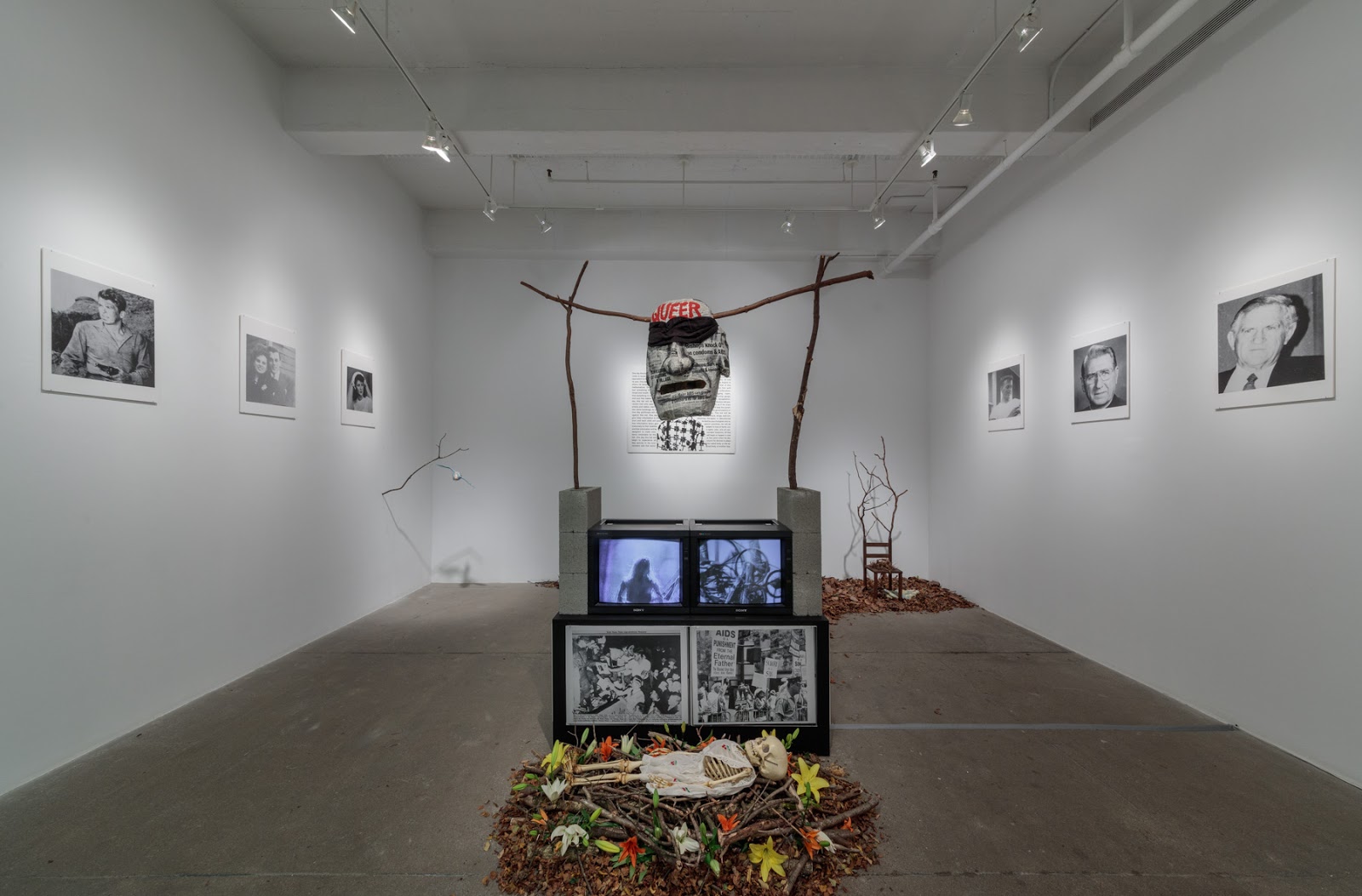
David Wojnarowicz (1954 - 1992), Heads of Family/Heads of State, 1990,
 multimedia installation, dimensions variable.
Installation view of P•P•O•W exhibition Soon All This Will be Picturesque Ruins: 
The Installations of David Wojnarowicz, 
July 12 - August 24, 2018
Photo:  Courtesy of P•P•O•W

Three exhibitions devoted to Wojnarowicz can be seen currently in New York. The Whitney Museum of American Art has a comprehensive retrospective, David Wojnarowicz: History Keeps Me Awake at Night, covering all aspects of the artist's career with the exception of his installation art.  P•P•O•W, Wojnarowicz's long-term gallery, presents Soon All This Will be Picturesque Ruins: The Installations of David Wojnarowicz with four of the artist's installations and his film You Killed Me First as well as materials related to these works. At New York University's Mamdouha Bobst GalleryElmer Holmes Bobst Library, the exhibit The Unflinching Eye: The Symbols of David Wojnarowicz uses archival photographs, journals, papers, books and more from the Fales Library & Special Collections David Wojnarowicz Papers to explicate symbols Wojnarowicz used throughout his career. These shows connect with and cross-fertilize each other.  To do justice to Wojnarowicz's extensive art and activism, this post will be in two parts, July and August 2018.  


David Wojnarowicz (1954 - 1992),  One Day This Kid manuscript, undated, 
David Wojnarowicz Papers, Series III, Box 4, Folder 67,
Installation view from the exhibition The Unflinching Eye: 
The Symbols of David Wojnarowicz
July 12 - September 30, 2018, 
Photo:  Hillary Ganton

The artist's biography is not easy to recount since Wojnarowicz gave different accounts of his life at various times.  What is definitively known is that his childhood was awful.  He and his two siblings were verbally and physically abused.  Mistreatments ran the gamut from being locked in an attic for hours without bathroom facilities, beatings, a placement in a boarding home where more abuse took place, a kidnapping by their father and more or less abandonment by their mother. 

Wojnarowicz's father, from Detroit, was a seaman for passenger liners. He met his wife on a trip to Australia.  She was ten years his junior.  His occupation kept him away from the family for months which probably was best for he drank and would get violent with the children and his wife.  He had a tremendous ability to inflict pain.  He killed the children's pet rabbit and fed it to them making them eat it all.  Two years after Wojnarowicz was born, his parents separated.  A final divorce came a year later giving custody to his mother.  The children ended up living with the father and his second wife in New Jersey under strict rules and regulations. Eventually returning to their natural mother who was living in New York City, Wojnarowicz outlasted his brother and sister.   They were thrown out by their mother for disobeying her. Wojnarowicz meanwhile entered High School of Music and Art. He had been a good student who skipped a grade but was not happy in high school and his grades suffered. During this period, he had an affair with a young man confirming his sexual proclivity.  He began to turn tricks, hustling and ended up living on the street. In time, he took on menial jobs, obtained his high school diploma, got involved with poetry and the East Village art scene. There, in 1980, he met the photographer Peter Hujar (1934 - 1987) who became his lover, friend and mentor.  Hujar encouraged Wojnarowicz to paint and created a supportive environment for the young artist.  

David Wojnarowicz (1954 - 1992), Journal, 1978, 
David Wojnarowicz Papers, Series III, Box 1, Folder 7,
Installation view from the exhibition The Unflinching Eye: 
The Symbols of David Wojnarowicz
July 12 - September 30, 2018, 
Photo:  Hillary Ganton

Poetry, writing and photography occupied Wojnarowicz's early artistic efforts.  He was a voracious reader and prolific writer keeping diaries almost his entire life.  There are some 31 in extant dating from 1971 until 1991.  Over two dozen are on view at the Mamdouha Bobst Gallery and three can be seen in the Whitney Museum retrospective. Written in school-type lined notebooks, words seem to pour out of him propelling the reader to continue.  The writing is personal yet universal in affect. He may be writing about his particular response or thoughts but the feelings elicited are common.  Reading Wojnarowicz may cause "aha moments," sudden insights or comprehension.  This is true for all his output whether prints, paintings or installations.   

David Wojnarowicz (1954 - 1992), When I Put My Hand on Your Body manuscript, 1987
David Wojnarowicz Papers, Series III, Box 5, Folder 128,
Installation view from the exhibition The Unflinching Eye: 
The Symbols of David Wojnarowicz
July 12 - September 30, 2018, 
Photo:  Hillary Ganton

Take his response to Hujar's death in the 1987 manuscript When I Put My Hand on Your Body.  He writes about the loss of touching his beloved and how the memory of the physical fades with time.  This was Wojnarowicz's first confrontation with his feelings of death.  In 1990 he used a slightly revised version in one of his prints, Untitled (When I Put My Hands on Your Body).

David Wojnarowicz (1954-1992), Untitled (When I Put My Hands on Your Body), 1990,
gelatin silver print with silkscreened text,
26 × 38 in. (66 × 96.5 cm), edition of 3.
Collection of Eric Ceputis and David W. Williams, 
promised gift to the Art Insititute of Chicago
Installation view from the exhibition David Wojnarowicz: 
History Keeps Me Awake at Night
July 13 - September 30, 2018
Photo:  Hillary Ganton

In this work, the words are printed in red over a black and white photograph of skeletons in an excavated Native American burial site. Wojnarowicz took the picture in 1989 in an Illinois museum (now closed) that was on the site of an ancient Indigenous community. The changes in the text's wording and punctuation marks from the earlier version are small but increase the essay's flow.  The last line which in an earlier manuscript reads "All these moments will be lost in time like tears in rain"  is modified to "All these moments will be lost in time like tears in the rain."  The addition of the definite article "the" seems minor but substantially enhances the sentence's impact. Yet, in a 1992 reading of his own work for a benefit at the Drawing Center, New York, he recited this text but eliminated the "the" in the last line. You can hear his presentation of this text along with another short piece and excerpts from two of his books at the Whitney Museum where a gallery is devoted to his readings.  

David Wojnarowicz (1954-1992), Science Lesson in 3D, 1984,
acrylic on printed paper collage and paper maché, monofilament wire and nail, glass, rock and plastic toys,
34 x 13 x 13 in. (86.4 x 33 x 33 cm).
Collection of Gail and Tony Ganz 
Installation view from the exhibition David Wojnarowicz: 
History Keeps Me Awake at Night
July 13 - September 30, 2018
Photo:  Hillary Ganton

Throughout his life Wojnarowicz used particular imagery over and over again in different contexts.  Maps, money and frogs are a few of his recurring motifs.  Each had a meaning to him as an outsider in what he called a "pre-invented" world.  The maps and money represents both expansion of freedom and boundaries to it. Maps indicate the world open to exploration but also restrictions set by divisions of territories. Similarly, money  could provide economic freedom but without it, cause constraints on autonomy.  The frog symbolizes an outsider since as an amphibian it neither belongs fully to land or water.

David Wojnarowicz (1954 - 1992)Arthur Rimbaud in New York, 1978–79, 1990, 
gelatin silver print, 8 × 10 in. (20.3 × 25.4 cm).
Image courtesy of the Estate of David Wojnarowicz and P•P•O•W  New York, NY
Photo:  Whitney Museum of American Art Press Image

In the late 1970's he began a series of photographs taken in New York City of men wearing a mask of the French poet Arthur Rimbaud (1854 - 1891). Rimbaud had special significance for Wojnarowicz who identified with the poet's homosexuality and unconventional life. Rimbaud's father was eleven years older than his mother.  He was home infrequently due to his military career and abandoned the family when Rimbaud was six.  The poet's formal education ended when he was sixteen.  He ran away from home to Paris, and at times lived on the street. Coincidentally, Rimbaud also died when he was 37 years old. 

The Rimbaud images convey not only the connection between Wojnarowicz and the poet but also the resemblance between nineteenth-century Paris and New York City of the 1970s as centers of artistic creativity and bohemianism.   Many consider these photos Wojnarowicz's first major art project.  Rimbaud photographs are in both the Whitney Museum and Bobst Gallery shows.  The Whitney in addition has on display one of the masks used in the series complete with the rubber band used to keep it on the model's face and eye holes in the cardstock which appear to be burnt out by a lighted cigarette. The mask, by the way, is from New York University's Fales Library & Special Collections.

Untitled (One day this kid . . .), is probably the artist's most famous work.  It shows a blown-up photograph of Wojnarowicz taken when he was about eight years old surrounded by text describing the homophobic reactions the child would be subject to in the future. The boy is innocent-looking, freckle-faced and smiling.  The picture looks like a typical, innocuous school photograph parents would keep of the children in their wallets.  The pleasantness and geniality of the picture is in stark contrast to the harrowing text.  The words express what could and would happen to a boy who choose another male as his lover. The piece was eventually turned into a poster and postcards. There was also a German edition with German text and in 2012, it was reproduced posthumously in a edition of 100 as a fundraiser for Printed Matter, Inc.  The image still resonates today.

The work was originally made for the artist's 1990 sole survey during his life time at the University Galleries of Illinois State University. It was not included in the show but was reproduced in a full-page plate in the exhibition's catalogue and appeared on announcement cards for subsequent venues.  Wojnarowicz used it as a stand alone artwork in his installation  America: Heads of Family/Heads of State, constructed for a 1990 exhibition at the New Museum of Contemporary Art, New York and, and presently recreated at P•P•O•W.   

Untitled (One day this kid . . .) is hung on the back wall of the room-size installation that includes unframed photographs of politicians and the artist's family, two TV monitors, a papier-mâché head suspended from the center of the ceiling, a child's skeleton, and other objects placed on the floor.  The total evokes a rage against those in power who were indifferent to the AIDS crisis and sorrow for all those that suffer because of their sexual orientation.  

More in the next blog post.  

David Wojnarowicz: History Keeps Me Awake at Night
July 13 - September 30, 2018
99 Gansevoort Street, Manhattan
Hours:
Monday - Thursday 10:30 am - 6:00 pm*
Friday and Saturday  10:30 am - 10:00 pm
Sunday  10:30 am - 6:00 pm
*The Whitney is open on Tuesdays only during July and August.


Soon All This Will be Picturesque Ruins: 
The Installations of David Wojnarowicz
July 12 - August 24, 2018
535 West 22 Street, Manhattan
Hours:
Monday - Friday 10:00 am - 6:00 pm


The Unflinching Eye: The Symbols of David Wojnarowicz
July 12 - September 30, 2018
70 Washington Square South, Manhattan
Hours:
Monday - Sunday 7:00 am to 11:00 pm