
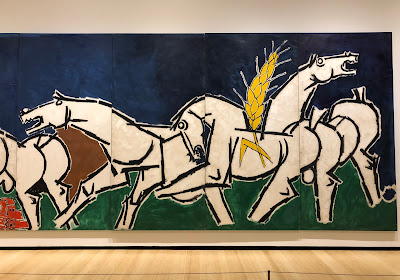
Installation view of exhibition M.F. Husain: Art and the Nation,
March 20, 2019 - August 4, 2019, Asia Society Museum, New York
On wall: M.F. Husain (1915 - 2011), Lightning, 1975,
oil on canvas, 10 x 60 ft. (3 x 18 m)
Marguerite and Kent Charugundla Collection
Photo: Hillary Ganton
In the painting entitled Lightning, a rush of 10 white horses moves right to left across an expanse of blues, greens and purple ground. The pack advances from darkness to light ending at a half circle of red in which rears a baby horse beneath a nuclear symbol. A variety of details punctuate the background.

Installation view of exhibition M.F. Husain: Art and the Nation,
March 20, 2019 - August 4, 2019, Asia Society Museum, New York
On wall: M.F. Husain (1915 - 2011), Lightning, 1975,
oil on canvas, 10 x 60 ft. (3 x 18 m)
Marguerite and Kent Charugundla Collection
Photo: Hillary Ganton
The work is 10 feet high and 60 feet long, consisting of 12 panels each 10 by 5 feet. The artist is Maqbool Fida Husain (1915 - 2011), known as M.F. Husain. He has been called the "Picasso of India." Lightning is one of two of the artist's largest paintings. When it was purchased in 2002 by the collectors and art dealers Marguerite and Kent Charugundla, it was Husain's largest work. The painting was first shown publicly in the United States in New York at the owners' Tamarind Art Gallery in 2003. It caused a sensation stimulating interest in the collecting of modern Indian art. Since then, Lightning has not been on public view until the current exhibition M.F. Husain: Art and the Nation at the Asia Society Museum.
Husain spoke of the work, “This is one of my most significant paintings. The horses in Lightning have sheer energy in minimum of lines. They say that when there is lightning in the sky white horses are cutting across the spaces."
When the Charugundlas bought Lightning, the panels had been in storage for some twenty years in the artist's home in Faridabad, India, a city less than an hours drive from New Delhi. The canvases had to be cleaned which was accomplished in a hotel lobby due to their size and space availability. It was made in 1975 as a backdrop for Prime Minister Indira Gandhi's Congress Party political rally that took place in the Shivaji Park, Bombay, India, the city now known as Mumbai. After the rally, Husain kept the work until 2002, lending it only once in the 1980s as the background for an Indian theater group. The painting is recognized as one of Husain's masterpieces combining his extreme artistry with allusions to important political events of that time.

Installation view of exhibition M.F. Husain: Art and the Nation,
March 20, 2019 - August 4, 2019, Asia Society Museum, New York
On wall: M.F. Husain (1915 - 2011), Lightning, 1975,
oil on canvas, 10 x 60 ft. (3 x 18 m)
Marguerite and Kent Charugundla Collection
Photo: Hillary Ganton
Husain was not only a painter but also a printmaker and film director. He was born in Pandharpur, in the state of Maharashta, India, the son of an accountant. The family moved to Indore early on where the artist spent most of his youth. Although he briefly studied at college and took some art classes, Husain was basically self-taught. In 1936 he moved from the provinces to Mumbai, the capital of Maharashta, to pursue his artistic career. Without financial resources, he painted billboard film industry advertisements and designed and crafted children's furniture and toys for a toy company while working on his own paintings when he could. His break came in 1947, the year of India's independence, when he won an award at the prominent Bombay Art Society. This led to critical acclaim. In the 1950s and 1960s, he traveled extensively having solo exhibitions in major cities all over the world. He was the special invitee along with Pablo Picasso (1881 - 1973) to the 1971 São Paulo Art Biennial, the second oldest art biennial in the world. This accolade attested to the considerable international esteem Husain had achieved by the early 1970s.

Installation view of exhibition M.F. Husain: Art and the Nation,
March 20, 2019 - August 4, 2019, Asia Society Museum, New York
On wall: M.F. Husain (1915 - 2011), Lightning, 1975,
oil on canvas, 10 x 60 ft. (3 x 18 m)
Marguerite and Kent Charugundla Collection
Photo: Hillary Ganton
His art is influenced by a wide variety of artistic movements and artists. For example, he particularly liked the full-bodied supple figures of Gupta sculpture, a style developed during the Gupta Empire period from the 4th to the 6th century and the 10th- and 11th-century erotic sculptures of the temples at Khajuraho Chhatarpur, Madhya Pradesh, India. He spent much time sketching the sculptures while on a visit to the complex. He also went to Madras, the city now called Chennai, to see and study the famed bronzes of the Chola period, 9th - 13th-century, in the Government Museum. All these ancient Indian artworks are characterized by their sinuous lines and strong sense of movement.

Attributed to the Master of the Early Rasamanjari,
Devi in the Form of Bhadrakali Adored by the Gods,
folio from a dispersed Tantric Devi series
India, Punjab Hills, kingdom of Basohli, ca. 1660-70,
opaque watercolor, gold, silver and beetle-wing cases on paper,
7 x 6 9/16 in. (17.8 x 16.7 cm)
Promised Gift of Steven Kossak, The Kronos Collections
Photo: Courtesy of the Metropolitan Museum of Art, New York
As for Indian painting, Husain favored the 17th- to 18th-century Basohli school of Pahari miniatures. Their vivid mostly primary colors placed one next to the other vitalize the painting surface.*

Xu Beihong (1895 - 1953), Galloping Horse, 1944, hanging scroll
ink and light color on paper, Image: 24.5 x 19.8 in. (62.3 x 50.3 cm)
Scroll: 73.8 x 30.6 in. (187.5 x 77.6 cm)
Photo: Art Gallery of NSW, Sidney, Australia Web site
In the early 1950s, horses became a favorite subject of the artist. Husain's horses have several sources. One is the horse of the martyred grandson of the Prophet Muhammad. Husain would have witnessed many processions on the holiday honoring his death which included a horse symbolic of his historical one. Other sources are the battle scenes with horses as described in the ancient Indian epics Mahabharata and the Ramayana. He was also influenced by Tang pottery horses which the artist traveled to China to study and the equestrian sculptures of the Italian artist Marino Marini (1901-1980) which he saw on a trip to Italy. Most significantly, in 1951 in Beijing, Husain met the Chinese artist Xu Beihong (1895 - 1953) and became familiar with Xu's celebrated ink paintings of horses. Xu had exhibited in Southeast Asia including India where he met, among other prominent persons, Mahtma Gandhi (1865 - 1948). Following the encounter with Xu, Husain's art reflected the bold ink lines of the Chinese master.
In 1947, after India's independence, a diverse group of artists formed the Progressive Artists' Group in Bombay. This association sought a new modern art for a new India that incorporated the artistic heritage of their country and the modern art movements of Europe and America. The artists, Hindus, Muslims and Catholics, came from different social and cultural backgrounds. The group's work expressed the new nation's principles of the separation of the state from religious institutions, heterogeneity, unity and internationalism. Husain was one of its founding members. His belief in an India of secular nationalism never wavered.
Lightning praised the achievements of Indira Gandhi (1917 - 1984), the 3rd Prime Minister of India. It was part of a series of paintings Husain made for her. She was the daughter of India's 1st Prime Minister, Jawaharlal Nehru (1889 - 1964) who advocated modernistic design and architecture which he thought was effective in forming the nation's progress.
Husain's mural was not commissioned but rather made as a contribution to Gandhi's rally to highlight the country's achievements. The artist said once he started the work he did not stop till it was finished and was exhausted at the end.
1975 was a troubled year for India. Gandhi had declared a state of emergency which lasted till 1977. The Emergency, as this period of controversy was called, established a rule by decree: elections were suspended and civil liberties curtailed. The causes given were internal and external threats to the state. Looking forward, Indira Gandhi would be entering her 11th year in power which, according to Husain, accounts for the 11 horses in Lightning.
The panels are read from right to left as in the writing of Urdu, a language spoken in Northern India and Pakistan which Husain knew. Among the painted horses are visual references to India's development. A large stalk of wheat dominates the second panel from the right. Wheat, a worldwide food staple, is the traditional symbol of fertility and abundance. Here it is a reminder of the country's Green Revolution which was an effort to make India agriculturally independent by introducing new hybrids of wheat that grew faster and more extensively than the wheat previously farmed.
Moving left is a red tank and a field gun along with other parts of defense artillery. These are meant to indicate India's military strength and the nation's ability to protect itself. They also evoke the country's recent victory in 1971 over Pakistan in the war that led to the establishment of the independent nation of Bangladesh. The tank, stated Husain, "....symbolizes the struggle for freedom..." Next comes an industrial worker in overalls holding in his raised right arm two wrenches, one with an open end fit and the other an adjustable type, and an axe. This is a reference to India's industrialization where goods manufactured were stamped "Made in India." To the left of the worker, seated under a horse, is a woman with two small children and a red triangle. Although a woman with children denotes motherhood, this configuration represents the country's push towards birth control. The Red Triangle became a symbol of family planning and contraception services. The sign was invented by an assistant commissioner to the Indian family planning program in 1969. The triangle symbol however goes back to the ancient world and has many meanings, among them the allusion to femininity and masculinity depending on the triangle's position.
 A large hand in a gesture of blessing rises from the back of the horse sheltering the woman and children. Indian hand gestures, mudras, are an important part of the country's long-established system of symbolism. Meanings attached to hand positions are understood as a way of communicating a concept. A case in point is the Open Hand Monument in Chandigarth, India, the planned city designed by Le Corbusier who was contracted by Prime Minister Nehru in 1950 to create a new modern city that stood for India's future for the administration of the county. The Open Hand was made to be an emblem of peace and reconciliation. In Lightning, Husain painted a hand with three fingers raised and two fingers, the fourth and fifth digits, bent. This position of the fingers is used in the Christian blessing and the making of the sign of the cross. In images of the Christ as Savior of the World, Salvator Mundi, the Christ figure has his hand in this configuration. Perhaps Husain is alluding to Gandhi as a savior of the country.
The mural's final panel at the left, has a nuclear sign above a baby horse contained in a red circle half of which is cut off by the canvas's end. The red circle, likened to a forceful sun, holds nuclear power which at the time, was sought by India to provide electrical energy for its cities. India began its nuclear program in 1967 and conducted its first nuclear test in 1974.

Husain stipulated in the sale of the painting that the panels should never be exhibited in the same order. The variety of display, explained Husain, would stimulate new insights into his art. In the work's first showing at the Tamarind Gallery, the panels were not in the narrative arrangement as they appear currently at the Asia Society.

The owner, Mr. Charugundla, had asked Husain to sign each of the panels on their back. He also had the artist sign and date another panel on the front. The original signature and date were on the last panel in the narrative order at the far left, the one with the baby horse and nuclear symbol. Mr. Charugundla said since the mural was quite long, he wanted another signature and date placed near the middle of the work so viewers would know who had painted it. Husain obliged and signed and dated the 6th panel from the far left, the one with a horse's bowed head and neck encircling a yellow patch. The horse seems now to bend in respect to the painter's signature.

Whatever the panel order, the painting retains the the power and excitement of Picasso's Guernica and the grace and colors of the dance paintings by Henri Matisse (1869 - 1954). Meaningful and compelling, Lightning is not to be missed.
In 1947, after India's independence, a diverse group of artists formed the Progressive Artists' Group in Bombay. This association sought a new modern art for a new India that incorporated the artistic heritage of their country and the modern art movements of Europe and America. The artists, Hindus, Muslims and Catholics, came from different social and cultural backgrounds. The group's work expressed the new nation's principles of the separation of the state from religious institutions, heterogeneity, unity and internationalism. Husain was one of its founding members. His belief in an India of secular nationalism never wavered.

Installation view of exhibition M.F. Husain: Art and the Nation,
March 20, 2019 - August 4, 2019, Asia Society Museum, New York
On wall: M.F. Husain (1915 - 2011), Lightning, 1975,
oil on canvas, 10 x 60 ft. (3 x 18 m)
Marguerite and Kent Charugundla Collection
Photo: Hillary Ganton
Lightning praised the achievements of Indira Gandhi (1917 - 1984), the 3rd Prime Minister of India. It was part of a series of paintings Husain made for her. She was the daughter of India's 1st Prime Minister, Jawaharlal Nehru (1889 - 1964) who advocated modernistic design and architecture which he thought was effective in forming the nation's progress.
Husain's mural was not commissioned but rather made as a contribution to Gandhi's rally to highlight the country's achievements. The artist said once he started the work he did not stop till it was finished and was exhausted at the end.
1975 was a troubled year for India. Gandhi had declared a state of emergency which lasted till 1977. The Emergency, as this period of controversy was called, established a rule by decree: elections were suspended and civil liberties curtailed. The causes given were internal and external threats to the state. Looking forward, Indira Gandhi would be entering her 11th year in power which, according to Husain, accounts for the 11 horses in Lightning.
The panels are read from right to left as in the writing of Urdu, a language spoken in Northern India and Pakistan which Husain knew. Among the painted horses are visual references to India's development. A large stalk of wheat dominates the second panel from the right. Wheat, a worldwide food staple, is the traditional symbol of fertility and abundance. Here it is a reminder of the country's Green Revolution which was an effort to make India agriculturally independent by introducing new hybrids of wheat that grew faster and more extensively than the wheat previously farmed.
Moving left is a red tank and a field gun along with other parts of defense artillery. These are meant to indicate India's military strength and the nation's ability to protect itself. They also evoke the country's recent victory in 1971 over Pakistan in the war that led to the establishment of the independent nation of Bangladesh. The tank, stated Husain, "....symbolizes the struggle for freedom..." Next comes an industrial worker in overalls holding in his raised right arm two wrenches, one with an open end fit and the other an adjustable type, and an axe. This is a reference to India's industrialization where goods manufactured were stamped "Made in India." To the left of the worker, seated under a horse, is a woman with two small children and a red triangle. Although a woman with children denotes motherhood, this configuration represents the country's push towards birth control. The Red Triangle became a symbol of family planning and contraception services. The sign was invented by an assistant commissioner to the Indian family planning program in 1969. The triangle symbol however goes back to the ancient world and has many meanings, among them the allusion to femininity and masculinity depending on the triangle's position.

Section/Detail panel of M.F. Husain (1915 - 2011), Lightning, 1975,
oil on canvas, 10 x 60 ft. (3 x 18 m),
Marguerite and Kent Charugundla Collection
Exhibit: M.F. Husain: Art and the Nation,
March 20, 2019 - August 4, 2019, Asia Society Museum, New York
The mural's final panel at the left, has a nuclear sign above a baby horse contained in a red circle half of which is cut off by the canvas's end. The red circle, likened to a forceful sun, holds nuclear power which at the time, was sought by India to provide electrical energy for its cities. India began its nuclear program in 1967 and conducted its first nuclear test in 1974.

Installation order of Lightning panels in the Tamarind Gallery 2003 exhibition.
Photo: Asian art, Oriental art, Asian antiques and Arts of Asia Web site
Husain stipulated in the sale of the painting that the panels should never be exhibited in the same order. The variety of display, explained Husain, would stimulate new insights into his art. In the work's first showing at the Tamarind Gallery, the panels were not in the narrative arrangement as they appear currently at the Asia Society.

Detail of panel in M.F. Husain (1915 - 2011), Lightning, 1975,
oil on canvas, 10 x 60 ft. (3 x 18 m),
Marguerite and Kent Charugundla Collection
Exhibit: M.F. Husain: Art and the Nation,
March 20, 2019 - August 4, 2019, Asia Society Museum, New York
Photo: Hillary Ganton

Detail of panel in M.F. Husain (1915 - 2011), Lightning, 1975,
oil on canvas, 10 x 60 ft. (3 x 18 m),
Marguerite and Kent Charugundla Collection
Exhibit: M.F. Husain: Art and the Nation,
March 20, 2019 - August 4, 2019, Asia Society Museum, New York
Photo: Hillary Ganton
M.F. Husain: Art and the Nation
March 20, 2019 - August 4, 2019
725 Park Avenue, Manhattan
Hours:
Monday - Sunday 11:00 am - 6:00 pm
Friday 11:00 am - 9:00 pm (mid-September - June)
Closed Mondays and major holidays.


 Posts
Posts

