Thursday, April 24, 2014

No More Uptown! 

The 2014 Whitney Biennial 

Whitney Biennial 2014 Poster, Entranceway, 
Whitney Museum of American Art 
945 Madison Avenue at 75th Street, Manhattan
Photo: Hillary Ganton

The Whitney Museum of American Art's 2014 Biennial is here.  This vast, diverse and jam-packed Biennial is the final one to take place at the museum's Madison Avenue and 75th Street building. The Bauhaus-trained architect Marcel Breuer completed the Brutalist-style  edifice in 1966.  Initially ridiculed, the building is now generally admired and liked.  Next year, the Whitney Museum moves downtown to the Meatpacking District where a new building designed by Renzo Piano will triple its current space.  Thus, this is the last chance to see the Whitney's signature show in the iconic Breuer building.


Whitney Museum of American Art
945 Madison Avenue at 75th Street, Manhattan
Photo: Hillary Ganton

The Biennial purports to survey the contemporary American art scene. Every two years, art world denizens are chosen to curate the exhibit. This year three non-New York curators were appointed:  Anthony Elms, Philadelphia, Stuart Comer, London (at time of appointment but now in New York) and Michele Grabner, Chicago.  Each took charge of a Whitney floor.  Elms's picks are on the second floor, Comer's on the third and Grabner's on the fourth.  Choices, nevertheless, spilled over into other locations creating some confusion should the viewer want to follow one curator’s mindset.  On a positive note, the resulting mix makes for some interesting juxtapositions of some 103 represented artists.

Installation view of  2014 Whitney Biennial fourth floor, 
ceramic sculptures by Ruby Stirling in the foreground,
Whitney Museum of American Art 
Photo:  Kathleen MacQueen, Shifting Connections Web site

Installation, performance, conceptual, collective, residency, video, film and sound works dominate the more traditional sculpture, painting or photography modes of expression.  Poetry, literature, music and dance are also included.  No artistic medium appears to be left out and materials employed are as varied as the forms.  

Installation view of Sheila Hicks, Pillar of Inquiry/Supple Column,
2013–14, acrylic, linen, cotton, bamboo, and silk,
Whitney Biennial, fourth floor gallery
Photo:  Rozalia Jovanovic., artnet news Web site

Artists multitask.  Gone are the adherence to one, two or three disciplines.  These artists write, edit, sculpt, paint, perform, compose, collaborate, collect, curate and more.  Such is the case for the artist A.L. Steiner whose art involves performance, video, photography, collectives, collaborations and activism for art and political causes.  


Installation view of A.L. Steiner, “Cost-benefit analysis”, 2014, 
pigmented inkjet prints, photocopies, and paint;
“More Real Than Reality Itself”, 2014, 
multichannel video installation, color, sound, (54 min.),
2014 Whitney Biennial, third floor gallery,
Whitney Museum of American Art
Photo:  Jillian Steinhauer, Hyperallergic Web site

Curation, as an art form, is particularly common in the current scene and, often results in curatorial layering.  At the Whitney Elisabeth Sussman and Jay Sanders, Whitney Museum curators, advised this year’s appointed triumvirate.  Elms, Comer and Grabner, in turn, selected some artists to “curate” their own shows resulting in exhibits within an exhibit. 


Installation view of mixed media works by Richard Greene,
curated by Catherine Opie and Richard Greene,
 2014 Whitney Biennial, third floor gallery, 
Whitney Museum of American Art,
Photo:  ARTFCITY Web site


Tony Greene, His Puerile Gestures, 1989, 
mixed media, 25 1/2 × 29 3/4 in. (64.8 × 75.6 cm),
Collection of Ray Morales from the estate of Norm MacNeil, 
Copyright Ray Morales. Courtesy Ray Morales,
Whitney Museum of American Art,
Photo: Whitney Museum of American Art Web site

In one small third floor gallery, artists Richard Hawkins and Catherine Opie, selected by Comer, have organized a show of works by the mixed media artist Tony Greene.  Hawkins and Opie went to school with Greene who died of AIDS-related complications in 1990.  Greene's  paintings, usually in oil on photographs mounted to wood, are rich and attention-deserving.  An image of Greene's studio taken by Opie is the only non-Greene piece in the "Greene" gallery.  It adds to the installation's sense of melancholy.      

Gaylen Gerber, a Grabner choice, stretched a painted gray, 40-foot-long canvas on a Whitney wall making it indistinguishable from the actual wall.  On this, Gerber hung works by other artists.  When the Biennial opened, two Trevor Shimizu paintings were displayed.  A few weeks later, they were replaced with artworks by David Hammons and Sherrie Levine.  Gerber effectively curates his "backdrops" engendering quiet mediations on the interaction of art with its context.  

Installation view, Public Collectors, Malachi Ritscher
2014 Whitney Biennial, second floor gallery,
Whitney Museum of American Art
Photo:  Jillian Steinhauer, Hyperallergic Web site

Public Collectors, an Elms selection, is a Chicagoan collaborative devoted to preserving cultural artifacts.  Their Biennial contribution is an installation of objects relating to the life of Malachi Ritscher.  Ritscher, an audiophile, musician and engineer, recorded thousands of non-commercial concerts from Chicago's music scene.  Much experimental music performances that took place would be lost if not for these recordings.  Visitors may hear some of these recordings at a gallery listening station.  Ritscher was also a political activist who committed suicide in 2006 in protest to the Iraq war.  


Charlemagne Palestine,  hauntteddd!! n huntteddd!! n daunttlesss!! n shuntteddd!!,
2013, 12-channel sound installation,
Whitney Museum of American Art  stairwell
Photo:  Jillian Steinhauer, Hyperallergic Web site

Audio pieces, not restricted to earphones, makes for a rather noisy Biennial.   These works reverberate through the museum's public spaces.  In the museum's lobby, a composition by  the composer and artist Sergei Tcherepnin emanates from the Breuer designed ceiling lights.  Tones and silences alternate and change according to the time of day.  The composer, musician, performer and visual artist Charlemagne Palestine fills the entire museum stairwell with his sounds. The ritualistic audio piece travels with visitors as they pass stairwell landing speakers which were covered by the artist with fabric and stuffed animals. The museum's elevator is not silent either.  Jeff Gibson's video plays on a monitor inside the elevator cab's wall.  His humorous critique of consumerism is accompanied by the banal tunes of Muzak.  It makes for an entertaining ride.  


Radamés “Juni” Figueroa, Breaking the Ice
2014, mixed media construction, 
Whitney Museum of American Art  Sculpture Court, 
Photo:  Hillary Ganton

If all the busyness is too much, visitors may rest in Radamés “Juni” Figueroa’s amusing makeshift beach hut in the museum's sculpture court.  It is even heated for tropical verisimilitude.  

A curious aspect of this year's exhibit is the prominence of many older (60 plus years) and deceased artists.  This group makes up approximately 25 percent of all the selected participants.  Gerber is in his sixties.   Hammons was born in 1943 and Levine in 1947. Palestine was born in 1947 too.  Ritscher and Greene are deceased along with artists not already cited: photographer Sarah Charlesworth (1947 - 2013), painter, draftswoman and installation artist Susan Howe (1937 - 2013), and performance artist, musician, opera impresario, producer, director and writer Robert Ashley (1930 - 2014).


 Installation View of  various notebooks and materials by David Foster Wallace,
2014 Whitney Biennial, second floor gallery,
Whitney Museum of American Art
Photo:  Hrag Vartanian, Hyperallergenic Web site

The writer David Foster Wallace (1962 - 2008) is also among those no longer with us.  His late notebooks are showcased on the fourth floor. They are open to pages with notations from the last novel he worked on before committing suicide.  These  are archival material  from the Harry Ransom Center of the University of Texas at Austin.  The University acquired them at the end of 2009.  Perhaps these historical documents are better suited for public display at the Center's library or museum.  


Louise Fishman, Ristretto, 2013, oil on linen, 
70 × 60 in. (177.8 × 152.4 cm),
Private Collection; courtesy Cheim & Read, New York
Photo:  Brian Buckley,  Whitney Museum of American Art Web site

More "senior" artists include Jimmie Durham (born 1940) represented by a splendid wooden mixed media sculpture from 1989, no recent work of his is shown; ceramist John Mason (born 1927) shows his remarkable technically complex sculptures; ink and watercolorist Etel Adnan (born 1925) displays her delightful accordion paper books mixing text and paint; sculptor, painter and weaver Shelia Hicks (born 1934) presents a massive column of colorful  fibrous cords as well as four more successful small easel-size works using paper and various textile threads;  painter Louise Fishman (born 1939) has her evocative, blue-green Venice-inspired oils on exhibit and painter Dona Nelson (born 1947) has on view her two-sided intensively colored canvases employing both paint and embroidery that simultaneously stimulate the sense of touch and sight.  


Zackary Drucker and Rhys Ernst, still from She Gone Rogue, 2012, 
HD video, color, sound, 23 minutes
Courtesy the artists
Photo:  Whitney Museum of American Art Web site

Although many of these older and deceased artists are exhibition-worthy, it is as if the curators did not have time to uncover and explore the work of younger artists who may be just under the art world's radar screen. 

Having said that, there is still plenty of art by those under sixty.  Of this group, Zackary Drucker and Rhys Ernst should be praised for their beautiful film and photographs addressing polymorphic gender, identity and transformative themes.  Their work is a highlight of the show.  Also of merit is Zoe Leonard's camera obscura installation with its serene manifestation of perception evolving over time.  

This big Biennial may not be the best ever but it is stimulating and fun. Take it in.  

As for the fate of the Whitney Breuer building, the Metropolitan Museum of Art has agreed to take it over in 2015.  The Met plans to use the space for the exhibition of modern and contemporary art and educative programs.  The multiyear, renewable agreement between the Whitney and the Met includes the possibility of  collaborations on collections, publications and other educational undertakings.  Lots of good things to look forward to.  

WHITNEY BIENNIAL 2014
MAR 7–MAY 25, 2014

945 Madison Avenue at 75th Street, Manhattan
Wednesdays, Thursdays 11:00 a.m. - 6:00 p.m.
Thursdays 11:00 a.m. - 9:00 p.m.
Saturdays, Sundays 11:00 a.m. - 6:00 p.m
Closed Mondays and Tuesdays

The Museum is closed on Thanksgiving Day, 
Christmas Day, and New Year’s Day.
The Museum is open to the public on July 4, Independence Day.
Check the Museum Web site for special holiday hours.

Friday, March 21, 2014

Masterworks Where You Might Not Expect:


Don’t underestimate local, county or state art museums. They may offer some astounding surprises, meriting inclusion on any art lover’s destination list. A case in point is the North Carolina Museum of Art (NCMA) in Raleigh.  Long known by art world professionals for its stellar collection of Renaissance and Baroque paintings, the museum remains obscure to the general public.  The result is missing out on splendid artwork.

Sandro Botticelli (c. 1444/5 - 1510),  Adoration of the Child, c. 1500,
tempera on panel,  Diam.  49 1/2 in. (125.7 cm),
Gift of the Samuel H. Kress Foundation, 1960
Photo: Courtesy of  North Carolina Museum of Art, Raleigh, NC

The museum originated in 1947 with an unprecedented state legislature appropriation of $1 million for the sole purpose of forming a public art collection.  The allocation provided funds for an initial acquisition of 139 European and American works of art.   In 1960, these holdings were significantly enriched with the Samuel H. Kress Foundation gift of 69 paintings and 2 sculptures mainly from the Italian Renaissance and Baroque periods.  With the exclusion of the works donated to the National Gallery of Art in Washington, DC, the NCMA bequest was the largest and most important ever given by the Kress Foundation to any of the nation’s museums*.   It effectively put the NCMA in the "big league" of  museum collections.


Giotto di Bondone (c. 1266/67 - 1337) and Assistants, 
The “Peruzzi Altarpiece,”
 c. 1310 - 1315, tempera and gold leaf on panel, 
41 5/8 x 98 1/2 in. (105.7 x 250.2 cm),
Gift of the Samuel H. Kress Foundation, 1960
Photo:  Courtesy of North Carolina Museum of Art, Raleigh, NC

The Kress works include the well-known. Giotto, Veronese, Tintoretto, and Titian are present.  The Giotto is the only altarpiece by the artist outside of Italy.  There are also those less familiar such as Giovanni Antonio Boltraffio or Massimo Stanzione.   All are represented by paintings of distinction.  Each has compelling qualities which hold the viewer's attention and reward observation.  The figures of St. John and Christ in Veronese's Baptism of Christ move as if in some other-worldly ballet.  In Stanzione's Assumption of the Virgin, the upward gazing Virgin with outstretched arms soars into the sky.  Securely held aloft by an interlocked circle of muscular putti, she appears oblivious to her height.

The multitude of figures in Tintoretto's Raising of Lazarus overwhelms**.  Lazarus, supine, raises one arm towards the giver of life with whom he is engaged in a silent communion.

Domenico Tintoretto (c. 1560-1635), The Raising of Lazarus, 1585-90, 
oil on canvas, 47 7/8 x 77 1/4 in. (121.6 x 196.2 cm),
Gift of the Samuel H. Kress Foundation, 1960
North Carolina Museum of Art, Raleigh, NC
Photo:  Courtesy of North Carolina Museum of Art, Raleigh, NC

Domenico Tintoretto (c. 1560-1635), Detail of The Raising of Lazarus
1585-90, oil on canvas,
 47 7/8 x 77 1/4 in. (121.6 x 196.2 cm),
Gift of the Samuel H. Kress Foundation, 1960
North Carolina Museum of Art, Raleigh, NC
Photo:  Hillary Ganton

In the 1950s, the museum acquired some impressive acquisitions. Using state funds presciently, NCMA bought seventeenth-century and eighteen-century paintings. These included paintings by Bernardo Strozzi, Canaletto, Bernardo Bellotto, Peter Paul Rubens, Jacob Jordaens and Jan Lievens.  At the time of purchase, such works were not highly valued.  Today they are among the highlights of the museum's holdings.

Jan Lievens (1607-1674), The Feast of Esther,
c. 1625, oil on canvas, 
51 1/2 x 64 1/2 in. (130.8 x 163.8 cm),
Purchased with funds from the State of North Carolina
Photo:  Courtesy North Carolina Museum of Art, Raleigh, NC

One digression:  I have heard the remark, "I do not like religious painting."  Subsequently, a wealth of visual and intellectual joys are passed over.  For those so inclined, I urge looking beyond the religiosity.  Think of biblical scenes as stories and the different possibilities of representing the same tale.  Ask yourself, "What is going on?"  What feelings does the work elicit?  What ideas come to mind? Look upon the Madonna (Virgin) and Child (Christ)  imagery as depictions of a mother and child.  Consider the variety of ways the subject may be portrayed.  A comparison might be a popular tune interpreted by singers in their own distinct manner.  One might prefer a particular rendition over another but the melody remains the same. 

Peter Paul Rubens  (1577 - 1640) and Workshop, 
The Holy Family with St. Anne , 1630-35,
oil on canvas, 68 3/4 x 56 in. (174.6 x 142.2 cm),
Purchased with funds from the State of North Carolina
Photo:  Courtesy of North Carolina Museum of Art, Raleigh, NC

Take a look at Peter Paul Rubens's The Holy Family with St. Anne.  A loving scene of a child asleep on his mother's lap.  His maternal grandmother seated alongside the pair.  Her left arm draped about her daughter's shoulder.  The three generations are compositionally contained within a triangular form.  This serves to further their connectedness as well as  to separate them from the painting's sole male figure.  He looks at the ancestral trio from behind a parapet.  So isolated, his relationship to the main group is questioned.  He is part of them yet apart.  Thus, without the theological explanations which are surely the artist's intent, the work enthralls.  

Having said that, the NCMA has many works of a non-religous nature. The collection covers a wide range of artifacts from ancient Greece through contemporary works.  Of special note is American paintings with three works by John Singleton Copley.

John Singleton Copley (1738 - 1815), 
Sir William Pepperrell (1746-1816) and His Family,
1778, oil on canvas,
90 x 108 in. (228.6 x 274.3 cm)
Purchased with funds from the State of North Carolina
Photo:  Courtesy of North Carolina Museum of Art, Raleigh, NC

The museum's 2010 award winning building is set in a 160 acre museum park.  Glass-curtained walls, skylights, high-ceiling galleries, flooring that reduces walking fatigue, acoustically quieting techniques and well-positioned seating contribute to an outstanding viewing experience.  Make a visit.

*The Kress Foundation has distributed over 3,000 artworks from the Kress Collection to academic and regional museums in the United States.  Their excellent Web site, www.kressfoundation.org, allows viewers to look through the collection by map, repository or artist.

**Tintoretto's painting shows the strong influence of Titian's Martyrdom of Saint Lawrence.  Titian completed two versions of the painting one in 1558 for the Church of I Gesuiti, Venice and another in 1567 for the Monasterio de San Lorenzo, El Escorial, Madrid. Tintoretto's Lazarus appears to be variation of Titian's figures of St. Lawrence in reverse as if inspired by prints of the Titian works.  Prints render the original image designed on the printing plate in the opposite position.  Furthermore, the dark setting, crowd and turmoil of Tintoretto's Raising of Lazarus also link it to Titian's canvases. 

Titian (c. 1488/90 - 1576), Martyrdom of St. Lawrence, c. 1558,
oil on canvas, 196.9 × 110.2 in. (500 × 280 cm) 
I Gesuiti, Venice,
Photo:  Wikipedia

Titian (c. 1488/90 - 1576), Martyrdom of St. Lawrence, 1567,
oil on canvas, 173.2 x 126 in. (440 x 320 cm),
Monasterio de San Lorenzo, El Escorial

Disorder and confusion which surround  momentous happenings such as resurrection or martyrdom, bring to mind critical real-life events. Recall the photographs from the Robert F. Kennedy assassination.  An acknowledgement to Robert Schwarz for pointing this out.

A mortally wounded Robert Kennedy on the floor of the kitchen at the Ambassador Hotel, June 1968.
Photo:  Bill Eppridge — Time & Life Pictures/Getty Images 

2110 Blue Ridge Road, Raleigh, North Carolina 
Hours: 
Tuesday – Thursday 10 a.m. – 5 p.m.

Friday 10 a.m. – 9 p.m.

Saturday – Sunday 10 a.m. – 5 p.m.

Closed Mondays 
The Museum is closed on July 4, Thanksgiving, Christmas Eve, and Christmas Day. 
 The Museum Park is open daily, including holidays, from dawn to dusk.

Monday, February 24, 2014

The Dying Gaul: Everlasting

Dignity in Defeat
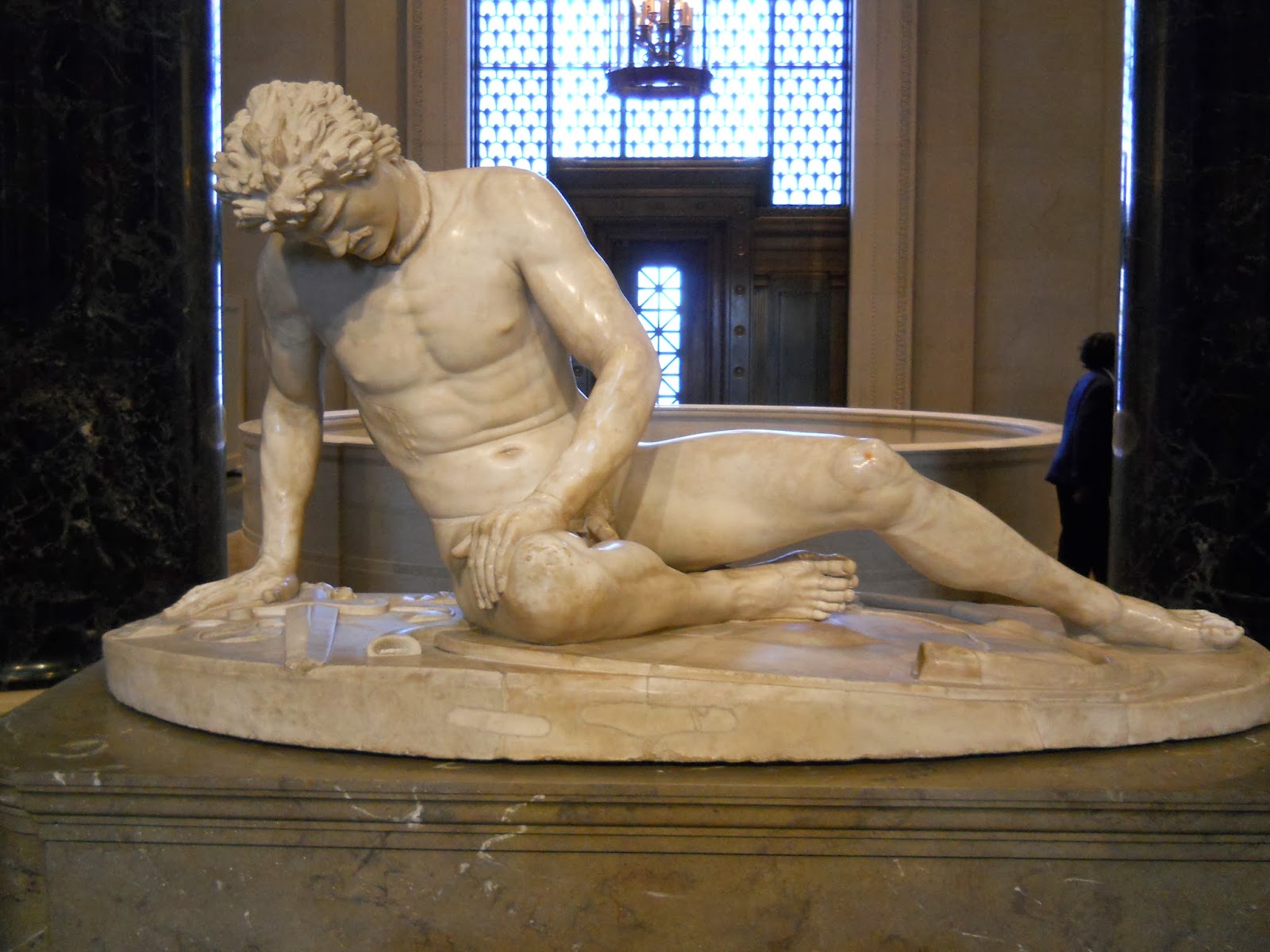
Dying Gaul, Roman, 1st or 2nd century AD, marble, 
37 x 73 7/16 x 35 1/16 in. (94 × 186.5 × 89 cm), *
Sovrintendenza Capitolina - Musei Capitolini, Rome, Italy 
Photo: Hillary Ganton

Certain figurative images last. Often emblematic of a universally valued quality, they are held in high esteem by different cultures over long periods of time. Such is the case of the Dying Gaul, a Greek 3rd century BC bronze sculpture known only through copies.

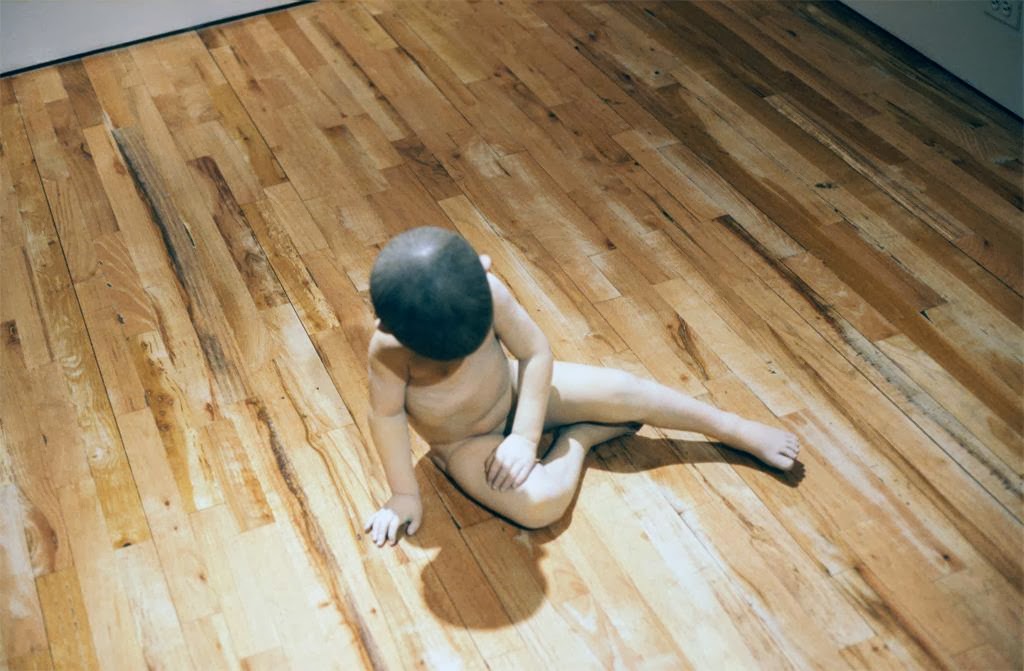
I was reminded of this on a visit to Oregon's Portland Museum of Art, this past summer.   Coming out of a gallery devoted to Renaissance and Baroque paintings,  I came across John DeAndrea's hyperrealistic life-size sculpture, Dying Gaul. 

John De Andrea (b. 1941), Dying Gaul, 1984,
polyvinyl and polychrome with pigment
29 ½ x 31 x 62 in. (74.9 x 78.7 x 157.5 cm)
Portland Art MuseumPortland, Oregon
Photo:  Hillary Ganton

So real was the rendering, it might have been a performance piece. Subject to no idealism, this soulful contemporary reveals all wrinkles and flaws.  Although the artist set his model in the famed Hellenistic pose, tragic heroism has been replaced by emotional reflection.  The figure's import would suffer without the ancient warrior allusion. 

Thoughts turned to the marble Dying Gaul in the Capitoline Museum, Rome.  This superb 1st or 2nd century AD Roman copy of a Greek bronze original is considered one of the masterpieces of ancient art. The sculpture is presently on view at the National Gallery of Art, Washington, DC, in the exhibition, The Dying Gaul: An Ancient Roman Masterpiece from the Capitoline MuseumRome.

The sculpture was most likely discovered in Rome in the early 1620s during the construction of Cardinal Ludovico Ludovisi's villa and gardens. The first reference to the work is found in the 1623 inventory of the Cardinal's collection.  Acclaimed immediately, its renown  spread across Europe helped no doubt by a French artist's etching published in Rome in 1638.  Pope Clement  XII purchased the sculpture in 1737 and placed it in the Musei Capitolini.  Until the mid-nineteenth century, the well-educated were expected to be familiar with the work, stopping to see it on their Grand Tour.

Napoleonic troops took the treasured marble to France in 1797.  The work was returned to Rome in 1816 after Napoleon's final defeat.  It remained in Italy for some 200 years until its present visit to the National Gallery.

The sculpture has been drawn, painted, etched and engraved, cast in a variety of sizes and materials including plaster as well as bronze and noted in prose and poems.  The Marble Faun by  Nathaniel Hawthorne (1804-1864) opens with a description of the main characters looking at the Dying Gaul in the Musei Capitolini's sculpture gallery.  In the novel, Hawthorne described the marble as that "... noble and most pathetic figure.... just sinking into his death-swoon."

Francesco Faraone Aquila (1676-1740), Dying Gladiator (Dying Gaul), 
plate LXV, 1704,
engraving, 13.4 x 9.8 in. (34 x 24.8 cm)
Photo:  ARTstor

Giovanni Paolo Panini (1691 - 1765), Ancient Rome , 1757,
67 3/4 x 90 1/2 in. (172.1 x 229.9 cm), oil on canvas,
Photo:  Metropolitan Museum of Art, New York

The sculpture was initially thought to represent a dying gladiator.  In the eighteenth century, the figure was identified as a Gaul, a member of the fierce fighting Celtic tribes.  The Gauls invaded much of Western Europe and Asia Minor.  Ancient texts described them as mustached warriors with thick, long, matted hair.**  They fought in the nude and wore tight-fitting necklaces as a symbol of rank and a reward for bravery.  Their power peaked in the 3rd century BC. and were eventually conquered by Julius Caesar. The Greeks and Romans considered them barbarians.*** 

Dying Gaul (Detail), Roman, 1st or 2nd century AD, marble, 
37 x 73 7/16 x 35 1/16 in. (94 × 186.5 × 89 cm), 
Sovrintendenza Capitolina - Musei Capitolini, Rome, Italy 
Photo: McClatchy DC, December 12, 2013

About 220 BC, the Gauls attacked Pergamon but were repelled by the Pergamon king, Attalus I.  As a tribute to his victory and an acknowledgement of the opponent's valor, Attalus I erected a monument with bronze statues by Greek artists at the sanctuary of Athena.  The Dying Gaul is thought to have come from that memorial. Scholars believe the Greek bronze was brought to Rome either by Julius Caesar in the first century BC or by Emporer Nero in the first century AD.  Both rulers wanted to celebrate Rome's victory over Gallic uprisings.  Romans had marble copies made of Greek bronzes as the metal sculptures were usually melted down to supply weapon material. Caesar was more likely to have taken the bronze original since the Capitoline Museum's marble copy was unearthed on property that once belonged to him.  

The Dying Gaul has long been praised as the embodiment of stoic heroism, eliciting feelings of compassion for the defeated.  No matter what pain the Gaul suffers, his face expresses no outward cry. Triumphs over such brave fighters flatter the victors.  Mighty must the winners be to overcome such valiant foes.

The work does not photograph well.  The visceral impact of confronting a life-size figure, over six feet tall, is lost in two-dimensional reproductions.  A single vantage point misses details.  In the case of the Dying Gaul, one view can not encompass all the warrior's belongings which are clues to his character. The statue must be approached in the round.  Having said this, what follows is this writer's attempt to overcome photographic  constraints. 

The warrior reclines on his shield on which also lies a large trumpet and part of a broken smaller one. 


Dying Gaul (Detail), Roman, 1st or 2nd century AD, marble, 
37 x 73 7/16 x 35 1/16 in. (94 × 186.5 × 89 cm), 
Sovrintendenza Capitolina - Musei Capitolini, Rome, Italy 
Photo: Hillary Ganton

His right arm supports the weight of his torso.  His left hand rests on his right thigh.  Blood drips down his side from a chest wound.

Dying Gaul (Detail), Roman, 1st or 2nd century AD, marble, 
37 x 73 7/16 x 35 1/16 in. (94 × 186.5 × 89 cm), 
Sovrintendenza Capitolina - Musei Capitolini, Rome, Italy 
Photo: Hillary Ganton

On the ground to his right are his sword, belt and part of the broken small trumpet. The pommel of the sword is carved with a lion's head whose mane recalls the warrior's own leonine locks.

Dying Gaul (Detail), Roman, 1st or 2nd century AD, marble, 
37 x 73 7/16 x 35 1/16 in. (94 × 186.5 × 89 cm), 
Sovrintendenza Capitolina - Musei Capitolini, Rome, Italy 
Photo: Hillary Ganton
Dying Gaul (Detail), Roman, 1st or 2nd century AD, marble, 
37 x 73 7/16 x 35 1/16 in. (94 × 186.5 × 89 cm), 
Sovrintendenza Capitolina - Musei Capitolini, Rome, Italy 
Photo: Hillary Ganton
Dying Gaul (Detail), Roman, 1st or 2nd century AD, marble, 
37 x 73 7/16 x 35 1/16 in. (94 × 186.5 × 89 cm), 
Sovrintendenza Capitolina - Musei Capitolini, Rome, Italy 
Photo: Hillary Ganton

At one time the statue was identified as a herald - trumpeter.  During battles, trumpets were used to communicate orders to troops. This warrior's two trumpets - the smaller, high pitched, the larger, low pitched - could have conveyed a variety of commands.  The smaller one appears to have been split in two:  its top, mouthpiece part, is still fastened by cord to a loop attachment near the bell section of the larger horn.  The remainder of the smaller instrument appears on the ground near the Gaul's right thigh between the edge of his shield and his sword's blade.

From every angle, the figure's lifelike appearance astounds.

 Dying Gaul (Detail), Roman, 1st or 2nd century AD, marble, 
37 x 73 7/16 x 35 1/16 in. (94 × 186.5 × 89 cm), 
Sovrintendenza Capitolina - Musei Capitolini, Rome, Italy 
Photo: Hillary Ganton

The carving of the right foot is particularly noteworthy.

 Dying Gaul (Detail), Roman, 1st or 2nd century AD, marble, 
37 x 73 7/16 x 35 1/16 in. (94 × 186.5 × 89 cm), 
Sovrintendenza Capitolina - Musei Capitolini, Rome, Italy 
Photo: Hillary Ganton

Dying Gaul (Detail), Roman, 1st or 2nd century AD, marble, 
37 x 73 7/16 x 35 1/16 in. (94 × 186.5 × 89 cm), 
Sovrintendenza Capitolina - Musei Capitolini, Rome, Italy 
Photo: Hillary Ganton

The statue still has unknowns.  Scholars are perplexed about the circular diagram engraved on the  lower right surface of the work's base next to the shield.  It may have been an aide for the sculptor in positioning the figure.  The meaning remains unclear. 


Dying Gaul (Detail), Roman, 1st or 2nd century AD, marble, 
37 x 73 7/16 x 35 1/16 in. (94 × 186.5 × 89 cm), 
Sovrintendenza Capitolina - Musei Capitolini, Rome, Italy 
Photo: Hillary Ganton

The Dying Gaul turns up in unlikely imagery.  

 Port Jackson Painter, A Native wounded while asleep
between 1788 and 1797, water color and ink, 
tondo 6.8 in. (17.3 cm) in diameter,
 on laid paper 8.2 x 7.4 in. (20.8 x 18.7 cm),  
Natural History Museum, London, UK 
Photo:  ARTstor

It continues to be quoted by contemporary artists.

Judy Fox (b. 1957), Dying Gaul , 1995, 
hydrostone, casein, original terra cotta, casein,
18 1/2 x 24 1/2 x 16 1/2 in. (47 x 62.2 x 41.9 cm)
Photo:  Larry Qualls/ARTstor

The Dying Gaul may very well be everlasting.    

*All photographs of the Dying Gaul which appear in this blog post were taken in the National Gallery of Art, Washington, DC at the exhibition, The Dying Gaul: An Ancient Roman Masterpiece from the Capitoline MuseumRome.
**Scholars have concluded that the Dying Gaul's hair was trimmed in the seventeenth century.  His thick locks may have been a foot longer than they appear at present.
***Greeks and Romans were clean shaven and wore their hair short as distinguished from barbarians who wore their hair long and were not clean shaven.  In addition, barbarians were depicted with large genitalia.  The manhood of a Greek or Roman was not as prominent.  

The Dying Gaul: An Ancient Roman Masterpiece from the Capitoline Museum, Rome 
December 12, 2013 – March 16, 2014
West Building Rotunda 
National Gallery of Art, Washington, DC
Hours:
Monday-Saturday: 10 a.m. - 5 p.m.
Sunday: 11 a.m. - 6 p.m.
Closed:
December 25 and January 1