Tuesday, October 22, 2013

A Raphael Visits New York 
 

St. Catherine of Alexandria

Raphael (Raffaello Sanzio, 1483-1520), St. Catherine of Alexandria (recto)
ca. 1500-1503, oil on wood, 15.4 x 5.9 in. (39 x 15 cm), 
Photo:  Hillary Ganton

In celebration of 2013 Year of Italian Culture in United States, a painting of St. Catherine of Alexandria by Raphael from the Galleria Nazionale della Marche, Urbino, Italy, is on view at the Italian Cultural Institute New York.

Installed in its own room, both the panel's recto and verso can be seen by moving around a centrally placed glass vitrine.  The back (verso) shows a marbled reflection and inscription.  More about this later.

Raphael (Raffaello Sanzio, 1483-1520), 
marble reflection and inscription (verso); 
St. Catherine of Alexandria (recto),
ca. 1500-1503, oil on wood,  15.4 x 5.9 in. (39 x 15 cm),

The front (recto) has the image of St. Catherine of Alexandria.


Raphael (Raffaello Sanzio, 1483-1520),  
St. Catherine of Alexandria (recto),
ca. 1500-1503, oil on wood,  15.4 x 5.9 in. (39 x 15 cm),
Photo:  Hillary Ganton

Scholars date this panel to the early sixteenth century when Raphael was still working in Urbino, the city of his birth, as well as Città di Castello in the Umbria region of Italy. For those not familiar with Italian regions, Urbino is located in Italy’s Marche region, adjacent to Umbria.

The work's provenance is traced back to the collection of the painter Vicenzo Camuccini (1771 - 1841).  In 1856 a great portion of Camuccini’s painting collection was sold to the Duke of Northumberland.  His purchase primarily comprised paintings by Italian masters of the sixteenth and seventeeth centuries.  The Duke took his acquisitions back home to Alnwick Castle

In 1955, the art historian Roberto Longhi attributed the St. Catherine of Alexandria to Raphael.  At the time, the painting was in the collection of Count Alessandro Contini Bonacossi. The Count was a businessman, art collector and dealer. Longhi had been his art advisor from about 1920 until 1945. The Count died in 1955 and his collection was subsequently dispersed (1). The Saint Catherine was acquired by the art dealer Spencer A. Samuels & Co. Ltd. of New York (2). It was subsequently sold to the Philippine dictator Ferdinand Marcos.  After he died in 1989, his wife auctioned the Marcos collection.  In 1990, the Italian State purchased the Saint Catherine of Alexandria for the Galleria Nazionale of the region of Marche.

St. Catherine of Alexandria was a fourth century martyr.  She was the daughter of a king who publicly protested the emperor and refused to worship idols.  Catherine was tortured by beatings and imprisonment. An attempt to rip her apart on a spiked wheel failed when the wheel broke into pieces. She was finally beheaded.   The spiked wheel became her attribute.

Raphael (Raffaello Sanzio, 1483–1520),
Detail  of  St. Catherine of Alexandria (recto),  
ca. 1500-1503, oil on wood,  15.4 x 5.9 in. (39 x 15 cm), 
Photo:  Hillary Ganton

In the St. Catherine of Alexandria panel now on exhibit in New York, Raphael depicted the youthful saint holding the martyr’s palm frond.  A halo marks her holiness.  She is a blond beauty with exquisitely rendered hands and feet.  She faces to her right.  Her head is tilted down and eyes lowered as if deep in thought.

Catherine is richly attired as befits a noblewoman.  Her long-sleeved red dress is specked in gold.  Two slender gold bands adorn the edges of its sleeves.  The neckline and hem is trimmed in what appears  to be a deep green border.  The gown's belt is green as well as an overgarment wrapped about her shoulders and secured across the chest by two gold clasps.   Lastly, a voluminous pale golden yellow toga gently envelopes the figure.  Its curving folds echoed by the undulation of the fabric about her hair

She stands barefoot on a spiked wheel.  Her body twists in a classical contrapposto posture - weight mostly on her right foot, left knee slightly bent.  She forms an S-shaped curve. The green ground is undifferentiated.  The dark background is embellished with gold interlocking eight-pointed stars and crucifix forms.

Raphael (Raffaello Sanzio, 1483–1520),
Detail  of  St. Catherine of Alexandria (recto),  
ca. 1500-1503, oil on wood,  15.4 x 5.9 in. (39 x 15 cm), 
Photo:  Hillary Ganton

The small work is packed with meaning.  The palm branch in Christianity alludes to the victory of the spirit over flesh and to resurrection, the triumph over death through the union with  Christ.  The eight-pointed star is symbolic of regeneration, redemption as well as the representation of baptism.  It reflects Jesus’ resurrection on the eighth day and reminds that baptism unites the believer with this miracle.  The cross represents sacrifice and salvation.  Red, the color of blood, alludes to Christian martyrs.  Green denotes the victory of life over death.  Golden yellow signifies purity, an appropriate choice for a virgin martyr.  Bare feet  refers to humility and holiness.  The spiked wheel, of course, is the symbol of her martyrdom.
  
The placement of Catherine’s wheel was innovative.  It is usually depicted upright at the saint’s side.  Raphael used the typical placement in a later painting of St. Catherine of Alexandria in the National Gallery, London as well as in his  Madonna and Child Enthroned with Saints, Metropolitan Museum of Art, New York. 

Raphael (Raffaello Sanzio, 1483–1520),
St. Catherine of Alexandria, ca. 1507, oil on poplar,
28.4 x 21.9 in. (72.2 x 55.7 cm),
National Gallery, London, U.K.
Photo:  Artstor

Raphael (Raffaello Sanzio, 1483–1520),
Madonna and Child Enthroned with Saints, ca. 1504, oil and gold on wood,
Main panel, overall 67 7/8 x 67 7/8 in. (172.4 x 172.4 cm), 
painted surface 66 3/4 x 66 1/2 in. (169.5 x 168.9 cm),
Photo:  Artstor

By placing the instrument of torture on the ground, Raphael increased the impression of spatial depth,  allowing ample room for the figure’s three-dimensional pose.  At the same time, the wheel’s position acts as the figure’s pedestal raising this greatly admired saint to a higher level and emphasizing the triumph of the princess martyr.

Raphael (Raffaello Sanzio, 1483–1520),
Saint Mary Magdalene,
ca. 1500-1503, oil on wood,  15.4 x 5.9 in. (39 x 15 cm),
Location unknown,
Photo:  Artstor (3)

A now lost Saint Mary Magdalene painting was the pendant to St. Catherine of Alexandria panel (3).  The Magdalene is almost the mirror image of the Catherine figure.  The figures are posed in the same posture but Magdalene faces her left and her head and gaze are raised.  Her hands are in the gesture of prayer.  

The position of the two saints and the works’ size strongly support the theory that the paintings were the side panels of a small triptych intended for private devotion.  An inscription on the back (verso) of the Saint Catherine of Alexandria provides further evidence for this conclusion.

Raphael (Raffaello Sanzio, 1483-1520), 
Detail of marble mirror and inscription (verso) of the the St. Catherine of Alexandria (recto),
ca. 1500-1503, oil on wood,  15.4 x 5.9 in. (39 x 15 cm),
Photo:  Hillary Ganton

In a circle of blue on a marbleized mirror background, elegant gold capital letters read: BENEDI/CAT VIRG/O MARIA.  The invocation, figuratively “May the Virgin Be Blessed”, points to the likelihood that the triptych's central panel would have represented an image of the Virgin Mary, perhaps a Virgin and Child or a Holy Family.

The Saint Catherine of Alexandria and Saint Mary Magdalene may have been part of a group of paintings in the possession of Guidobaldo da Montefeltro, Duke of Urbino and his consort Elisabetta Gonzaga (3). When Raphael resided in Urbino, he completed works for the Duke and his wife.  The panels may have been belonged to a painting of the Virgin Mary described by Giorgio Varsari, the sixteenth-century Italian painter, architect, writer and historian.  Varsari wrote that when Raphael lived in Urbino, he made religious paintings including representations of the Madonna.  Specifically, the historian records that Raphael painted two panels of the Virgin Mary for Guidobaldo which were “...piccoli, ma bellissimi”.  Certainly, the Saint Catherine of Alexandria is small yet very beautiful and could have belonged to a triptych with an image of the Madonna in the center panel.  The connection of the Saint Catherine painting with the city of Urbino is further enhanced by the colors used in the inscription on the panel's back:  gold letters on a blue background.  These are the colors of the coat of arms of the city of Urbino.  In addition, Saints Mary Magdalene and Catherine, were among the saints most venerated in this area.  Thus, their appearance together on a work made in Urbino would be fitting.  

The Mary Magdalene and Catherine panels were together in the early twentieth century in Duke of Northumberland's collection at Alnwick Castle.  The panels were next documented in the Contini Bonacossi Collection, Florence, Italy and then with Spencer A. Samuels & Co. Ltd., New York.  At this point, the whereabouts of  the Saint Mary Magdalene is unknown.  Perhaps, the painting will turn up one day.  Until then, you may want to be on the look out for it.

Two additional comments:

Raphael was known to have excelled in the particular technique of painting faux marble as executed in high quality on the back of the St. Catherine of Alexandria panel.

Raphael (Raffaello Sanzio, 1483–1520),
Detail of Madonna and Child Enthroned with Saints, ca. 1504, oil and gold on wood,
Main panel, overall 67 7/8 x 67 7/8 in. (172.4 x 172.4 cm), 
painted surface 66 3/4 x 66 1/2 in. (169.5 x 168.9 cm),
Photo:  Artstor

The gold speckled decoration of the Madonna’s mantle in Raphael’s Madonna and Child Enthroned with Saints, Metropolitan Museum of Art, New York is very similar to the Catherine's dress in the St. Catherine of Alexandria panel.

(1) Count Alessandro Contini Bonacossi (1878-1955) had bequeathed his art collection of some 1,000 works to the Italian state.  The Count's heirs, however, successfully contested the will.  The overwhelming majority of the collection was sold abroad.  What was left for the state is now part of the Uffizi Gallery and, presently may only be seen by appointment. Contini Bonacossi was found guilty of being a Nazi collaborator and fascist after World War II.  His bequest appears to be a gesture of amends.

(2) The Saint Catherine of Alexandria panel was in the  2009 exhibition, Raffaello e Urbino, that took place in Galleria Nazionale della Marche, Urbino, Italy.  The citation for the painting in the exhibition catalogue, edited by Lorenza Mochi Onori, entry 33, p. 170, states that the painting was acquired by the antiquarian, Spencer of New York after the  break up of the Bonacossi Collection.  I could not find any information about "Spencer of New York".  The exhibition catalogue probably refers to Spencer A. Samuels & Co. Ltd, New York.  Spencer A. Samuels was a world-renowned art dealer and expert on old masters who died at age 85 in 1999.  The information concerning the Saint Catherine of Alexandria and Saint Mary Magdalene panels in Artstor, supplied by  by the Department of Image Collections, National Gallery of Art, Washington, D.C., states that the Saint Catherine of Alexandria and Saint Mary Magdalene panels were formerly in the Contini Bonacossi Collection, Florence and later with Spencer A. Samuels & Co. Ltd, New York.  
My thanks to Giorgio Civolani for his help in the translation of the Raffaello e Urbino exhibition catalogue entry for the Saint Catherine of Alexandria panel.

(3) I have reproduced below the Artstor black and white image of Saint Catherine of Alexandria panel for its clarity which far surpasses the color image from the  2013 Year of Italian Culture in United States Web site or my own photographic attempts.  The Artstor black and white image of Saint Mary Magdalene panel was the only image of this lost painting that I was able to find.

Raphael (Raffaello Sanzio, 1483–1520),
St. Catherine of Alexandria (recto), ca. 1507, oil on wood,
28.4 x 21.9 in. (72.2 x 55.7 cm),
National Gallery, London, U.K.
Photo:  Artstor

The black and white images and information associated with Saint Catherine of Alexandria and Saint Mary Magdalene panels were supplied to Artstor by the Department of Image Collections, National Gallery of Art, Washington, D.C.  The   data for both panels attribute the work to Raphael and state that the location of both panels are unknown.  The dimensions of the panels were not furnished in the Artstor citations. I have assumed that the two paintings have the same dimensions and used the dimensions of the Saint Catherine of Alexandria panel for the label description of the Saint Mary Magdalene image. 

(3) See Raffaello e Urbino exhibition catalogue entry 33, p. 170 concerning this hypothesis.

St. Catherine of Alexandria by Raphael
October 1 to October 28, 2013 
Monday - Saturday,
10:00 a.m. - 4:00 p.m 

686 Park Avenue, New York, NY

Monday, September 30, 2013

A Focus On Design and Craftsmanship

Norway and the Decorative Arts


Trondheim, Norway 
Photo: Hillary Ganton

No other region is associated with craftsmanship and modern/contemporary design as much as Scandinavia. Denmark, Norway, Sweden and Finland boast top design firms. They manufacture goods characterized by simplicity, functionality and creative use of natural as well as innovative materials. Useful everyday objects turn into works of modern art. Ikea, Electrolux, Bang & Olufsen, Marimekko, George Jensen, Snohetta and Acne Studios are just some of the companies renowned for these skillful products. How did this come about? Why is one area so distinguished? The definitive answer is beyond this writer. A suggestion, however, may be postulated. Perhaps, these countries much more than others, used resources to support crafts as well as educate, influence and develop public taste toward an acuity for design. Good design became imprinted into the minds of the populace. What happened in Norway and the evolution of one applied arts museum will serve as an example. 

Norway became a wealthy country in the nineteenth century. Industrialization, textile manufacture, shipping, export trade in such goods as timber and fish bought economic prosperity. By 1870, Norway’s GNP per capita was well above the European average. The country’s first rail and telegraph lines opened in the mid-1850s. In 1877, coast-to-coast trains made eased travel between Oslo, the country’s capital and Trondheim, its third largest city. Rail linked Oslo to Bergen, the second largest city, in 1909.  Norway inaugurated a constitution in 1814. Parliamentary sessions began meeting regularly from the late 1860s. The country achieved independence from Sweden until 1905. Norwegian nationalism flourished. The West, however, was still looked at for cultural leadership.  Radical aesthetic changes were taking place in England, France, Holland and Germany.

In 1851, London’s Great Exhibition of the Works of Industry of all Nations, also known as the Crystal Palace Exhibition, ushered in a century of popular world fairs.  These showcased the most advanced modern goods, objects and inventions. Paris’ Exposition Universelles followed in 1855, 1867, 1889 and 1900. Philadelphia hosted the first American international exposition in 1876. The hugely successful 1893 Chicago World Columbian Exposition was seen by over 27 million people. 

The nineteenth century also saw the rise of great public art museums seeking the comprehensive collecting of painting, sculpture and historical artifacts. Notably, few acquired decorative arts. Such objects were left to applied art museums. These institutions evolved in a desire to encourage industry and public awareness after London’s Great Exhibition of 1851. London’s Victoria and Albert Museum was established in 1852; Paris’ Musée des Arts Décoratifs was founded 1905; and, the United States’ Cooper-Hewitt, National Design Museum was started in 1896. 

In contrast to a one nation - one principal museum, Norway’s three major cities opened their own applied arts museums: the Museum of Decorative Arts and Design, Oslo, 1876; the West Norway Museum of Decorative Art,* Bergen, 1877 and the National Museum of Decorative Arts in Trondheim, 1893. All three accumulated extensive collections. 

Today, the Museum of Decorative Arts and Design in Oslo and Bergen’s West Norway Museum of Decorative Art* each hold some 35,000 objects. Trondheim’s National Museum of Decorative Arts has about 40,000 works. The latter is one of the country’s premier institutions and its holdings, some opined, is the best of its kind in the country. As such, a closer look at its history is revealing. 

The museum’s collecting pattern can be traced back to Jens Thiis who became director in 1895. He took charge of a museum with only a few hundred donated objects. Thiis, just 25 years old, was an art historian with innovative ideas. He wanted to collect the most advanced examples of contemporary design. To do this, he traveled widely in Western Europe. At first, he bought works in the international Arts and Crafts style but after attending the Paris’ Exposition Universalle in 1900, he focused on Art Nouveau. 

He commissioned the Belgian architect, painter and designer Henry van de Velde to create a room and furnishings in the museum specifically for displays. What he completed in 1907/1908 is a unique room.  It is one of the few remaining van de Velde rooms in existence. It has been recreated in the present museum where you can also see turn-of-the century artworks such as three prints by Edvard Munch that Thiis had acquired in 1902. 

Thiis' exhibition techniques were as pioneering as his purchases. Soon the museum was recognized as one of the most advanced museums in Northern Europe.   Contemporary applied art filled a whole floor. One room was dedicated to French designs, another to works from England with walls covered with modern wallpaper and curtain fabric by William Morris.  

Thiis wanted to illustrate how contemporary artists were influenced by Japan’s arts and crafts.  Consequently, a collection of Japanese Art began.  Two framed Japanese prints in the van de Velde room are samples of Thiis' buying activities. At present, the museum houses the only permanent Japanese Art exhibition in Norway with objects dating from the prehistoric Jomon period through the Edo era and beyond. 

Most of Thiis' planned museum workshops for a variety of crafts such as wood- and metalworking never were started. One, however, did open in 1898: a successful weaving studio and school which lasted nineteen years. 

In 1908 Thiis left Trondheim to become director of the Oslo’s National Gallery.** He was succeeded by Hans Dedekam in 1909. Dedekamly primarily purchased older objects and Norwegian folk art. Dedekam felt it was an education necessary to make the public aware of their cultural history. He wanted to arouse people's "sense of beauty." Local craftsmanship were encouraged and given temporary exhibitions. Dedekam had been recruited from Oslo’s Museum of Decorative Arts and Design.  In 1919 he returned there as director. 

Fredrik B. Wallen took over from Dedekam in 1920.  He remained director for twenty-five years. Wallen increased the museum's holdings in textiles, ceramics, glass, silver, enamel and tapestries. Craftspersons became actively involved with the museum. A glass-painting school started in 1935. During the War years, acquisitions were put on hold and the collection removed for safety. 

In 1946, Thorvald Krohn-Hansen became director and, like Thiis, wholeheartedly bought modern art and design. His special preference was for Scandinavian designs. In 1951, he engaged the Danish architect Finn Juhl to design a museum room to house the best selections of contemporary Scandinavian furnishings and crafts. The result was “Interior -52” still on view today.  To make room for new displays, the museum's folk art was sent to the Trøndelag Folk Museum.  Collected tapestries were kept.  

Jan-Lauritz Opstad became director in 1980. His particular interest is experimental contemporary crafts - objects that pushes the definition of what we call crafts. Opstad’s acquisitions have a distinct international profile and include pottery, furniture, printed fabrics, fiber-art, glass, costumes and modern jewelry. The latter is especially prominent. He has reached out to practicing artisans and promoted research in modern Norwegian crafts. 

In 1990, the museum’s buying power increased substantially when the government set up a National Fund for the acquisition of Norwegian Contemporary Crafts. This enabled the museum to devote most of its own resources to the purchase of international works. 

This past August, I had the privilege of spending several hours with Jan-Lauritz Opstad at the museum. As we walked through the galleries, he told me anecdotes about some pieces. Opstad explained that the museum acquired the majority of its holdings soon after they were made. Prices for acquisitions were usually not that high yet. He pointed out that the museum’s small size set limits on what could be displayed. Only about 2.5% of the museum's collection, approximately 1,000 objects, are on view.


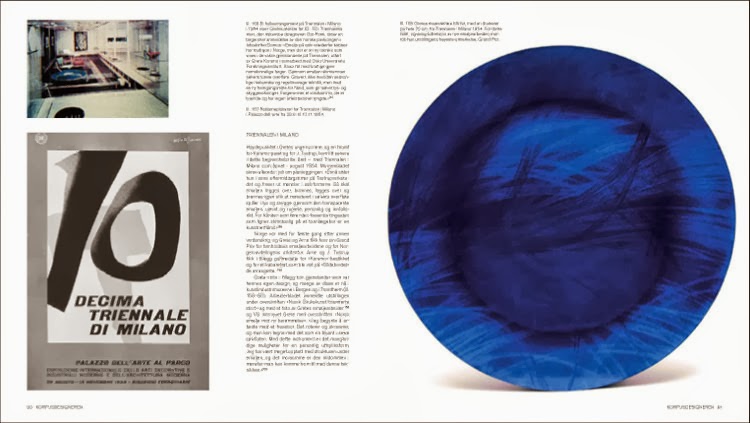
Grete Prytz Kittelsen (1917 - 2010), Plate, 1954, 
blue enamel on silver, D: 27 1/2 in. (70 cm), 
Trondheim, Norway 
Photo: Hillary Ganton

I thought I would put him on the spot when I asked if he had one favorite work. He thought a few seconds and took me to see a blue enamel silver plate by Grete Prytz Kittelsen, the distinguished Norwegian enamel artist, designer and goldsmith. Its highly reflective surface and form made me think of some of Anish Kapoor’s sculptures. Looking closely at the plate, I discerned a multitude of engraved lines. The design added a sense of depth and variety to the vibrant blue hue. Opstad explained that the artist achieved this effect by using a dentist drill while moving her outstretched arm back and forth. He told me her reach determined the size of the plate. The piece, 27 1/2 inches (70 cm) in diameter, was too big to fire in the artist’s kiln. Kittelsen had to send it out to a manufacturer of bathroom items that had a kiln big enough to fire enamel onto tubs!


X Triennale in Milan Illustration, 1954,
Photo of Grand Prix Award Winning Plate,
Grete Prytz Kittelsen (1917 - 2010), Plate, 1954,
blue enamel on silver, D: 27 1/2 in. (70 cm)
Photo:  Web Image


The artist won Grand Prize in the 1954 Milan Triennial Exhibition of Decorative Arts for her enamel collection which included this plate. It was one of Opstad's acquisitions. The director’s selection did not seem surprising after I found out that his Ph.d. thesis topic was medieval Norwegian enamels. 

Nearby was a gallery called “Director’s Room”.  As the title suggests, Opstad was responsible for every purchase. It was filled with contemporary jewelry, decorative platters and sculpture-like objects which ranged in date from the 1980s to the early 21st century. The use of ceramic, glass, fiber and metal was often unconventional. American, Danish, Dutch, Spanish, French, Italian and Finnish artists were represented. Like a proud father remembering things about his children, Opstad could recall everything about each piece from its inception, to what the artist had to say about it and how it was made. 

A new museum director began September 1.  For the first time in the museum’s history, a woman who is a craftsperson - jewelry designer - will be in charge. All past directors were art historians and male. After 33 years at the helm, Opstad looks forward to his next challenge. He will be cataloging the museum’s vast holdings. A task that is long overdue. 

Some caveats concerning a visit to the museum: Staffing restrictions have led to inconsistent labeling of objects. Texts are in Norwegian. English translations are infrequent. At times, non-speaking Norwegians may find it impossible to decipher what a work is. This is especially true for the earlier objects although these do not make up the bulk of the holdings. One tall wooden table will serve as an illustration. The piece, to me, looked like a printing press. A tall turning apparatus appeared to be a press screw that could push an attached square piece of wood down tightly on the object's top surface. I tried to interpret the Norwegian label.  Dates “1650-1700” were clear but the only words I could make sense of were “presse”, “Holland”.  I assumed it was a decorative printing press.  Wrong.  I asked Ostad about it.  He told me it was a linen press which imprinted patterns into linen.

Identification, however, is not necessary for appreciation. Museum visitors can still appreciate workmanship and beauty in objects with unknown purposes.

I return to my original hypothesis. Could the efforts of Norway’s design museums, repeated in cities across Scandinavia, have engendered a general populace innately attuned to good design? Could these institutions have affected a cultural proclivity for well-made goods? 

Think of it this way: Consider the comprehensive collections of New York’s Metropolitan Museum of Art (1870), the Museum of Fine Arts, Boston (founded 1870, opened 1876), the Art Institute of Chicago (1879) and the oldest public art museum in the United States, Hartford, Connecticut’s Wadsworth Atheneum Museum of Art (1842). What if, concurrently, New York, Boston, Chicago and Hartford decided to establish museums strictly devoted to decorative arts? Would the sensitivities of the American public have changed? When you think of good design, would you think of the U.S.? 

Take what you will from this writer's above rumination. Hopefully, your thoughts will turn to change, innovation and how to go about transforming a culture.

*Consolidated in 2006 with four other museums to form one museum entity called the Art Museums of Bergen.
**Part of the National Museum of Art, Architecture and Design since 2003.

Munkegata 5, Trondheim, Norway 
Hours:   
Tuesday, Wednesday, Saturday
10:00 a.m. - 3:00 p.m.,  
Thursday  10:00 a.m. - 5:00 p.m,  
               Sunday  12:00 p.m. - 4:00 p.m.                 
 
Closed Mondays  Hours change June 1st

Saturday, August 31, 2013

The Beguiling Porcelain Couple

An Adventure in Looking


Night Group or Night and Day, 1781 - 1791, Porcelain, Royal Copenhagen, 
glazing attributed to A. Hald, 
H. approx. 5 in. (13 cm), 
Photo:  2013, Steffen Wesselvold Holden, National Museum of Decorative Arts, Trondheim, Norway

Trondheim, Norway, is home to the National Museum of Decorative Arts - Nordenfjeldske Kunstindustrimuseum .  Established in 1893 as a museum of applied art, its collection comprises over 40,000 objects of which approximately 1,000 are on display.  Thanks to astute, forward-looking directors buying contemporary works, the museum has exceptional examples of early twentieth-century furniture and utilitarian objects as well as crafts and design of the twenty-first century.  Other acquisitions illuminate the historical development of decorative arts. 

I knew the museum was well-worth visiting since I had been there before.  Thus, given a recent opportunity to go back again, I grabbed it.  My intent was visual enjoyment and serendipitous discovery.  

The museum’s lower level galleries are filled with objects, dating from the middle ages to the present.  Furniture, tapestries, paintings, designs, and display cases with glass, ceramic and silver wares compete for attention.  

One vitrine held eighteenth-century Meissen and Royal Copenhagen porcelains.  I surveyed the small mythological and pastoral figurines.


Detail of Night Group or Night and Day, 1781 - 1791, Porcelain, Royal Copenhagen, glazing attributed to A. Hald, 
H. approx. 5 in. (13 cm), 
Photo:  2013, Steffen Wesselvold Holden, National Museum of Decorative Arts, Trondheim, Norway

A Royal Copenhagen piece caught my eye (display case #35, middle shelf, 2nd from left).*  It shows a swooning maiden ostensibly succumbing to the initial advances of a nude male who is about to place a kiss on her right wrist.  The male sits with his back to the viewer, front and center along the base of the porcelain’s triangular format.  The woman’s head is at  the composition's apex.  The triangle form is echoed by the V-shaped tree trunk and the bent left arms of the two figures.  Nudity underscores the work's exemplary modeling.

At first I dismissed the piece as simply a typical late eighteenth-century neoclassical grouping, a bit more sensual than most.

I walked on but soon paused.  What was really going on between the couple?   Was it a seduction or something else?  Why was he undressed and she clothed?  I went back for closer inspection.


Detail of Night Group or Night and Day, 1781 - 1791, Porcelain, Royal Copenhagen, glazing attributed to A. Hald, 
H. approx. 5 in. (13 cm), 
Photo:  2013, Steffen Wesselvold Holden, National Museum of Decorative Arts, Trondheim, Norway

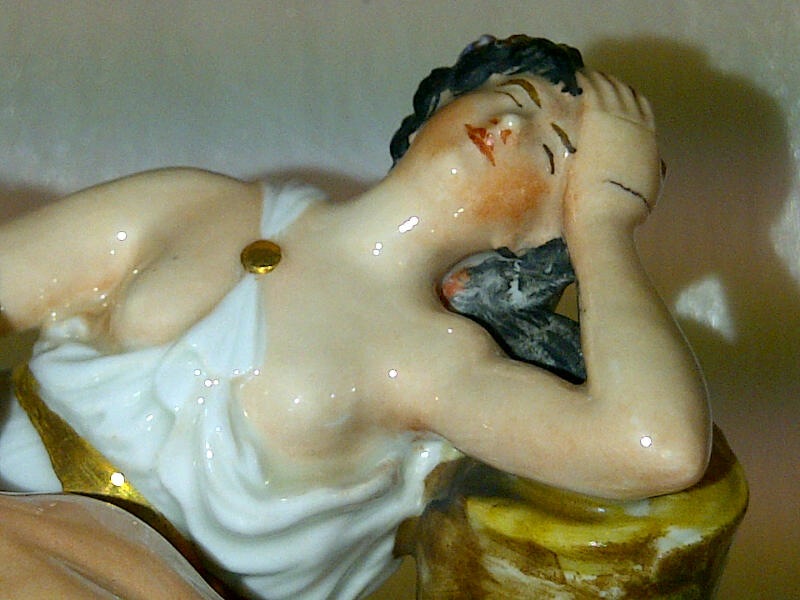
Dress and hair set the couple in antiquity.  She wears an ancient Greek type of garment called an Ionic chiton.  It was made with light weight fabric, intricately draped into many pleat-like folds and secured by shoulder brooches and belt.  In the porcelain piece, one such fastening in gold appears to have slipped down exposing the lady’s breasts.  Her arms and lower legs are also undraped.  


Detail of Night Group or Night and Day, 1781 - 1791, Porcelain, Royal Copenhagen, 
glazing attributed to A. Hald, 
H. approx. 5 in. (13 cm), 
Photo:  2013, Steffen Wesselvold Holden, National Museum of Decorative Arts, Trondheim, Norway

Hairstyles are Greek.  His is short.  Hers, adorned with a pink and violet-blue flower garland, is long, swept neatly up on one side.  On her other side and back, her tresses are down.   Stray wisps of hair appear on the figures’ foreheads and necks.  A loose strand of the lady's locks rests on top of her left hand.   Is the woman's coiffure partly undone like her dress or simply the style?


Detail of Night Group or Night and Day, 1781 - 1791, Porcelain, Royal Copenhagen, 
glazing attributed to A. Hald, 
H. approx. 5 in. (13 cm), 
Photo:  2013, Hillary Ganton

Pinks and reds highlight mouths, nostrils and the inner corner of the man's wide open eyes.  His skin darker than hers.  Both figures have reddened cheeks.

I considered clues to the work’s meaning: flushed faces, mussed hair, loosened dress, uncovered breasts, naked male.  Are we seeing a couple post or precoital?  Is this foreplay or post-play?  Is he undressed because of what took place or what is planned?  Is her gown disheveled because of what has happened or is happening?


Detail of Night Group or Night and Day, 1781 - 1791, Porcelain, Royal Copenhagen, 
glazing attributed to A. Hald, 
H. approx. 5 in. (13 cm), 
Photo:  2013, Hillary Ganton

A straw-colored basket of colorful flowers rests between the couple.  Two blooms have fallen out as if to underscore the twosome.  Their petals do not touch.  Could the full floral basket denote a flowering of a relationship?  Are the ground flowers a suggestion of separateness or disconnect?  Are they purely decorative elements?  Probably, naturalistic flowers were typical motifs for porcelains during this period.


Detail of Night Group or Night and Day, 1781 - 1791, Porcelain, Royal Copenhagen, 
glazing attributed to A. Hald, 
H. approx. 5 in. (13 cm), 
Photo:  2013, Steffen Wesselvold Holden, National Museum of Decorative Arts, Trondheim, Norway


Detail of Night Group or Night and Day, 1781 - 1791, Porcelain, Royal Copenhagen, 
glazing attributed to A. Hald, 
H. approx. 5 in. (13 cm), 
Photo:  2013, Steffen Wesselvold Holden, National Museum of Decorative Arts, Trondheim, Norway

I noted contrasts.  The male stares straight ahead.  The woman’s eyes are closed. Her bosom is bare, open for play.  Her lower half covered: legs cross, toes touch as if to close off any advance. 


Detail of Night Group or Night and Day, 1781 - 1791, Porcelain, Royal Copenhagen, 
glazing attributed to A. Hald, 
H. approx. 5 in. (13 cm), 
Photo:  2013, Steffen Wesselvold Holden, National Museum of Decorative Arts, Trondheim, Norway

The male’s left hand is active, holding the female’s right wrist.  He bends his head, placing his lips on her skin.  His right hand, unengaged, casually rests on his left thigh.  

I questioned what their looks communicate.  Is his straight-ahead stare a sign of boredom or anticipation?  Does her face express pleasure or ennui.  She could be saying to herself, “What have I gotten into?” or “What have I done?” or “This is wonderful.” 


Detail of Night Group or Night and Day, 1781 - 1791, Porcelain, Royal Copenhagen, 
glazing attributed to A. Hald, 
H. approx. 5 in. (13 cm), 
Photo:  2013, Steffen Wesselvold Holden, National Museum of Decorative Arts, Trondheim, Norway

The museum curator, Steffen Wesselvold Holden, kindly allowed me to see the piece outside its case. Obviously, the porcelain was meant to be seen in the round.  Its form and size invite handling.  From the back, contrasting textures and colors stand out - the woman’s thick black hair against the white of her dress, the twisted gold girdle between the soft garment folds, and the greens and browns of the rough tree trunk and uneven ground distinct from the smoothness of the figure's execution. 


Detail of Night Group or Night and Day, 1781 - 1791, Porcelain, Royal Copenhagen,
 glazing attributed to A. Hald, 
H. approx. 5 in. (13 cm), 
Photo:  2013, Steffen Wesselvold Holden, National Museum of Decorative Arts, Trondheim, Norway

The Royal Copenhagen porcelain marking - three wavy lines symbolizing Denmark's straits - appears on the rear base.  

The curator told me he had found only two other examples of the figure group.  Both are in private collections.  A couple of motifs differed.  One had a flower basket; the other did not.  One had the woman’s eyes open and the other did not.  The porcelain is  most likely a reproduction of a Meissen piece.  Almost all of Royal Copenhagen factory figurines produced during this period were copies of Meissen originals.  The work's title, Night Group or Night and Day, and its attribution to the painter A. Hald were not certain.


I pondered Night and Day personifications.  My first thought was Michelangelo’s Medici Chapel in Florence, Italy.


Michelangelo Buonarroti (1475 - 1564), Tomb of Giuliano de' Medici, 1520 - 1534, marble, 
20 ft. 8 in. x 13 ft. 9 in. (6.1 m x 20.3 cm x3.9 m 22.9 cm), 
Medici Chapel, San Lorenzo, Florence, Italy 

The tomb of Giuliano de’ Medici has two figures personifying Night and Day. Night is a female with her right hand raised to her head. Day is a male. My thoughts turned to Greek mythology. The Greek goddess of Night is Nyx. Hemera is the Greek goddess of Day, who was the result of Nyx mating with the god of darkness, Erebos. The association of Day with a male may relate to Apollo, the sun/day god. His twin, the goddess Diana, is identified with the moon/night. Alas, they were not lovers. This was not leading me anywhere.  Wait.  Could this be a forest nymph and her lover.  I stop.

My search for meaning has come to no conclusion.  Perhaps, the work was meant to be ambiguous.  The viewer could interpret as he or she saw fit.  Whatever, the piece entices intense looking.  Though not a masterpiece, the porcelain couple is full of visual delights.  On your next museum visit, spend some time with a non-master work.  You will very likely be rewarded.

More to come about Trondheim’s National Museum of Decorative Arts.

*I am indebted to Steffen Wesselvold Holden of the National Museum of Decorative Arts, Trondheim, Norway, for his splendid digital photographs of the porcelain.

Munkegata 5, Trondheim, Norway 
Hours:  
Tuesday, Wednesday, Saturday  10:00 a.m. - 3:00 p.m., 
                Thursday  10:00 a.m. - 5 p.m,  Sunday  12:00 p.m. - 4:00 p.m.                 

Closed Mondays 
Hours change June 1st