Friday, June 8, 2012

Vuillard At His Finest: A Reappraisal


Edouard Vuillard (1868 – 1940), Misia Sert and her Niece Mimi Godebska
(The Black Cups)
,
c. 1923-5, distemper on canvas,
55 1/8 × 68 7/8 in. (140.0 × 175.0 cm),
Private Collection
Photo: Courtesy of Jill Newhouse Gallery

The late paintings of Edouard Vuillard (1868 – 1940) are the focus of a show at the Jill Newhouse Gallery, Edouard Vuillard Paintings and Works on Paper, and an exhibition at the Jewish Museum, Edouard Vuillard: A Painter and His Muses, 1890-1940. Scholars and critics are reappraising the works which date from the end of the 1890s until the artist’s death in 1940. These are primarily commissioned portraits and murals.  They have been criticized for being ornamental and bland and cited as examples of the painter’s failing powers when he pandered to his rich clients.

Early in his career, Vuillard had been part of the Nabis group of artists. Highly influenced by Japanese prints, their paintings broke down reality into flat patterns of colors. Abstraction dominated. Later, Vuillard’s work changed. His paintings became more naturalistic. What was depicted came to the fore. When successful, the subject and setting interlock making the sitter’s environment an explication of his reality. Vuillard explained, “I don’t paint portraits, I paint people in their surroundings.”

A large number of the late paintings are inaccessible. They belong to the private family collecitons of the original patrons. These owners are often reluctant to lend them for public display. The late works lack exposure has served as a barrier for a thorough understanding. This being the case, the Vuillard exhibits currently on view in New York are a must see. Although the Jewish Museum exhibition is the more comprehensive, the works at Jill Newhouse make the best case for a reevaluation in an installation conducive to contemplative viewing. Thus, I am concentrating my remarks on the gallery show.

Twelve works from private collections are displayed in two beautifully proportioned rooms. Major paintings are balanced with smaller ones. The latter act as visual rest stops from the intense looking required by the former.

Misia Sert and her Niece Mimi Godebska (The Black Cups) takes up almost an entire wall. Vuillard’s first muse Misia, now 51, is seated at a dining room table with her 21-year-old niece standing nearby. At the time Misia was married to her third husband, the Spanish painter Josep Maria Sert (1). She is heavy in middle-age, trying to be up-to-date with her Chanel-like clothes and bobbed hairstyle. Her earlier unconvential life when she had been the focus of the artist’s attention is replaced by upper-class comfort.

Dizzying in its details, the room cannot be taken in quickly. Only slowly do dabbles and blurs of paint become identifiable. Wonders of reflective descriptions fill a higly polished table at the bottom of the picture. Note the glints on the coffee service, the glass goblet with its blue highlights and, in front of the Chinese ceramic figurine, the matchbox that appears to double in the glossy expanse of wood. Look at Misia’s diamond necklace and the brown terrier on her lap then down to their reflections on the varnished table top. Take in the candelabra on a side board, the small blackamoor next to it, the Chinese style chairs against the walls, the sculpture under the mantle shelf and the painting above, perhaps by Sert or Bonnard. Let your eye move backward, through the mirror-like glass door to a partial view of the living room and decorations within. Each object must have been carefully choosen for its formal and tonal qualities.


Edouard Vuillard (1868 – 1940), Misia Sert and her Niece (preparatory sketch),
1925, glue-based distemper and pastel on paper, mounted on canvas,
55 3/8 × 70 7/8 in. (140.5 × 180.0 cm),
Private Collection
Photo: Courtesy of Jill Newhouse Gallery

While Vuillard was painting the portait, he was simultaneously making a full-scale sketch of it on paper. When the painting was finished, he stopped work on the sketch. Both are on exhibit together for the first time. The sketch gives viewers some idea of what the painting would have looked like in its early stages and before the artist ’s 1933-34 changes. These modifications were made prior to the work’s public exhibition. It was displayed in the French Pavilion of the 1934 Venice Biennial. Although Sert wanted Vuillard to paint Misia, he never bought the painting. Perhaps he was not satisfied with it or by 1925 had eyes for someone else. He left Misia for a younger woman a few years later. The sketch and canvas remained in Vuillard’s studio. They were there when he died. One regret, the two works are hung in separate rooms.

Vuillard’s methodolgy involved much preparation. He made extensive drawings of the sitters and their settings then went to his studio to paint. Over 100 sketches survive for Misia Sert and her Niece Mimi Godebska (The Black Cups). He also took photographs with a handheld Kodak camera. He had purchased one in 1897, 9 years after its invention (2). Vuillard seems to have wanted to record everything then paint undisturbed in his studio at his own pace.


Edouard Vuillard (1868 – 1940), Madame Jean Bloch and Her Children,
second version, 1930, reworked 1933 and 1934,
 
glue-based distemper on canvas,
72 7/8 x 70 7/8 in. (185 x 180 cm),

Private collection, Paris
Photo: Jewish Museum Web site
(On exhibit at the Jewish Museum)

You can listen to Claude Bloch Dalsace’s recollections of posing for Vuillard on the Jewish Museum’s Web site section, Sitting for Vuillard. Jean-André Bloch, her father, commissioned a family portrait in 1927. He wanted a painting of his wife and children. Claude was the Bloch’s middle daughter. She describes the many pastel sketches Vuillard made during the family’s numerous sittings. These sessions lasted about two and a half hours. The artist had been very strict and was displeased when a sitter moved. Afterward, back at his studio he worked on the painting.

Vuillard portrayed Mrs. Bloch and her children in the family’s opulent grand salon. Mr. Bloch was a prosperous businessman. He had amassed a significant collection of seventeenth-century decorative art including the silk wall covering seen in the painting. Gilded furniture, paneled doors, and a Persian carpet all affirm the family’s fortune and sophisticated taste. The portrait of Pope Clement XI hanging on the salon’s back wall was not an oil painting but a tapestry done after a work by the late Baroque artist Pietro Nelli.


Edouard Vuillard (1868 – 1940), Madame Jean Bloch and Her Children,
 first version, 1927-1929, 
glue-based distemper on canvas,

75 3/4 x 70 5/8 in. (192.5 x 179.5 cm),
Neffe-Degandt Ltd., London
Photo: Jewish Museum Web site
(On exhibit at the Jill Newhouse Gallery)

Vuillard painted several versions of the portrait. The earlier one is on display in the gallery show. Madame Bloch is depicted with her three children Giselle, Thierri and Claude. Although barely perceivable, their nanny is included at the left-hand edge of the canvas. She was considered part of the family. A fourth child, Agnès, was born in 1928. Subsequently, the artist was asked to do a second picture. The final version with Agnès is on exhibit in the Jewish Museum. In that last painting, the three other children appear older and the nanny is more clearly defined. Mr. Bloch kept it in his office until World War II when the work was hidden in the countryside. The Blochs recovered the painting after the war. Its earlier versions remained with the artist until his death.

Vuillard choice of medium may have influenced his working methodology. After the turn of the century, he preferred to paint with glue-based distemper. The artist may have been introduced to distemper when he did set designs for the theater. It was commonly used for decorating sets and scenery. The paint is quick drying, spreads well across large surfaces and produces a non-reflective, matte finish which does not dazzle under strong lighting. It could be built-up without difficulty making textural effects easy. The medium, however, is time-consuming and complicated to work with. Sheets of glue, usually rabbit-glue, have to be soaked for hours in water, heated and mixed with powder pigments. Each color requires its own pot. The mixture must be kept warm to prevent it from becoming too hard or thick. The paint had to dry before applying additional layers. In addition, colors change noticeably when dry so the artist had to have a first-rate color memory. The painting that resulted contrasted dramatically with the high gloss look of academic easel painting.

The colors and surface effects of distemper obviously appealed to the artist. He said he liked the process because it forced him to slow down. He had time to think about the work unhurriedly. The possibilities of this paint seem fully exploited in his The Sewing-Party at Loctudy of 1912. Pats and smudges of paint coordinate to form a tapestry-like arrangement. The surface is thick and palpable. As characteristic of Vuillard’s best efforts, the eye transforms marks into recognizable forms gradually. At the request of its private owner, it could not be reproduced.


Edouard Vuillard (1868 – 1940), Venus of Milo,
1920, glue-based distemper on board,
26 × 28 3/4 in. (66 × 73 cm),
Private Collection

Most enticing is the Venus of Milo with its muted hues of blues, pinks and pale yellows. Vuillard posed a model in an intricate domestic interior. The setting was his studio on the second floor of his home, 26, Rue de Calais, where he lived with his mother. Placed off-center, the model’s stance echoes the Venus de Milo’s head and torso full-size plaster cast which sits precariously on the mantel. The sculpture had been unearthed in 1863 on the island of Samothrace. It became part of the Louvre collection a year later. Vuillard undoubtedly know the piece for his primary art education consisted of studying the museum's holdings.

The room is surveyed as if through a fisheye which takes in all. Patterns, textures and objects are varied. The mirror above the mantelpiece reflects multiple images: the back of the Venus cast, statuettes and other items on the mantel’s shelf; a framed painting on the unseen far wall; and, the head and partial upper torso of the model who appears to be looking down at an easel painting to the left of the fireplace (3). In addition, the decor clearly shows the artist’s interests in medieval tapestries and the British Arts and Crafts movement.

The painting is done on board, a surface Vuillard favored. He liked its absorbancy and the pale brownish yellow and grey base it provided for his subdued color harmonies. Initially financial constraints may have led to its use. He had torn off parts of cardboard boxes to work on. Later this choice was purely artistic.

Model Undressing, Boulevard Malesherbes, c. 1909, has an eroticism not normally associated with the artist. A model is seen from behind and to one side removing her slip. Her far shoulder, arms and legs are already exposed. She stands in a room by the side of a bed. Beyond, through a doorway, is a look into another space, perhaps the bath for there appears to be a sink, mirror and tiling. It is a symphony in pinks, mauves and burgundy. The structure is complex. Rectangles, diagonals and squares lead the eye forward and backward yet stabilize the composition. Again, the owner did not want the work replicated. It is for sale like all the works in the gallery show. Misia Sert and her Niece (preparatory sketch) is being sold with its 113 preparatory sketches.

Take a look at the earlier small oils on display. In the tradition of the old masters, Oil Lamp is an engrossing meditative still life of a lamp, key and matches. Painted in 1888, about 9 x 15 inches, the oil reminds us of Vuillard’s indebtedness to the past. It also points to his future in the evenness of tonality and the tactile quality of its painted surface.

1. Josep Maria Sert was a famous and prosperous mural painter. His Abolition of War and Time, both cleaned a few years ago, can be seen in the lobby of 30 Rockefeller Plaza.

2. The Jewish Museum’s exhibition includes a short presentation of Vuillard’s photographic images. The majority of the photographs he made are in his family’s archive and have not been published. The camera’s impact on Vuillard and, for that matter, other artists of this period, is an area that warrants further investigation. The issue was explored in a recent exhibition, Snapshot: Painters and Photography, Bonnard to Vuillard, February 4 – May 6, 2012, at the Phillips Collection, Washington, D.C. More needs to be done.

3. Although not in the New York exhibitions, for comparison purposes I have reproduced Vuillard’s painting, Madame Vuillard Lighting the Stove. See below. The setting is the same as the Venus of Milo. Note the placement of the mantel items and the easel on the left.
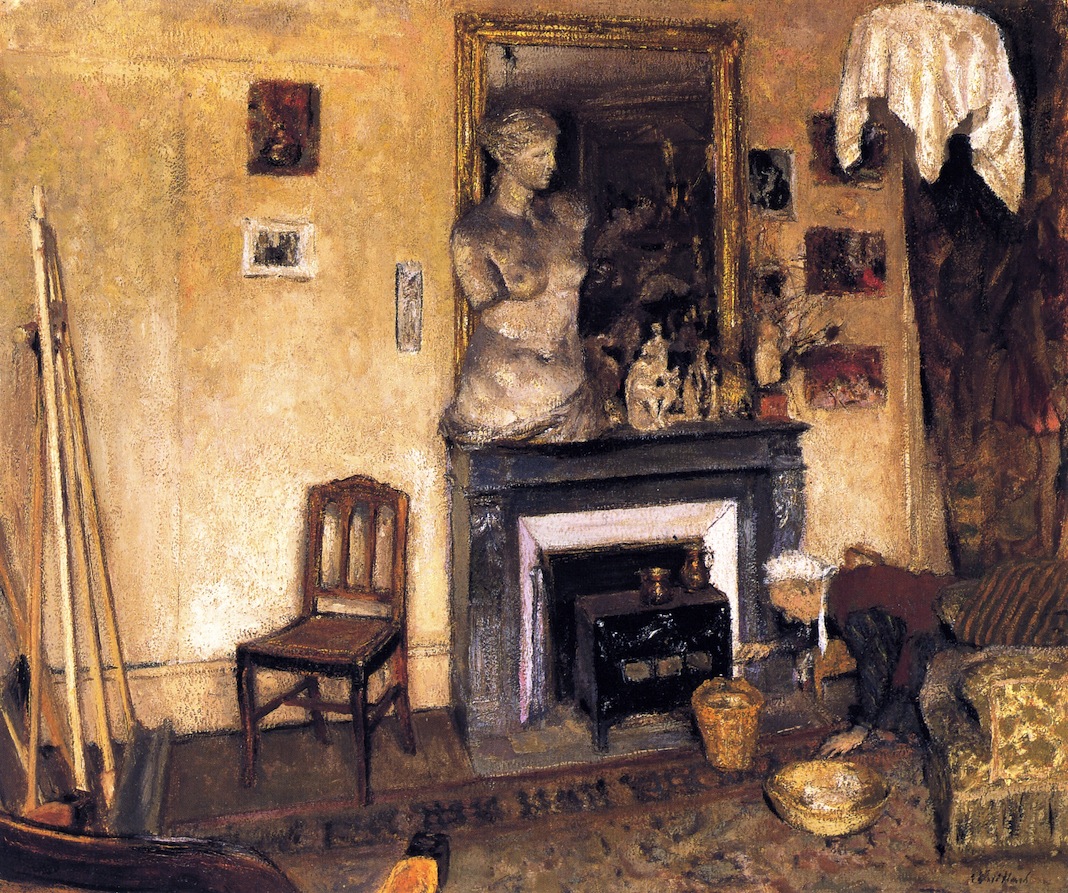

Edouard Vuillard (1868 – 1940), Madame Vuillard Lighting the Stove,
1924, oil on paper mounted on canvas,
25 x 29.25 in. (63.5 x 74.3 cm),
(Not on exhibit in New York)

**************************************************

Edouard Vuillard
Paintings and Works on Paper
April 11, 2012 - May 25, 2012
4 East 81st Street, Manhattan, New York
Monday - Friday, 10:00 a.m. - 5:30 p.m.

Edouard Vuillard: A Painter and His Muses, 1890-1940
May 4, 2012 - September 23, 2012
1109 5th Ave at 92nd St., Manhattan, New York
Monday, Friday - Sunday, 11:00 a.m. - 5:45 p.m.
Thursday, 11:00 a.m. - 8:00 p.m.
Closed Wednesday

Note: Posted originally on May 18, 2012. This is revised post.

Sunday, April 8, 2012

"Harderer. Betterer. Fasterer. Strongerer." Brucennial 2012

Installation view of Brucennial 2012
Photo: Hillary Ganton

“Harderer. Betterer. Fasterer. Strongerer” are the catchwords of the 2012 Brucennial. It may very well be harder, better, faster and stronger than previous ones. The works of some 400 artists are displayed on four levels of a former theater. Paintings are hung salon style sometimes five or six rows high. Informal, wacky and fun, this multifaceted show makes the Whitney Biennial and New Museum Triennial look over-processed.

Installation view of Brucennial 2012
Photo: Vito Schnabel Web site

Organized by the art collective Bruce High Quality Foundation which was founded in 2001 by former Cooper Union students and Vito Schnabel, art dealer son of painter Julian Schnabel, the Brucennial is an invigorating take on what is happening now.

The first Brucennial was in 2008 with about 90 artists. Entitled “Doing it Again”, it took place in the Bushwick section of Brooklyn. The location of the following year's installment was the artist Ray Smith’s Gowanus studio. Called “Smithumenta” the show had 80 participants.  Brucennial reached Manhattan in 2010 when over 400 entrants exhibited at a Soho venue. The tag for this last one was “Miseducation”.

2012 is the exhibition's fourth edition. Typical of the Brucennials, unknowns mix with the famous. Works by Damian Hirst, Cindy Sherman and Jean-Michel Basquait are placed alongside those by originators many have not heard of. The overwhelming majority are the latter.


Installation view of Brucennial 2012
Photo: Vito Schnabel Web site

Sculptors, painters, video, installation and other art forms are present. It’s equal-opportunity for all. If not invited, those who wanted to be in the show just needed to ask the Bruce team - most were accepted. Yet, some vetting must have taken place for the good certainly out number the bad.

Penciled or penned names written directly on the walls identify artists. There was one lone business card affixed under a painting that told more. A number of creators were not indicated. On my visit I saw a few gallery checklists, one for each area. These, however, were easily overlooked as if authorship was not that important. It’s the art that matters.

Installation view of Brucennial 2012
Photo: Vito Schnabel Web site

Brucennial 2012 has something for everyone and plenty of room to take it all in. This viewer saw much of merit but won’t comment on any particular work. The fun is seeing the pieces unbiassed and making up one’s own mind.

The works are for sale. Prices are not listed. To find out more, contact the artist.

Is this, as the organizers state, “The single most important art exhibition in the history of the world. Ever.”? Doubtful. Nevertheless, it is democratic, fresh and full of life. The Brucennials appear to be on the right track.

Don’t postpone your visit. The exhibit closes on April 20th.


Brucennial 2012
Through April 20
159 Bleecker Street, (between Thompson and Sullivan Street),
Manhattan, New York
Wednesday to Sunday, noon to 6:00 p.m.

(Originally posted April 8, 2012)

Tuesday, February 14, 2012

Renoir's Captivating Parisians

Pierre-Auguste Renoir (1841–1919), La Promenade, 1875–76,
oil on canvas, 67 x 42 5/8 in. (170.2 x 108.3 cm)
The Frick Collection, New York
Photo: Michael Bodycomb

Links between senses have long been recognized. The sensation of sound may involuntarily give rise to a sense of color or vice versa. These associations are called synaesthesia and it happens upon entering the Frick Collection’s special exhibition, Renoir, Impressionism, and Full-Length Painting. The exuberant paintings sing.

Pierre-August Renoir’s La Promenade inspired the show. Henry Clay Frick purchased the work in 1914. Initially, he contemplated returning it but, lucky for us, he didn’t. It was the last Impressionist work to enter the collection.

The exhibit, as well as its catalogue, are curatorial triumphs for Colin B. Bailey, the Frick’s Deputy Director and Peter Jay Sharp Curator. Eight important full-length paintings from seven institutions join La Promenade for a look at the work which occupied Renoir in the early years of Impressionism, from the mid-1870s through the mid-1880s. They represent Renoir’s confident and kindly view of modernity - fashionable ladies and gentlemen, a ballerina, an actress, young acrobats, and a trio of dancing couples. This is the first time the museum’s East Gallery has been turned over for a temporary exhibit. The installation takes advantage of the room’s natural light and ample proportions.

Although the Impressionists are known for their easel-size canvases, Renoir preferred to work in a large format. He painted on big surfaces early in his career when he had been employed to make full-scale religious images in imitation of stain glass windows on blinds intended for export to missionary churches. In addition, he had decorated cafe walls with murals.

Landscapes and scenes of contemporary life fell under his observational powers. Rendered in an audacious style of bright hues, feathery brush work and inventive compositions, his work shocked contemporaries.

A tailor father and seamstress mother may account for his interest in and visual acuity for fashion. His paintings can be dated by the clothing worn by those portrayed. He lived during a changing world of politics and industrialization. Napoleon III’s Second French Empire ended and the Third Republic established. Baron Haussmann’s designs transformed Paris into a metropolis of wide boulevards and expansive gardens. The proliferation of street lights made evening strolls safer. Lights illuminated theaters and the just developing department stores, the grand magazins. New railway networks facilitated travel. People spent time outdoors in the city’s gardens or nearby Parisian suburbs now easily reached by train. A diverse social mix enjoyed leisure activities.

Portable umbrellas were produced, made possible by the 1852 invention of the light weight steel-ribbed frame. Cigarette smoking, which had crossed into France from Spain by 1830, became popular. Match manufacturing began making smoking more convenient. In fact, the safety match, received an award at the Paris “World Exhibition” of 1855.

In 1830, a French tailor invented the first functional sewing machine that sewed straight seams. By the mid-1800s, sewing machines were mass produced. The invention of synthetic dyes made new cloth colors possible. Stylish garments became accessible and available at different price points. Women could buy expensive outfits in a cheaper version.

Renoir’s La Promenade, the finest Impressionist work in the Frick Collection, is a glorious depiction of nineteenth-century society. It is a wintry bright day in a public garden. A young women ushers two little girls along a pathway. They are dressed in fur-trimmed outfits. The girls wear matching apparel. One warms her hands in a muff, made of white mink or swans down, while the other holds a fully dressed doll. Besides fur, their ensembles are embellished with silk and lace. In the upper right background, at least eleven figures are discernible along with two dogs, one black and one white.

(For a close view, see the painting's high-resolution image on Google Art Project.)

The work had long been described as a mother and her two children but a recent technical examination supports a different interpretation.

In the spring of 2011, La Promenade was sent to the Metropolitan Museum of Art’s conservation department. An infrared reflectogram revealed a distinct underlayer image of two female figures at the upper left side of the canvas. One was an elegantly dressed older women of obvious high social rank; the other was modestly attired. They were most likely meant to represent the mother and nanny of the three remaining figures. Renoir may have chosen to leave them out in order to give more space to the final the composition and focus attention on the foreground youths, who are now understood to be three sisters. The older one wears a type of schoolgirl skirt. Note the bit of white petticoat sticking out from the right side of her hem. Her casual loose hair is indicative of girlhood. Only children or young, unmarried females of seventeen or eighteen years-of-age wore their hair this way. An older women would not be outside in public with her tresses down. Married, mature women wore their hair styled and pinned up under bonnets or hats.

Pierre-Auguste Renoir (1841–1919), La Parisienne, 1874,
oil on canvas, 64 3/8 x 42 3⁄4 in. (163.2 x 108.3 cm)
Miss Gwendoline E. Davies Bequest, 1951
Photo: © Amgueddfa Cymru—National Museum Wales

Such is the case of the woman pictured in La Parisienne who dresses in a chic, outdoor blue silk walking outfit with matching hat, toque and gloves. She is the height of fashion with a shaped jacket, overskirt pulled into a bustle puffing the fabric out behind and underskirt with pleated flounces. When this canvas was painted in the early 1870s, bright blue and mauve were the “it” colors of the fashionable.

Blues, which dominates La Parisienne, highlight The Dancer placed nearby. This may be the first time both paintings are together since they were shown at the First Impressionist Exhibition in 1874.

Pierre-Auguste Renoir (1841–1919), The Dancer, 1874,
oil on canvas 56 1/8 x 37 1/8 in. (142.5 x 94.5 cm)
National Gallery of Art, Washington, D.C., Widener Collection
Photo: National Gallery of Art, Washington, DC

The Dancer is a light filled canvas of bravado brushstrokes and radical coloration. The young ballerina may be in front of a mirror checking herself or showing her progress to a ballet master. Pushing back her tutu, she gets a better view of her body placement. Her feet are placed in ballet fifth position, the fundamental position from which all classical technique is derived and the one dancers spend their whole lives trying to perfect. Her skin is tinged with blue, green and yellow. The dermis seems to pick up the color of her costume’s sash, bodice trim and hair bows. Renoir doesn’t miss describing the velvet neck choker, delicate hankie and jeweled bracelets. The painter even delineates the taut ribbons of new pink toe shoes pressing against the young girl’s flesh.

The model for The Dancer, La Parisienne, and older sister in La Promenade has been identified as the then aspiring actress Marie-Henriette-Alphonsine Grossin whose stage name was Madame Henriot. She became one of Renoir’s favorite models posing for the artist between 1874, when she was seventeen-years-old, and 1876. Modeling gave her income and public exposure. In the painting Madame Henriot “en travesti” (The Page), also in the show and hung to the right of La Parisienne, the actress is portrayed as a page.

Edgar Degas (1834-1917), Little Dancer Aged Fourteen, 1878-1881,
yellow wax, hair, ribbon, linen bodice, satin shoes, muslin tutu, wood base,
overall without base: 38 15/16 x 13 11/16 x 13 7/8 in. (98.9 x 34.7 x 35.2 cm)
weight: 49 lb. (22.226 kg)
Collection of Mr. and Mrs. Paul Mellon
National Gallery of Art, Washington, DC
Photo: ARTnews

A short digression: The ballerina as subject is usually associated with Edgar Degas who also took part in the Impressionist exhibitions. His Little Dancer Aged Fourteen, presented in the Sixth Impressionist Exhibition of 1881, was the only sculpture the artist ever put on public display. Made of wax, hair and clothing materials, it defied convention. She stands in the ballet fourth position which gives the dancer a balanced solid-base, allowing for the body’s elongation and improved alignment. Yet, compared to Renoir’s painted dancer who stands in the more difficult fifth, the little wax ballerina looks awkward. Part of the reason, I suggest, is that Renoir was incapable of rendering his models indifferently. He made them look good, better than they actually were in life. The actress Mademoiselle Henriot was not a particularly attractive woman but Renoir made her appealing. His was a benevolent view of mankind.

Pierre-Auguste Renoir (1841–1919), The Umbrellas (Les Parapluies), c. 1881–85,
oil on canvas, 71 x 45 in. (180.3 x 114.9 cm),
The National Gallery, London, Sir Hugh Lane Bequest, 1917
Photo: © The National Gallery, London / Art Resource, NY

The Umbrellas (Les Parapluies) is on a wall by itself across from La Parisienne. Begun about 1881, it was completed five years later. The work is bifurcated yet the blue toned pigments unite dissimilarities. On the right are four figures in Renoir’s early luminous Impressionistic manner. A well-dressed mother holding an open umbrella looks down at her two daughters. Their luxurious garments demonstrate wealth. Next to them, a younger woman with an upturned face is in the process of opening her umbrella. Her clothing is evidence of some means.

Pierre-Auguste Renoir (1841–1919), Detail of The Umbrellas (Les Parapluies),
c. 1881–85, oil on canvas,
71 x 45 in. (180.3 x 114.9 cm),
The National Gallery, London, Sir Hugh Lane Bequest, 1917
Photo: ARTstor

On the painting’s left, a dapper man with top hat holds an open umbrella in his gloved right hand. He appears to protect the bare-headed woman standing before him. Her garments as well as the hat box with leather strap that she carries signifies she is a milliner's assistant. This pair as well as the background figures and umbrellas were painted in Renoir’s later linear, subdued style which emphasized form, line and volume rather than brushstrokes and colors.

Pierre-Auguste Renoir (1841–1919), Detail of The Umbrellas (Les Parapluies),
c. 1881–85, oil on canvas,
71 x 45 in. (180.3 x 114.9 cm),
The National Gallery, London, Sir Hugh Lane Bequest, 1917
Photo: ARTstor

Costume historians would recognize the shopgirl's fitted clothing as the up-to-date English fashion of the mid-1880‘s. The figures on the right are fashionistas of the earlier 1880s. The mother wears a 1881 ensemble characterized by a high bustle and tiered skirt. Renoir, as always, is meticulous in his clothing descriptions. Note the the footwear of the four right figures: both girls appear to be wearing Baby Jane type children shoes but the older sister sports dark spats covering her instep and ankle; the mother has on pumps with contrasting beige spat; and, peaking out from the other woman’s pleated skirt, are her shoes’ plain tips. Other well-observed details are the mother’s bracelets and the small buttons on the inside of her right hand glove. The little girl’s possessive grasp of her toy hoop and stick, the older sister’s affectionate touch on her younger sibling’s shoulder, the overlapping of numerous umbrellas and figures, make this one of Renoir’s best paintings.

Gustave Caillebotte (1848-1894) A Paris Street; Rainy Day, 1877,
oil on canvas, 83 1/2 x 108 3/4 in. (212.2 x 276.2 cm),
Charles H. and Mary F. S. Worchester Collection, 1964
Art Institute of Chicago, Chicago, Illinois
Photo: ARTstor

I can not help but bring up another famous “umbrella” painting, Gustave Caillebotte’s A Paris Street; Rainy Day. Renoir and his close friend and fellow artist Caillebotte both exhibited at the 1877 Third Impressionist Exhibition. Caillebotte’s painting was in that show and, no doubt, Renoir saw it. Like Ford Motel Ts, the umbrellas in Caillebotte’s 1877 work and Renoir’s The Umbrellas (Les Parapluies) of 1881-5 confirm the devices early uniformity.

Pierre-Auguste Renoir (1841–1919), Dance at Bougival, 1883,
0il on canvas, 71 5/8 x 38 5/8 in. (181.9 x 98.1 cm)
Museum of Fine Arts, Boston, Picture Fund
Photo: © 2012 Museum of Fine Arts, Boston

In 1883, Renoir was preparing intensely for an exhibition and produced three canvases of dancing couples: Dance in the City, Dance in the Country and Dance at Bougival. They are all at the Frick. The later is the most romantic of the trio and charged with an eroticism the other two lack.

Pierre-Auguste Renoir (1841–1919), Detail of Dance at Bougival,
1883, oil on canvas,
71 5/8 x 38 5/8 in. (181.9 x 98.1 cm)
Museum of Fine Arts, Boston, Picture Fund
Photo: ARTstor

Quite risqué for the time, the young female dancer wears no gloves. Skin touches skin as her partner’s left hand holds firmly to her uncovered right wrist. She rests her left hand gently about his neck. Their body language - faces near as the male bends toward her - suggests intimacy and seduction. Their dance embrace contrasts the more accepted hand to shoulder and palm to palm placement. As to be expected, the rendering of clothes is superb. The young woman’s red-trimmed frock swirls with the music and accentuates her luscious form.

Pierre-Auguste Renoir (1841–1919), Detail of Dance at Bougival,
1883, oil on canvas,
71 5/8 x 38 5/8 in. (181.9 x 98.1 cm)
Museum of Fine Arts, Boston, Picture Fund
Photo: ARTstor

Ground litter, made up of cigarettes butts, spent matches, small bouquet, leaf and flower, allude to pleasures enjoyed.

Pierre-Auguste Renoir (1841–1919), Detail of Dance at Bougival,
1883, oil on canvas,
71 5/8 x 38 5/8 in. (181.9 x 98.1 cm)
Museum of Fine Arts, Boston, Picture Fund
Photo: ARTstor

In the left background, a women, with her left hand under her chin, converses with the man seated at the same table. As if not to miss a word, she tilts her chair forward, balancing on its two front legs. He nonchalantly smokes a cigarette. Their unfinished drinks suggest slight intoxication. Behind them, a gentleman wearing a top hat approaches, perhaps to listen or enter into the chat.

Renoir typically used friends and colleagues for models. In Dance in the City, Suzanne Valadon, artist and model, partners with the writer and journalist Paul Lhote. Lhote also appears in Dance in the Country with Aline Charigot, the painter’s mistress and subsequent wife.

The couple depicted in Dance at Bougival had been difficult to determine. They resemble Valadon and Llote but not close enough to convince. The issue was clarified when an X-ray of the painting uncovered an earlier version of the female dancer. She looked like Aline Charigot. The final image reflects a mixture of Valadon and Charigot.

The male dancer was more likely based on Hippolyte-Alphonese Fournaise, the son of the owner of the Fournaise restaurant located in Chatou.  Like Bougival, Chatou was a popular weekend gathering spot about nine miles from Paris and accessible by railroad.

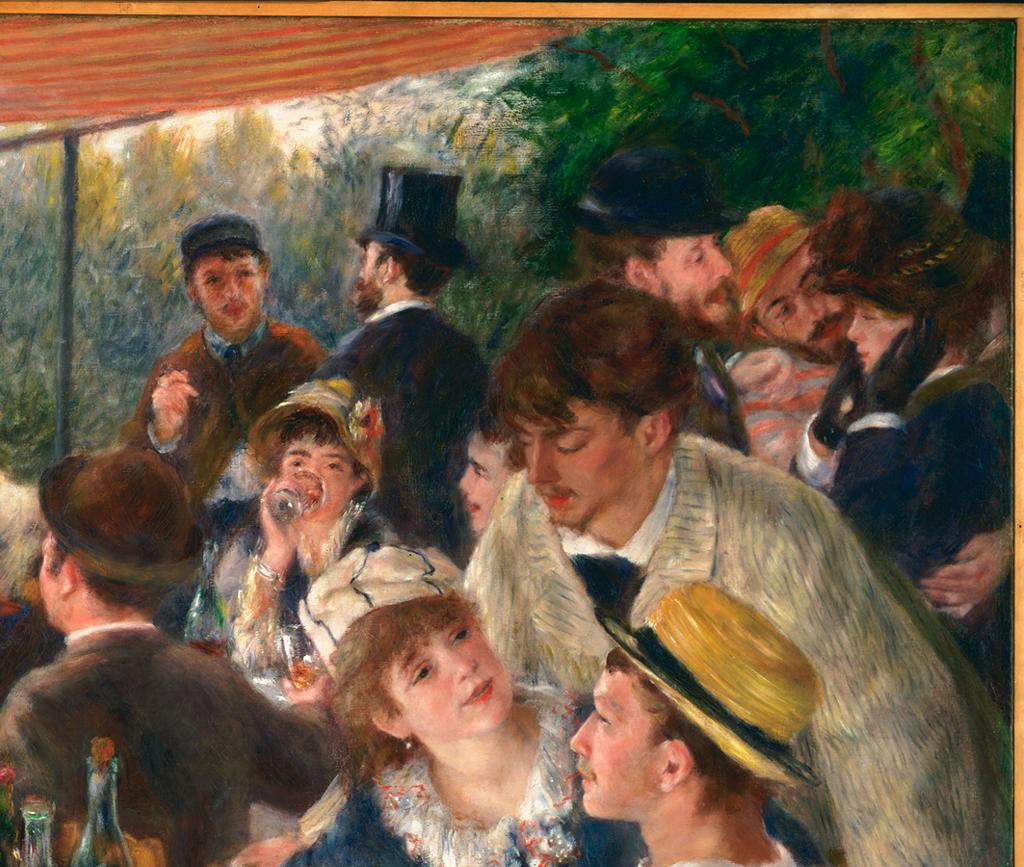
Pierre-Auguste Renoir (1841-1919), Luncheon of the Boating Party, 1880-1881,
oil on canvas, 51 1/4 x 69 1/8 in. (130.175 x 175.5775 cm),
The Phillips Collection, Washington, DC
Photo: ARTstor

Renoir began to go to there in the 1870s and he used the restaurant as a setting for the Phillips Collection’s Luncheon of the Boating Party. Llote, Charigot and Fourniase are in this painting.

Pierre-Auguste Renoir (1841-1919), Detail of Luncheon of the Boating Party,
1880-1881, oil on canvas,
51 1/4 x 69 1/8 in. (130.175 x 175.5775 cm),
The Phillips Collection, Washington, DC
Photo: ARTstor

Llote is in the right rear between the gentleman wearing a black hat (the bureaucrat Eugène-Pierre Lestringuez) and a woman whose gloved hands are raised to her cheeks (the actress Jeanne Samary).

Pierre-Auguste Renoir (1841-1919), Detail of Luncheon of the Boating Party,
1880-1881, oil on canvas,
51 1/4 x 69 1/8 in. (130.175 x 175.5775 cm),
The Phillips Collection, Washington, DC
Photo: ARTstor

In the near left foreground, Charigot is seated playing with a small dog. Fournaise leans against the railing behind her.

The Dance at Bougival was last in New York in the Spring of 1886 when it was paired with Luncheon of the Boating Party at the first exhibition of Paris Impressionists in America. The Umbrellas (Les Parapluies) was also in that show. It was the only time the painting had been in the United States before the current Frick exhibition.

The works on view at Renoir, Impressionism, and Full-Length Painting may very well be the best of Renoir. No one knows if they will ever be together again. Make a visit.

Hint: The museum’s Spanish paintings and two full-length Whistler portraits were moved to the Oval Room for the duration of the show. Take a look. The impact of Renoir’s revolutionary style will intensify.

Renoir, Impressionism, and Full-Length Painting
February 7, 2012, through May 13, 2012
1 East 70th Street, Manhattan, New York
Tuesday through Saturday, 10:00 a.m. to 6:00 p.m.
Sundays, 11:00 a.m. to 5:00 p.m.
Closed Mondays and holidays

Extended Hours Event: Renoir Night
Date: Friday, April 27, 2012, 6:00 p.m. to 9:00 p.m.

Tuesday, January 3, 2012


 Happy New Year!


2012


Start the year with 
a picture and poem.


Edouard Manet (1832 - 1883), 
1862-63, oil on canvas,
unframed: 37 5/16 x 44 3/4 in. (94.7 x 113.7 cm)
framed: 46 7/8 x 54 5/16 in. (119 x 138 cm)


A Great Number 
by Wislawa Szymborska 


Four billion people on this earth of ours,
but my imagination is unchanged.
It does not do well with great numbers.
It is still moved by what is individual.
Flitting through darkness like a flashing beam,
it picks out only the faces that are nearest,
meanwhile the rest are lost to blind oversight,
non-thought and non-regret.
Dante himself could not have prevented that.
And what if one is not?
Even with all the muses at my back.


Non omnis moriar - a worriment that's premature.
Yet am I fully alive, and is that enough?
It was never enough, now more than ever.
Choosing I reject, there is no other way,
yet that which I reject is more numerous,
more dense, more clamorous then ever before.
At the cost of losses indescribable - a little poem, a sigh.
To this thunderous Calling I reply in a whisper.
How much I pass over in silence, I will not say.
A mouse at the foot of the maternal mountain.
Life lasts but a few scratches of the claw in the sand.


My dreams - even they are not, as is proper, inhabited.
There's more in them of solitude than crowds and tumult.
Someone long dead may drop by for a moment.
The handle is moved by a lone hand.
The empty house is crowded round with annexes of echoes.
I run from the doorstep down into the tranquil
valley that seems to be no one's, already anachronistic.


Where this space within me comes from still -
that I do not know.
(1976)


Addendum: Wislawa Szymborska (born July 2, 1923) died February 1, 2012 at her home in Krakow, Poland. She received the 1996 Nobel Prize in Literature.

Tuesday, December 13, 2011

Rauschenberg's Friends

Andy Warhol, Robert Rauschenberg, 1967,
acrylic and silkscreen ink on linen,
14 x 10 1/4 in. (35.6 x 26 cm),
© Andy Warhol. Courtesy Gagosian Gallery.
Photography by Robert McKeever.
Collection of the Robert Rauschenberg Revocable Trust

You go to someone’s home, observe what’s around, meet their friends and, from this input, gain a better understanding of the person. Similarly, for more insight into an artist and what he or she does, look at what he or she collects.

The exhibition, The Private Collection of Robert Rauschenberg at the Gagosian Gallery offers this opportunity. Curated by Ealen Wingate, the director of Gagosian’s 24th Street gallery, the show provides visual evidence of Robert Rauschenberg’s extensive interests and intimacies. It makes obvious the collection's inclusive quality which links it to the artist's own work - silk screens and Combines which may include anything and everything.

Installation view of The Private Collection of Robert Rauschenberg
© Gagosian Gallery.
Photography by Robert McKeever.
Collection of the Robert Rauschenberg Revocable Trust

From left to right:

Jean Tinquely, Untitiled, 1962,
brick, metal, feather, tape and motor,
21 x 10 1/2 x 8 in. (53.3 x 26.7 x 20.3 cm)

Unknown, Mali (Bamana), Power Object (Boli)
wood, clay, organic substances such as earth, sacrificial blood,
bark, honey, chewed kola nut, millet and beet,
15 x 20 x 6 1/2 in. (38.1 x 50.8 x 16.5 cm)

Unknown Amazon, Tribal Costumes, 20th Century,
beaten bark, string, balsa wood,
73 x 25 in. (185.4 x 63.5 cm)

Some 145 works which the artist acquired through gifts, exchanges, or purchases are on view. There are paintings, drawings, sculptures, sketches, letters, notes, photographs, musical notations, tribal artifacts, and other items held on to for private reasons. The installation, which takes over three of the gallery's floors, entices visitors with interesting juxtapositions and surprises. Since archival material is scarce, determining how and when pieces were obtained is difficult.

Installation view of The Private Collection of Robert Rauschenberg
© Gagosian Gallery.
Photography by Robert McKeever.
Collection of the Robert Rauschenberg Revocable Trust

From left to right:

Andy Warhol, Gem, 1979,
acrylic, silkscreen ink, and diamond dust on linen,
54 x 86 in. (137.2 x 218.4 cm)

John Chamberlain, Untitled, c. 1965,
painted and chroium plated steel,
43 x 35 1/2 x 26 in. (109.2 x 90.2 x 66 cm)

James Rosenquist, Spaghetti, 1965,
oil on linen,
30 x 30 in. (76.2 x 76.2 cm)

There are works by Rauschenberg’s close friends Cy Twombly and Jasper Johns as well as other contemporaries like Andy Warhol, Claes Oldenburg, Frank Stella, Öyvind Fahlström, James Rosenquist, and John Chamberlain. Women artists include Elaine Sturtevant, Susan Weil and Niki de Saint Phalle. Among a younger generation are Brice Marsden, Damian Hirst, Ed Ruscha and Al Taylor. Photographers represented include Hans Namuth, Robert Mapplethorpe, Mathew Brady, and Eadweard Muybridge. Materials by choreographers and composers such as Philip Glass, John Cage, Merce Cunningham and Trish Brown are also here. In addition, there are modern masters like Henri Matisse, Kurt Schwitters, Marcel Duchamp, René Magritte and Francis Picabia. The variety attests to Rauschenberg's gregarious and generous nature. 

Many items were made for Rauschenberg and inscribed - For Bob, Marcel (Marcel Duchamp), For Bob, B. Marsden (Brice Marden), Flowers for Bob, Cy (Cy Twombly), Token for Bob, Trish Brown, For Bob, Al Tayor, Pour Robert, Tinguely (Jean Tinguely) and more. Merce Cunningham’s 1993 pen on paper, Choreography Instructions, has on its reverse a letter which describes the dance and ends with the wish: “I hope you will help us do this.”

Installation view of The Private Collection of Robert Rauschenberg
© Gagosian Gallery.
Photography by Robert McKeever.
Collection of the Robert Rauschenberg Revocable Trust

Clockwise from top left to right:

Andy Warhol, Eggs, 1982,
Acrylic and silkscreen enamel on canvas,
8 x 8 in. (20.3 x 20.3 cm)

Elaine Sturtevant, Untitled, 1967,
silkscreen on canvas,
40 x 32 3/8 in. (101.6 x 82.2 cm)

Jean Tinquely, Saint Phalle, 1961,
wood stool, wire and pigments,
28 1/2 x 14 x 16 1/2 in. (72.4 x 35.6 41.9 cm)

The show presents something for everyone. Two photographs of stores are sumptuous in detailing. Themes of sales and foreign lands, various objects, shapes, textures, layers of space and the mechanically made would surely have intrigued Rauschenberg. Eugene Atget’s Shop, Halles Market, 1925, is all reflections and ambiguous layers of planes. Hung below is Kusakabe Kimbei’s The Silk Store, c. 1890. Although black and white, Kimbei’s image of overlapping textile patterns appears colorful.

Duchamp’s pencil drawing, Peasant’s Leg, 1904-05, is adjacent to Magritte’s 1963 Study for the Well of Truth, a pastel depicting a trouser leg. Seen together, they illicit concepts of rural and urban, formal and informal as well as what constitutes suburb draftsmanship.

Twombly’s 1970 and 1982 “Flowers for Bob” were birthday pictures made for Rauschenberg. The graphite and crayon earlier work could pass for a Matisse or Bonnard design.

Cy Twombly, Untitled, 1953,
oil based house paint on canvas,
52 1/8 x 52 1/8 in. (132.4 x 132.4 cm),
© Cy Twombly. Courtesy Gagosian Gallery.
Photography by Robert McKeever.
Collection of the Robert Rauschenberg Foundation

Not often seen are two early career pieces. One is by Hirst, Expanded from Small Red Wheel, a 1985 assemblage-like construction; the other is by Twombly, a suggestive black and white canvas, Untitled, 1953. The latter reminiscent of Jean Dubuffet’s late 1940s and early 1950s paintings,

Although some important works by Johns had been sold in the 1980s to support the artist’s international project ROCI - Rauschenberg Overseas Cultural Interchange - significant things remain such as the encaustic Map of 1960 and 1958 papier-mâché Flashlight II.

The exhibit has many things that simply delight. Marden’s elegance is nicely exemplified by Study for Lot, 1968 and Untitled Drawing, 1965. Ruscha’s 1980 Romeo, With Contraceptive Ghost is alluring. Warhol’s portraits of the artist are touching. Alexander Calder’s 1925 Study of a Chicken amuses. Fahlström’s Unititled Cutout, c. 1973, provokes thought.

On the fourth floor, opposite the building’s two main elevators, is a blown-up, mural-size photograph of Rauschenberg in his studio. The image is filled with works from the artist’s collection. You can clearly recognize Marcel Duchamp’s Bottle Rack (aka Bottle dryer) and two of Tinquely’s constructions, Radio No. 1 and Saint Phalle.   The photo is a record of how Rauschenberg lived with these artworks on a daily basis.  
Many exhibition pieces are for sale to benefit the Robert Rauschenberg Foundation. Established by the artist in 1990, the Foundation engages in philanthropic activities supporting artists, arts education, environmental and humanitarian endeavors.

A catalogue of selected works from the collection is in progress.

The Private Collection of Robert Rauschenberg
November 3, 2011 - December 23, 2011
980 Madison Avenue, Manhattan, New York
Tuesday - Saturday 10:00 am - 6:00 pm