Saturday, October 29, 2011

MoMA Revitalized: A New Narrative of Modern Art

Louise Bourgeois (American, born France. 1911-2011), Sleeping Figure,
1950, painted balsa wood,
6 ft. 2 1/2 in. x 11 ft. 5/8 x 11 3/4 in. (189.2 x 29.5 x 29.7 cm), 
Katharine Cornell Fund. 
© 2011 Louise Bourgeois Trust

There is change at the Museum of Modern Art. The installation of the Museum’s peerless permanent collection of modern and contemporary art has been reassessed, bringing back the excitement of discovering the new.

After the closing this past April of the abstract expressionist show, the fourth-floor Alfred H. Barr, Jr. Galleries, usually devoted to the Museum’s collection, were empty. For the first time since her 2008 appointment as chief curator of painting and sculpture, Ann Timken had the chance to completely reinstall the 1940s through contemporary art. The choices she and her five member curatorial team made as well as the modifications to the 1880s to 1940s array on the fifth floor express a break from the past. An open and flexible approach to the history of modernism replaces a dogmatic methodology with the belief that there are many ways to look at the history of modern art as well as the Museum’s collection. Painting, sculpture and objects in other mediums are mixed and those on exhibit alternate regularly. Attention is given to overlooked artists, artworks too long in storage, works by women and international artists. Contemporary art has more space and there is a commitment to increase collecting in this area.

The twelve galleries on the fourth floor, Painting and Sculpture II, have been transformed the most. They are the subject of this post.

Wilfredo Lam (Cuban, 1902-1982), The Jungle, 1943,
gouache on paper mounted on canvas, 94 1/4 x 90 1/2 in. (239.4 x 229.9 cm),
Inter-American Fund.
© 2011 Artists Rights Society (ARS), New York / ADAGP, Paris

A glance through the entrance into the first fourth-floor gallery (Gallery 15) reveals a difference. A sculpture by a woman leads off. Perhaps, the expected start would have been an iconic painting by some celebrated male painter like Jackson Pollock or Jasper Johns. Instead, Louise Bourgeois’s totemic, phallic-like Sleeping Figure greets visitors. To the right is Wilfredo Lam’s masterpiece, The Jungle. Alongside this hangs the wood and rope sculpture Totem for All Religions by Frederick Kiesler which neighbors André Masson’s canvas, The Kill. These Surrealist works play off each other, enhancing visual experience by illuminating shared characteristics. A woman, a Cuban, an American born in Romania, and a French artist begin the visitor’s visual journey. Dorothea Tanning’s work is also in this gallery making the impact of the female contingent even stronger.

A short digression: the issue of women artists at MoMA has been remarked upon in the past. In the November 18, 2007 New York Magazine article, “Where Are All the Women? On MoMA’s identity politics.”, the art critic Jerry Saltz laments that out of 137 artists presented in the permanent galleries, only 11 were women. I recently counted 24 women artist who had works on view and several were represented by more than one object.

Jackson Pollock, (American, 1912-1956), One: Number 31, 1950, 
1950,
oil and enamel paint on canvas,

8 ft. 10 in. x 17 ft. 5 5/8 in. (269.5 x 530.8 cm),
The Museum of Modern Art, New York.
Sidney and Harriet Janis Collection Fund (by exchange)

© 2011 Pollock-Krasner Foundation / Artists Rights Society (ARS), New York

Barnett Newman (American, 1905-1970), Vir Heroicus Sublimis,
1950-51, oil on canvas,
7 ft. 11 3/8 in. x 17 ft. 9 1/4 in. (242.2 x 541.7 cm),

The Museum of Modern Art, New York. 
Gift of Mr. and Mrs. Ben Heller

© 2011 Barnett Newman Foundation / Artists Rights Society (ARS), New York

Proceeding sequentially (Gallery 16), brings into sight two large canvases by Barnett Newman which flank a Jackson Pollack. On the room’s other side, a Francis Bacon is set close to a Giacometti portrait. Two sculptures by the latter are also on display. The pairings highlight associations and distinctions. I especially delighted in the comparison between Pollack’s expansive, rhythmic One: Number 31, 1950 and Newman’s calm yet vibrant Vir Heroicus Sublimis.

Jasper Johns (American, born 1930), Flag, 1954-55 (dated on reverse 1954),
encaustic, oil, and collage on fabric mounted on plywood, three panels,
42 1/4 x 60 5/8 in. (107.3 x 153.8 cm),
The Museum of Modern Art, New York.
Gift of Philip Johnson in honor of Alfred H. Barr, Jr.
© 2011 Jasper Johns / Licensed by VAGA, New York, NY

Robert Rauschenberg (American, 1925-2008), Rebus, 1955,

oil, synthetic polymer paint, pencil, crayon, pastel, cut-and-pasted printed and painted papers, and fabric on canvas mounted and stapled to fabric, three panels,
 
8 ft. x 10 ft. 11 1/8 in. (243.8 x 333.1 cm),
The Museum of Modern Art, New York. 
Partial and promised gift of Jo Carole and Ronald S. Lauder and purchase

© Robert Rauschenberg/ Licensed by VAGA, New York, NY

A room filled with the famous is nearby (Gallery 17). There is Jasper John’s Target and Flag; Robert Rauschenberg’s Bed, Rebus and Untitled (Ashville Citizen); and, Cy Twombly’s Tiznit and Academy. The installation is spacious providing an atmosphere for unhurried contemplation.

Daniel Spoerri (Swiss, born Romania 1930), Kichka's Breakfast I,
1960, wood chair hung on wall with board across seat, coffeepot, tumbler, china, eggcups, eggshells, cigarette butts, spoons, tin cans, and other materials,

14 3/8 x 27 3/8 x 25 3/4 in. (36.6 x 69.5 x 65.4 cm),
The Museum of Modern Art, New York. Philip Johnson Fund
© 2011 Daniel Spoerri / Artists Rights Society (ARS), New York / ProLitteris, Switzerland

Lee Bontecou (American, born 1931), Untitled, 1961,

welded steel, canvas, black fabric, copper wire, and soot,
6 ft. 8 1/4 in. x 7 ft. 5 in. x 34 3/4 in. (203.6 x 226 x 88 cm),
The Museum of Modern Art, New York. Kay Sage Tanguy Fund

© 2011 Lee Bontecou

Art made of found, non-traditional materials called assemblage is close by (Gallery 18). Here are two- and three-dimensional pieces by Lee Bontecou, Niki de Saint Phalle, Jacques de la Villegié , Daniel Spoerri, Lucio Fontana, Alberto Burri, Natsuyuki Nakanishi, Mathias Goeritz, Jean Tinguely, Arman, John Chamberlain, and Christo (Christo Jaacheff). The familiar mix with the unfamiliar in this international group - only Bontecou and Chamberlain are Americans. Placements bring out connections that may not have been obvious. Set across from each other on opposite walls, the drawn and pierced ovals of Fontana’s Spatial Concept canvas seem to echo Bontecou’s rounded opening.

Lucio Fontana (Italian, born Argentina. 1899-1968), Spatial Concept,
1957, ink and pencil on paper on canvas,
55 x 78 7/8 in. (139.7 x 200.4 cm). Gift of Morton G. Neumann.
© 2011 Fondation Lucio Fontana

On my previous MoMA visits in the last few weeks, the Saint Phalle was not on view but a Yayoi Kusama paper work was. The present Villegié had replaced another work by the artist. Exchanges are nice surprises for the frequent visitor.

Richard Hamilton, (British,1922-2011), Pin-Up, 1961,
oil, cellulose, and collage on panel,
53 3/4 x 37 3/4 x 3 in. (136.5 x 95.8 x 7.6 cm) including frame,
Enid A. Haupt Fund and an anonymous fund. © 2011 Artists Rights Society (ARS),
 New York / DACS, London

A first-rate presentation of 1960s Pop Art (Gallery 19) follows. Star attractions include works by Roy Lichtenstein, Claes Oldenburg, Tom Wesselmann, George Segal, James Rosenquist, and Alex Katz. The installation also has pieces by Richard Hamilton, Michelangelo Pistoletto and Marisol. Hamilton’s 1961 Pin-Up combines different methods. The sex symbol’s bra is an applied photograph and her breasts are both drawn and in concrete relief. At her left knee is a Princess rotary telephone which was the “it” status phone for women in the early 1960s. Designed for use in the bedroom, the phone came in several colors and had a dial that lit up in the dark. Hamilton’s Pin-Up wears nylon hose. Pantyhose, as we know them in the United States, did not become extensively available and worn until the mid-1960s when miniskirts became fashionable. Hose have long been considered more attractive than pantyhose, making sex more accessible. I asked a few twenty year olds if they could identify the phone. Two queried did not recognize it as a telephone; the others that did had never heard of the Princess type. I never got into the hose versus pantyhose interpretation. Meanings, signs and symbols get forgotten over time.

Marisol (Marisol Escobar), (Venezuelan, born France 1930), Love,
1962, plaster and glass (Coca-Cola bottle),
6 1/4 x 4 1/8 x 8 1/8 in. (15.8 x 10.5 x 20.6 cm),
Gift of Claire and Tom Wesselmann. © 2011 Marisol

Although eliciting more humor than eroticism, Marisol’s Love exemplifies an outgoing sexual frankness that this writer finds more apparent in work by women artists. This sculpture was a gift from the artist Tom Wesselmann and his wife Claire. Wesselmann’s 1961 painting, Great American Nude 2, appears high on a near wall. On the other side of the room is James Rosenquist’s Marilyn Monroe I. Rosenquist incorporates an upside down section from the Coca-Cola trademark script linking its iconography to Marisol's sculpture across the gallery space.

De Wain Valentine, (American, born 1936), Triple Disk Red Metal Flake - Black Edge, 1966,
fiberglass reinforced polyester,
62 x 65 x 85 in. (157.5 x 165.1 x 215.9 cm),
Gift of Marie-Josée and Henry R. Kravis

The simplified forms of Minimalism are met with in the adjoining gallery (Gallery 20). Pieces by Dan Flavin, Donald Judd and the less known Jo Baer, Craig Kauffman and De Wain Valentine clear the mind by their exclusion of pictorial illusionism. Their variety attest to the possibilities even within the movement’s reductive constraints. The red mirror-like surface of Valentine’s 1966 fiberglass, Triple Disk Red Metal Flake - Black Edge, is illustrative. Approached from any side, the three disks have a anthropomorphic quality - touching, dancing, playing. The Valentine came into the collection last year, a gift from Marie-Josée and Henry R. Kravis.

Conceptional art of the late 1960s and early 1970s comes next (Gallery 21). These works move into the immaterial realm of thoughts, language, movement and sound. Sol LeWitt, Robert Smithson, Lawrence Weiner, Robert Barry and Hanne Darboven are here. Visitors most likely will recognize some but not all. Many of these works come from the collection of Seth Siegelaub and were acquired by MoMA this past spring. Siegelaub, curator, dealer and publisher, along with the Conceptional artists he supported questioned the display, ownership, distribution, and selling of art along with the participatory role of art viewers.

Hannah Wilke, (American, 1940-1993), Untitled, 1963-66,
pastel and charcoal on paper, 19 1/2 x 24 in. (49.5 x 61 cm),
The Judith Rothschild Foundation Contemporary Drawings Collection Gift. © 2011 Marsie, Emanuelle, Damon and Andrew Scharlatt - Hannah Wilke Collection and Archive,
 Los Angeles

The art of Hannah Wilke, a sculptor, painter, photographer, video and performance/installation artist is presented in a small side gallery (Gallery 22). Wilke tackled issues of feminism especially female sexuality using her own body to examine women’s physical experience. Her pieces on view includes a 1974 video, Gestures, drawings, photographs and sculpture. Although critically praised, Wilke’s controversial art has not been widely exhibited in museums. MoMa’s commitment is a notable beginning.

A light-filled stairway space (Gallery 26) hosts the diverse works of Agnes Martin, Ellsworth Kelly, Robert Indiana and Jack Youngerman. In the 1950s, these artists lived and worked on Coenties Slip, a street in lower Manhattan where rents were cheap. The gallery, off the Conceptional art area, is easy to miss but should be visited.

Frank Stella (American, born 1936), The Marriage of Reason and Squalor, II,
1959, enamel on canvas,
7 ft. 6 3/4 in. x 11 ft. 3/4 in. (230.5 x 337.2 cm),
Larry Aldrich Foundation Fund. © 2011 Frank Stella / Artists Rights Society (ARS),  New York

Retracing some steps leads to objects primarily from the late 1960s (Gallery 23). This was a period when artists turned away from Minimalism, concentrating on the process of art, creating with unusual materials such as latex, resin and wax. This space is packed with nine sculptures and one painting. Five works are by women and five by men. The two sculptures by Lynda Benglis, the one by Louise Bourgeois and the two by Eva Hesse appear organic, soft-edged, sexually evocative. The men’s pieces, by Richard Serra, Bruce Nauman, Frank Stella, Joseph Beuys, and Giovanni Anselmo tend to be hard edged, more mindful than sensual. The large 1959 Stella canvas, The Marriage of Reason and Squalor II, is installed alone on the gallery’s end wall. Belonging to the minimalist aesthetic, its repeated concentric inverted U-shapes, devoid any sense of depth, contrasts with the surrounding heterogeneous mixture of three-dimensional forms.

Bruce Nauman, (American, born 1941), Untitled,
1965, fiberglass, polyester resin, and light,
8 ft. 4 in. x 20 ft. x 21 in. (254 x 50.3 x 53.3 cm),
Gift of Joseph Helman. © 2011 Bruce Nauman / Artists Rights Society (ARS), New York

This gallery's sculptures bring to mind notions of maleness and femaleness. Bruce Nauman’s 1965 wall piece could be the male response to Lee Bontecou’s 1961 work in the “assemblage” gallery. The masculine Nauman, more height than breadth, is a closed, vertical protuberant. The softer, feminine Bontecou is rounded and open. One appears to discourage contact; the other reaches out and invites.

Fully-realized Conceptional art is displayed in the neighboring space (Gallery 24). Daniel Buren, Dan Graham On Kawara, Vito Acconci, Niele Toroni and Marcel Broodthaers are represented by pictures, objects and documents. Broodthaers dominates with 22 pieces. Engaging and perplexing, this artist reminds us that there are no easy answers while he examines the interrelationship among art world players - the artist, museum and art market. Everything on view was acquired this year from the Herman and Nicole Daled Collection. The Daleds amassed an extraordinary collection of 1960s and 1970s art. Herman Daled had a fitting appellation for these pieces. He called them “objects of knowledge”.

The last gallery before exiting (Gallery 25) showcases the painter and sculptor Richard Artschwager. His work relates to Pop art, Minimalism and the found object. Focusing on perception and using a variety of mediums, his creations seem an appropriate end to the fourth floor’s exploration.

The Alfred H Barr Painting and Sculpture Galleries II, Fourth Floor
11 West 53 Street, Manhattan, New York
Monday, Wednesday and Thursday, 10:30 a.m. to 5:30 p.m.
Saturday and Sunday, 10:30 a.m. to 5:30 p.m.
Friday, 10:30 a.m. to 8 p.m.
(Open until 8:30 p.m. the first Thursday of every month, September–June)
Closed Tuesdays
Closed Thanksgiving Day and Christmas Day

Friday, September 9, 2011

Connecting to The Yale Center for British Art

Sir Peter Paul Rubens (1577-1640, Flemish), Peace Embracing Plenty, between 1633 and 1634, oil on panel,
24 3/4 x 18 1/2 in. (62.9 x 47 cm),
Yale Center for British Art, Paul Mellon Collection
Photograph: Yale Center for British Art

The Yale Center for British Art celebrates the launch of their new online catalogue in an exhibition entitled Connections. Considered the most comprehensive collection of British Art outside of the United Kingdom, the Center’s holdings include some 2,000 paintings, 200 sculptures, 20,000 drawings and watercolors, and 31,000 prints, 35,000 rare books and manuscripts, an Archive and Reference Library. The entire collection will eventually be accessible through its impressive website, http://britishart.yale.edu. Presently entries for painting, sculpture and the Reference Library are complete; other areas are partially finished. Initial records cover essential information. Digital images in the public domain are included. Details concerning an object’s provenance, exhibition history, bibliography and conservation will be added as the site expands and evolves making possible unparalleled opportunities for online research. It’s free and available to everyone.

Connections stimulates the mind and pleases the eyes. Viewers get a sense of being in a tangible cyberspace where ”clicks” lead to a variety of paths. The exhibit demonstrates physically the extent and diversity of the Center’s collections by exploring different approaches to the meaning of relationships. Ten themed sections look at individual artists, periods, mediums, artists’ movements, genres, styles, history and places. Displays express interdisciplinary ties by juxtaposing paintings, drawings, watercolors, sculptures, books and prints. Topics such as Sporting Art, the Academy and the Human Body, Egypt, British Modernism in the 1930s, Samuel Palmer and the Ancients, and Hogarth and History bring to light fascinating linkages.

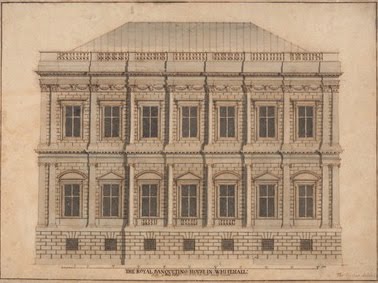
Thomas Forster (ca. 1677-after 1712, British), Banqueting House, Whitehall, undated, pen and brown ink, graphite, gray wash, heightened with white on medium, slightly textured, beige wove paper, sheet: 10 3/8 x 14 in. (26.4 x 35.6 cm),
Yale Center for British Art, Paul Mellon Collection
Photograph: Yale Center for British Art

The segment devoted to British Art in the 1630s is one of my favorites. Here drawings, paintings, books and prints focus on the work, artists and history associated with the Banqueting House at Whitehall. This edifice was part of the royal palace complex designed in 1622 by Indigo Jones for the Stuart monarch James I. It was the first building in England using classical vocabulary and ushered in the modern Italian Renaissance style of architecture.

Attributed to Inigo Jones (1573-1652, British), A Plumed Saddle-Horse, ca. 1640,
pen and brown ink on medium, slightly textured, cream laid paper,
sheet: 5 5/8 x 5 in. (14.3 x 12.7 cm),
Yale Center for British Art, Paul Mellon Collection
Photograph: Yale Center for British Art
t
Inigo Jones (1573-1652, British), Design for a Temporary Arch Ornamented with Putti and Allegorical Figures of Music and War, ca. 1622,
pen and brown ink and brown wash; verso: graphite on medium, slightly textured, cream laid paper, sheet: 9 1/2 x 6 3/4 inches (24.1 x 17.1 cm),
Yale Center for British Art, Paul Mellon Collection
Photograph: Yale Center for British Art

Royal ceremonies, receptions and entertainments called masques that combined theatre, music, dancing, elaborate scenery and costumes took place at the Banqueting House. Stage sets and other elements for these festivities were often devised by prominent architects like Jones.

James I was succeeded by his son Charles I who commissioned the Flemish artist Peter Paul Rubens to paint the Banqueting House’s ceiling glorifying his father and the Stuart reign.

Simon Gribelin (1662-1733, French, active in Britain), after Sir Peter Paul Rubens (1577-1640, Flemish), From the Painting of the Ceiling in the Banqueting House at White-Hall in the Year 1720, ca. 1720, line engraving on medium, slightly textured, cream laid paper,
3 sheets pasted together,
sheet (cropped inside plate): 37 3/4 x 18 1/2 in. (95.9 x 47 cm),
image: 36 3/8 x 18 1/8 in. (92.4 x 46 cm),
Yale Center for British Art, Paul Mellon Collection
Photograph: Yale Center for British Art

The king wanted Rubens to stay and work for him but the painter went back home to Antwerp. He left his pupil Anthony van Dyck to satisfy the monarch’s plans. Van Dyck thereafter became principal court painter. In 1649, Banqueting House was also the scene of Charles I’s execution. The king probably walked through one of the hall’s windows onto a platform erected on the building’s north end for his beheading. The building is the only structure remaining of the old palace.

Historical events, artworks, architecture, artists, architects, printmakers, spectacles, societal events, patronage and the role and status of artists are some of the subjects considered in this area. The artifacts on display pack a wallop of mental activity.

Josiah Wedgwood (1730-1795, British) and Thomas Bentley (1731-1780, British) after George Stubbs (1724-1806, British), Horse Frightened by a Lion (Episode A),
modelled 1780, solid blue jasper with white relief, shallow oval,
frame: 14 5/8 x 14 1/4 in. (37.1 x 36.2 cm),
image (oval): 10 x 16 in. (25.4 x 40.6 cm),
Yale Center for British Art, Paul Mellon Collection
Photograph: Yale Center for British Art

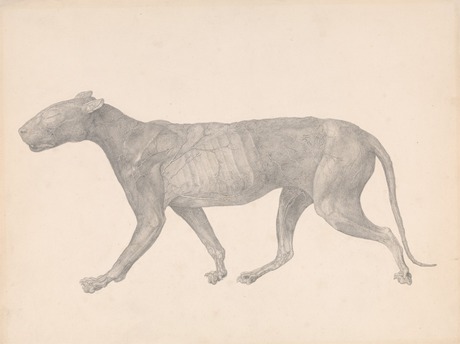
The section on George Stubbs also enthralls making apparent the scope of this artist’s achievements. There is much of merit to take in but of special note is a Wedgwood relief, enamel paintings and rarely exhibited human figure and animal drawings.

George Stubbs (1724-1806, British), A Comparative Anatomical Exposition of the Structure of the Human Body with that of a Tiger and a Common Fowl: Human Figure, Lateral View, Undissected (Finished Study for Table VIII),
between 1795 and 1806, graphite on moderately thick, slightly textured, cream wove paper,
sheet: 21 1/4 x 16 in. (54 x 40.6 cm),
Yale Center for British Art, Paul Mellon Collection
Photograph: Yale Center for British Art

George Stubbs (1724-1806, British), A Comparative Anatomical Exposition of the Structure of the Human Body with that of a Tiger and a Common Fowl: Tiger, Lateral View, with Skin and Tissue Removed (Finished Study for Table IX),
between 1795 and 1806, graphite on moderately thick, slightly textured, cream wove paper, 
sheet: 16 x 21 1/4 in. (40.6 x 54 cm),
Yale Center for British Art, Paul Mellon Collection
Photograph: Yale Center for British Art

George Stubbs (1724-1806, British), A Comparative Anatomical Exposition of the Structure of the Human Body with that of a Tiger and a Common Fowl: Fowl, Lateral View with Most Feathers Removed (Finished Study for Table X), between 1795 and 1806, graphite on moderately thick, slightly textured, cream wove paper, with a strip of same wove paper joined to bottom edge,
sheet: 22 1/4 x 16 in. (56.5 x 40.6 cm),
Yale Center for British Art, Paul Mellon Collection
Photograph: Yale Center for British Art

In the gallery devoted to Thomas Gainsborough, the artist came alive as I read the letter he wrote to his friend William Jackson, composer, essayist and organist of Exeter Cathedral (letter, 1773 Jan. 29, Rare Books and Manuscripts Collection). In his clear script, the artist precisely discloses his methodology for making chalk drawings look like oil paintings. His words make evident the two men’s close friendship. Also on view is a beautiful portrait of a young women. She has been called the "Mona Lisa of British Art" because of her smile and expression.

Thomas Gainsborough (1727-1788, British), Portrait of a Woman, ca. 1750,
oil on canvas, 29 7/8 x 26 1/4 inches (75.9 x 66.7 cm)
Yale Center for British Art, Paul Mellon Collection
Photograph: Yale Center for British Art

The last two rooms introduces visitors to the Seven & Five Society, an early twentieth-century art group whose artist members sought to combine modernity with Britishness. As the Society evolved, the group’s intention became experimental and abstract. Among the members were Henry Moore, John Piper, Ben Nicholson and Barbara Hepworth. Examples of their work are installed admirably for easy comparison.

Although the show may lack what is considered great masterpieces, it offers much that educates and delights. For those who can not make it to New Haven, go to the Center’s “user friendly” website and experiment with their online catalogue. There are many options to begin searches, various ways to narrow and refine results, mix filters or widen inquires. The database is a work in progress. Advance capabilities lie ahead


May 20, 2011–September 11, 2011
1080 Chapel Street
New Haven, Connecticut
Tuesday – Saturday, 10 am to 5 pm
Sunday, noon to 5 pm
Closed Mondays and holidays

Sunday, August 28, 2011

The Amazing Popularity of Alexander McQueen


Alexander McQueen (British, 1969–2010), Dress, Voss, spring/summer 2001,
Razor-clam shells stripped and varnished
Courtesy of Alexander McQueen
Photograph © Sølve Sundsbø / Art + Commerce

The Metropolitan Museum of Art’s Costume Institute exhibition, “Alexander McQueen: Savage Beauty”, was the eighth most popular exhibit in the Met’s 141-year-old history and the Costume Institute’s most attended. Its closing date was extended twice, special fee viewing hours were established on Mondays when the museum is usually closed and, for the first time, the Met remained open until midnight on the show’s last two days.


Alexander McQueen (British, 1969–2010), House of Givenchy Haute Couture
,
Ensemble, Eclect Dissect, autumn/winter 1997–98,

Dress of black leather; collar of red pheasant feathers and resin vulture skulls; gloves of black leather
Courtesy of Givenchy Haute Couture

Photograph © Sølve Sundsbø / Art + Commerce

From the public opening on May 4 to its closing on August 7, some 661,509 visitors swarmed the show. There were long lines with many waiting more than 5 hours to see the display - more reminiscent of a rock concert than a museum visit. I would venture that a good percentage of visitors had never heard of the designer until the April royal wedding of Prince William to Kate Middleton. Kate’s wedding gown and shoes were designed by the creative director of Alexander McQueen, Sarah Burton and her team. Ms. Burton had worked side by side with the designer for 14 years. Possibly, Alexander McQueen’s suicide last year at the age of 40 aroused the curiosity of some attendees. He hanged himself in the wardrobe of his tony Mayfair apartment after taking a significant amount of drugs and slashing his wrists.  Regardless, the people came in unexpected numbers and the museum made money surely needed. One estimate is that the Met made a minimum of $14.6 million in revenue (see Jenna Sauers, How Much Did The Met Make Off The Alexander McQueen Show, Jezebel, August 9, 2011).

The fashion conscious obviously knew about the designer. McQueen had married the rigors of classic tailoring with the playfulness of couture dressing using unconventional material. His couture expressed a blend of contrary concepts such light and dark, nature and technology, life and death, beautiful and grotesque. He won the coveted British Designer of the Year award four times; was named the Council of Fashion Designers’ International Designer of the Year in 2003; and, was honored as a BCE, Commander of the Order of the British Empire.


Alexander McQueen (British, 1969–2010), Dress, No. 13, spring/summer 1999,

White cotton muslin spray-painted black and yellow with underskirt of white synthetic tulle

Courtesy of Alexander McQueen

Photograph © Sølve Sundsbø / Art + Commerce

McQueen’s catwalk presentations were frequently off-putting yet mesmerizing. Comparable to theatre or performance art, his shows were compelling. McQueen had said (Harper’s Bazaar, US, April 2007), “I find beauty in the grotesque, like most artists.  I have to force people to look at things.”  He did.

In one presentation, two commercial robots firing black and yellow paint at a model’s voluminous white dress as she spun slowly in circles on a turntable attempting to protect herself from the robots’ shots in apparent fright (spring/summer 1999). In another, mussed up, distraught-looking models, many with breasts and bottoms exposed, teetered down the runway in torn garments (autumn/winter 1995-1996). One show had a model’s elbows and knees constrained by manacles crippling her catwalk (spring/summer 1997). Once he ended a presentation with a model surrounded by a ring of fire (fall/winter 1998).  At an earlier show, he had his models thoroughly soaked in a shower of golden rain (spring/summer 1998). 


Alexander McQueen (British, 1969–2010), Runway Show,
Untitled, spring/summer 1998
Photo source tumblr
Video source YouTube

Go to  http://blog.metmuseum.org/alexandermcqueen/video/  for highlights from some of McQueen's 1997-2010 runway shows.

The “Alexander McQueen: Savage Beauty” exhibit captured McQueen’s sense of the theatrical. Andrew Bolton, a curator of the Met’s Costume Institute, worked with Sam Gainsbury and Joseph Bennett, production designers for Alexander McQueen’s fashion shows, to curate the extravaganza. They installed 100 garments and 70 accessories in a variety of settings using dramatic lighting, holographic, film and video visuals, music and sounds. Most of the garments were from the Alexander McQueen Archive in London but some were privately lent. The show was organized around the theme of McQueen’s romantic mind. Wall surfaces were differentiated to reflect an aspect of his romanticism. For example, the “Romantic Gothic” gallery, which referred to the designer’s focus on Victorian gothic, was lined with aged mirrors.


“Alexander McQueen: Savage Beauty” Gallery View, Romantic Nationalism, 
The Metropolitan Museum of Art, 2011
Photo: The Photograph Studio, The Metropolitan Museum of Art

The space for “Romantic Nationalism”, McQueen’s take on his Scottish and British heritage, used marquetry as a background.


“Alexander McQueen: Savage Beauty” Gallery View, Romantic Exoticism,
The Metropolitan Museum of Art, 2011
Photo: The Photograph Studio, The Metropolitan Museum of Art

The “Romantic Exoticism” space, which held clothes influenced by other cultures, evoked a music box with rotating mannequins in bright mirrored vitrines.  “Romantic Primitivism” gallery, which related to McQueen’s take on the noble savage, used rusty metal enclosures and inspired thoughts of a sunken ship. Enhancing this effect was an overhead film projection of a young model sinking into deep water, her limbs entangled in seaweed-like chiffon. “Romantic Naturalism” room, containing designs derived from nature’s forms and materials, was covered in wall paper based on a blow-up of a McQueen drawing.


“Alexander McQueen: Savage Beauty” Gallery View, Cabinet of Curiosities,
The Metropolitan Museum of Art, 2011
Photo: The Photograph Studio, The Metropolitan Museum of Art

In the “Cabinet of Curiosities” gallery, meant to emulate 18th and 19th-century collector cabinets filled with a variety of objects, an assortment of wall mounts housed accessories - shoes, headdresses and jewelry. Monitors placed up high presented an on-going loop of past McQueen runway shows. The holographic projection of the model Kate Moss (fall/winter 1996) was seen in a smaller room.


Kate Moss Hologram, from “Alexander McQueen:  Savage Beauty”, 
The Metropolitan Museum of Art, 2011
Video source YouTube

Nearby was a variation of the gown Moss wore, a gorgeous garment made up of hundreds of layers of raw-edged silk organza.  People struggled to see the hologram but no one took notice of the actual gown. The final room of the exhibition, covered in acrylic tiles like a clinical lab, held some of the designer’s last creations.


Alexander McQueen (British, 1969–2010),
“Jellyfish” Ensemble, Plato’s Atlantis, spring/summer 2010,
 
Dress, leggings, and “Armadillo” boots embroidered with iridescent enamel paillettes

Courtesy of Alexander McQueen

Photograph © Sølve Sundsbø / Art + Commerce

I commend Bolton and his team for their inventive display. This was museum experience as spectacular entertainment with the feel of a funhouse or carnival. Although it had much appeal as the attendance figures affirm, an important learning opportunity was missed. There was no probing under the surface of the show. I would have liked to see McQueen’s designs put in a social, cultural or art historical contact with expertise from a costume or textile specialist. This viewer wanted to know more and, in many instances, found it difficult to even find or read the show’s descriptive labels.

I am perfectly aware of the need to rethink the traditional museum exhibition (see ArtWithHillary, The Spectacular Design of The Red and White Quilt Show, April 15, 2011) but this must be accomplished without a loss of meaning and critical thought.

I have similar issues with the museum’s exhibition catalogue. The book juxtaposes McQueen quotes printed in large type with fashion photographs. To find details or references about the clothing, citations and notes, readers must turn to the end pages. This is not an easy task due to the book’s heft, proportions as well as font pattern, typeface size and ink color. Although the catalogue includes a preface by Andrew Bolton explicating the exhibition’s premise and execution, an introductory biographic essay by Susannah Frankel, fashion editor for The Independent and an interview with Sarah Burton by the fashion writer Tim Blanks, it is basically a picture book . This was no scholarly tome.

The fashion photographer Sølve Sundsbø, known for his digital altered prints, was responsible for the imagery. Live models were made to look like inanimate mannequins by painting their skin white, articulating their joints with string, and removing their heads from the final shot. Many photographs had imaginative cropping but this reader could not help but wish for a more straight forward presentation.

Eyebrows have been raised about the cozy relationships between donors and exhibits since the Guggenheim Museum held a Giorgio Armani show in 2000 after a major contribution by the designer. Alexander McQueen supplied the major funding for the Met’s exhibition. Keeping this in mind, such endeavors are still worthwhile if done with good judgement. Since fashion has been recognized as art which warrants major museums’ attention, criteria on par with other curatorial undertakings should be applied. Put dress in the context of history, culture and other disciplines. Look inside, outside and beyond the clothes. Treat fashion as any other artistic masterwork. Meanwhile, the definitive Alexander McQueen exhibit and study has yet to be done.


The Metropolitan Museum of Art, Friday, August 5, 2011, 
Photo by Ramsay de Give for The Wall Street Journal

Saturday, July 23, 2011

A Radiant Masterpiece Reveals More: Part 2

Giovanni Bellini, Detail of St. Francis in the Desert, c. 1480,
oil on poplar panel, 49 x 55 7⁄8 in. (124.5 x 141.9 cm),
The Frick Collection, New York
Photo: Michael Bodycomb

The following is a continuation of the June blog post, A Radiant Masterpiece Reveals More - Part 1. The discourse considers The Frick Collection’s St. Francis in the Desert by Giovanni Bellini and the discoveries made last year during the painting’s five week technical analysis at the Conservation Center of The Metropolitan Museum of Art. This is also the subject of The Frick’s present exhibition, In a New Light: Bellini's St. Francis in the Desert.

Giovanni Bellini, St. Francis in the Desert, c. 1480,
oil on poplar panel, 49 x 55 7⁄8 in. (124.5 x 141.9 cm),
The Frick Collection, New York
Photo: Michael Bodycomb

Although the recent examination of Giovanni Bellini’s St. Francis in the Desert disclosed much that was new, the painting still remains an enigma. The study confirmed that the panel was in excellent condition and needed only surface cleaning to remove dust. Through infrared reflectography, it revealed Bellini’s previously concealed underdrawing. Since very few drawings, preparatory or otherwise, can be attributed to the artist, the uncovering of such designs is particularly important. Comparison between the underdrawing and painting that hid it, makes apparent the small as well as the noteworthy changes Bellini made to achieve the work’s final realization.

Giovanni Bellini, Infrared reflectogram detail of St. Francis in the Desert,
c. 1480, oil on poplar panel, 49 x 55 7⁄8 in. (124.5 x 141.9 cm),
The Frick Collection, New York,
Technical photography by Department of Paintings Conservation,
The Metropolitan Museum of Art Image © The Metropolitan Museum of Art

We see that at times the artist’s painted layers followed closely what was drawn such as in the rendering of the saint’s head and face. Mouth open, eyes searching upward, Francis expresses awe, surprise, ecstasy or a combination of these. For the drawing, the artist employed a variety of brushstrokes to create remarkable three-dimensionality. Thick or fine lines describe contours; hatching is used for modeling; and, a combination of hatching and crosshatching situate items in space. In some areas of the panel, Bellini made minor modifications as seen in the elimination of a door or chimney on a background edifice. In other instances, refinements made aesthetic sense such as the widening of the saint’s right sleeve.

Giovanni Bellini, Infrared reflectogram detail of St. Francis in the Desert,
c. 1480, oil on poplar panel, 49 x 55 7⁄8 in. (124.5 x 141.9 cm),
The Frick Collection, New York,
Technical photography by Department of Paintings Conservation,
The Metropolitan Museum of Art Image © The Metropolitan Museum of Art

Giovanni Bellini, Detail of St. Francis in the Desert, c. 1480,
oil on poplar panel, 49 x 55 7⁄8 in. (124.5 x 141.9 cm),
The Frick Collection, New York
Photo: Michael Bodycomb

At times the artist choose to redesign more. He transformed the background footbridge from a simple post-and-lintel type of construction which extended to the right bank into a more complex arch and vault bridge system that ended behind the shore edge. Moreover, during painting, Bellini added a back flat shelf to the slanting reading surface of the saint’s desk. On this he painted a cross with a crown of thorns and a skull.

The painting shows the moments after Francis was interrupted from his contemplation of the Passion of Christ - the final hours of Jesus’ life according to the New Testament. There is a bookmark to indicate the page where he stopped reading. His sandals are left in the enclosure when he hurriedly stepped outside on ground that may be perceived as holy. It is dawn and all is still. The lighting, more theatrical than real, is twofold - natural and sacred. The heavenly rays fall from the upper left of the sky onto Francis. The temporal morning light shines on the middle and far ground. In the distance, a shepherd and his flock look toward the saint as if to see what is happening.

Giovanni Bellini, Detail of St. Francis in the Desert, c. 1480,
oil on poplar panel, 49 x 55 7⁄8 in. (124.5 x 141.9 cm),
The Frick Collection, New York
Photo: ARTstor

A rabbit in the foreground comes out of his dark burrow to peer at the saint and the source of the supernatural beams. The painting is filled with flora and fauna. All are identifiable attesting to Bellini’s keen observation of the world. In fact, a botanist was brought to see the work and was able to describe each plant portrayed.

From the swaying, tall laurel tree on the left to the the small kingfisher bird under the water spout at the lower right, everything has meaning. The grapevine over the saint’s shelter evokes Christ as “the true vine” according to the Gospel of John 15. The laurel, whose leaves remain green all year, symbolizes triumph, eternity and the resurrection of Christ. The shepherd’s ram, as a leader of the herd, is another reference to Christ. The rabbit who needs protection alludes to those who hope for salvation through Christ in addition to denoting fertility and lust. The kingfisher, long a good omen, is associated with peace and prosperity. Even the spout protruding from the rocks is linked to the fountain of Muses in Greek mythology and thought to be a symbolic representation of imagination - as water flows through a spigot, imagination passes through the mind. Not incidentally, Bellini paints this detail not far from his signature.

Giovanni Bellini, Detail of St. Francis in the Desert, c. 1480,
oil on poplar panel, 49 x 55 7⁄8 in. (124.5 x 141.9 cm),
The Frick Collection, New York
Photo: ARTstor

This brings to mind the meaning of the rabbit placed quite close to the saint’s right hand. Tucked into the cord around Francis’ waist is what looks like a folded piece of paper or parchment. It has been postulated that this is a depiction of the piece of parchment,(the original now kept as a relic in the Church of St. Francis at Assisi), on which Francis wrote a hymn to God as well as a benediction to Brother Leo. Along with the writing, the saint drew on it a cross and skull, similar to the cross and skull on the cloister desk. Legend has it that Francis told Leo to keep the parchment as protection against temptation. Could it be used to prevent the lure of concupiscence symbolized by the nearby rabbit? Bellini was a meticulous thinker and planner, what he put in a painting has signification.

As noted earlier, theories and interpretations about the painting are numerous. Some hold it was created for a church; others maintain it was made for a private patron. One hypothesis proposes the lighting in the painting echoes the natural light entering the church or chapel of its intended location. Others have posited the work relates to the Renaissance argument concerning the merits of painting versus poetry - which of the arts can best reproduce reality and express emotion. The work has been connected to Italian pastoral or popular devotional poetry. There is even the opinion that the saint is singing! The abundance of explications can lead to confusion. For me, the strongest argument comes from scholars who interpret the painting as a devotional image, conceived for religious contemplation. It facilitates mediation, stimulates conversation and, encourages the exchange of ideas. I regard it not as descriptive of a specific narrative but as an open-ended, thought-inspiring work. Regardless of explanations, Bellini’s visual creativity never wanes. Take the small, golden tassel protruding from the bottom pages of the saint’s closed book or the tiny, exquisite knot on the string attached to the cloister’s bell made surely to ease the saint’s grip when he rang the bell to signal the canonical hours. These captivating depictions are nearly impossible to see in reproductions. They require and reward attentive viewing of the actual painting. To look this way, makes perceptible passages of delight.

Gerard David, The Disposition, c. 1495-1500,
oil on linen (mounted on mahogany panel),
56 1/8 x 44 1/4 in. (142.5 x 112.4 cm),
The Frick Collection, New York
Photo: ARTstor

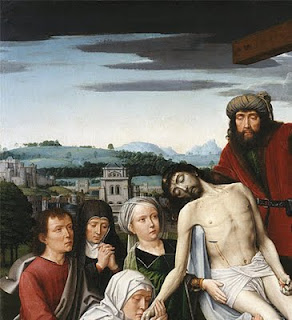
Let us return to the Living Hall and the space the St. Francis usually occupies. In its place is The Disposition by the Netherlandish painter, Gerard David (c. 1460-1523). The scene is Christ’s removal from the cross after His death. Joseph of Arimathea, who received permission to remove the body, is seen with Christ’s other followers along with the Virgin Mary, St. John the Evangelist and Mary Magdalene. The work was acquired by Frick the same year, in the same lot and from same collector as Bellini’s St. Francis.

Gerard David, Detail of The Disposition, c. 1495-1500,
oil on linen (mounted on mahogany panel),
56 1/8 x 44 1/4 in. (142.5 x 112.4 cm),
The Frick Collection, New York
Photo: ARTstor

Gerard David, Detail of The Disposition, c. 1495-1500,
oil on linen (mounted on mahogany panel),
56 1/8 x 44 1/4 in. (142.5 x 112.4 cm),
The Frick Collection, New York
Photo: ARTstor

Although The Disposition was painted about a century after the St. Francis, like the earlier work, the background contains a careful and precise naturalistic townscape with a variety of finely delineated structures. There are castles, towers, fortified walls, a church and windmill. Frick is known to have had a predilection for landscape paintings and this may account for his attraction to the work. Furthermore, there is a prominent skull at the foot of the cross. Although the skull denotes Calvary, the site of the Crucifixion, it has also long been a symbol of the transitory nature of earthly life, a reminder of mortality. Perhaps, in his late sixties, Frick had thoughts of his own end. Whatever the reasons for the purchase, we are lucky to have the David and, of course, the Bellini in New York for us to enjoy.

Note: The Frick has opened a Multimedia Room off to one side of the Garden Court where visitors may view videos on specific aspects of Bellini’s St. Francis in the Desert and look closely at the infrared photograph of the work’s underdrawing. The videos and related lectures are accessible on the museum’s Web site along with a link to the painting's Google Art Project gigapixal image. Susannah Rutherglen, The Frick's Andrew W. Mellon Curatorial Fellow, is responsible for the coordination of this extraordinary exhibit and deserves much acclaim.

In a New Light: Bellini's St. Francis in the Desert
May 22, 2011, through August 28, 2011
1 East 70th Street, Manhattan

Tuesday through Saturday, 10:00 a.m. to 6:00 p.m.
Sundays, 11:00 a.m. to 5:00 p.m.
Closed Mondays and holidays