Friday, November 29, 2019

A Celebratory Union in Life and Art

Helen Frankenthaler (1928 - 2011), Black with Shadows, 1961,
0il on canvas, 76 x 87 in. (193 x 221 cm)
David Shuman Collection, courtesy of Yares Art
Courtesy Mnuchin Gallery, New York


Good marriages bring together each partner's strengths and enrich their lives.  The joint experience may create a mutual influence that could continue even after the marriage dissolves.  These ideas are brought out in the exhibition The Art of Marriage: Helen Frankenthal & Robert Motherwell at the Mnuchin Gallery, New York.   

The artists met in 1956.  Motherwell was almost 43, married with two children.  Frankenthaler was 28 and single.  A serious relationship did not begin until a year later after Motherwell's marriage had ended. Motherwell and Frankenthaler were respected artists with their own distinctive way of making art.  He was well-known, the youngest member of the First Generation of Abstract Expressionists.  She, from a younger generation, was already recognized as a talented newcomer, represented by a gallery and a work acquired by the Museum of Modern Art.  They married in April, 1958. They became a golden couple with a cross-section of cultural luminaries as friends.  Their New York townhouse dinners with fine food, wine and diverse company were noteworthy.  Their marriage ended in 1971.


Robert Motherwell (1915 - 1991), Afternoon in Barcelona1958, 
acrylic and oil on canvas, 54 x 73 in. (137.2 x 185.4 cm)
New York Gift of Robert and Jane Meyerhoff 79.35
Photo: Tom Powel Imaging 
Courtesy Mnuchin Gallery, New York


The pair had come from similar affluent backgrounds. He was the son of the president of Wells Fargo Bank and she was the daughter of a New York State Supreme Court Judge.  The two were highly educated, well-traveled and exceedingly knowledgeable in the history of art. Both were focused on expressing emotions through art.  They were not interested in representing that which could be seen but they were rather interested in representing instinctive feelings.  They achieved their common pursuit in different ways.  


Helen Frankenthaler (1928 - 2011), Pompei, 1965,
acrylic on canvas, 58 x 80 in. (147.3 x 203.2 cm)
Private Collection
On view in the exhibition The Art of Marriage:  Helen Frankenthaler & Robert Motherwell,
October 30, 2019 - December 14, 2019, Mnuchin Gallery, New York
Courtesy Mnuchin Gallery, New York

Motherwell worked in a gestural style, typically using a limited palette of earth tones and black.  Frankenthaler  with the whole range of colors, staining and soaking raw canvases with a variety of hues. Motherwell's forms were bold with verticals and ovals used extensively while Frankenthaler's approach was softer, open and lyrical. Motherwell worked in series with  innumerable permutations to motifs while maintaining the work's basic composition. Frankenthaler responded to individual experiences, a place or light for example.  If it appears that she has related works it is only that she kept on responding to a particular idea until she felt it was treated thoroughly. Frankenthaler never intended to repeat in variation a motif again and again.  Motherwell excelled in collage; she used the medium only briefly. 


Robert Motherwell (1915 - 1991), Beside the Sea, with Black and White1962, 
oil and pasted paper on Strathmore paper,  29 x 23 in. (73.7 x 58.4 cm)
Private Collection
On view in the exhibition The Art of Marriage:  Helen Frankenthaler & Robert Motherwell,
October 30, 2019 - December 14, 2019, Mnuchin Gallery, New York
Photo: Tom Powel Imaging 
Courtesy Mnuchin Gallery, New York

It is uncertain to what extent these two strongly individualistic artists affected each other.  It may be said after their marriage, Motherwell's work became cheerful.  His strokes appeared more energetic and looser.  His colors broadened with the use of bright hues and tones. His 1959 oil and charcoal on canvas California is a good illustration of this. Frankenthaler's painting became less transparent, denser with expanses of solid color.  She incorporated hues associated with her husband specifically ochre and black.  Take a look at her 1961 oil on canvas Black with Shadows.  As mentioned, she explored the medium of collage after the marriage perhaps because of her husband's interest. The exhibit presents some half dozen Motherwell collages and five by Frankenthaler.  The group makes for informative comparisons. Noteworthy is Frankthaler's large collage, approximately  7 x 3 1/2 feet, New Year Greeting, December 1959,  which the artist made after the couple returned from Europe.  It is on loan from a private collection as are most of the show's works - a compelling reason to see the exhibit before these pieces are returned.  


Installation view, The Art of Marriage:  Helen Frankenthaler & Robert Motherwell,
October 30, 2019 - December 14, 2019, Mnuchin Gallery, New York
l to r,  Helen Frankenthaler (1928 - 2011), Courtyard of El Greco's House1959, 
oil on canvas, 45 3/4 × 60 1/2 in. (116.2 × 153.7 cm) 
Private Collection of Meredith and Cornelia Long
Helen Frankenthaler (1928 - 2011), Avebury, 1972, 
acrylic on canvas, 54 7/8 × 80 in. (139.4 × 203.2 cm)
Private Collection, St. Louis 
Photo:  Mnuchin Gallery Web site

An added bonus of the exhibition are peripheral themes that arise such as Frankenthaler's use of oil versus acrylic paint on canvas.  


Detail of Helen Frankenthaler (1928 - 2011), Courtyard of El Greco's House1959, 
oil on canvas, 45 3/4 × 60 1/2 in. (116.2 × 153.7 cm) 
Private Collection of Meredith and Cornelia Long
On view in the exhibition The Art of Marriage:  Helen Frankenthaler & Robert Motherwell,
October 30, 2019 - December 14, 2019, Mnuchin Gallery, New York
Photo:  Hillary Ganton

Some words about these mediums:  oil paint is slow drying and corrosive because of the oil utilized as binder and should be used on a prepared support, such as a primed canvas. Acrylic dries quickly, can be employed to achieve color transparencies and a watercolor semblance.  Acrylics can be easily thinned using water which seeps and spreads into the raw canvas. Acrylic maintains its color; oil paint yellows over time.


Detail view of Helen Frankenthaler (1928 - 2011),  Avebury, 1972, 
acrylic on canvas, 54 7/8 × 80 in. (139.4 × 203.2 cm)
Private Collection, St. Louis
On view in the exhibition The Art of Marriage:  Helen Frankenthaler & Robert Motherwell,
October 30, 2019 - December 14, 2019, Mnuchin Gallery, New York
Photo:  Hillary Ganton

Acrylic became Frankenthaler's medium of choice. A close inspection of Frankenthaler's 1959 oil Courtyard of El Greco's House and her 1972 acrylic Avebury illustrates the end results of using these two different paints on raw  canvas supports. 

Motherwell's admiration for Henri Matisse (1869 - 1954), who he said was his favorite painter, is evident in several of the show's pieces. His 1969 oil and charcoal, Open No. 93:  In Medium Ultramarine Blue with Charcoal Line brings to mind Matisse's 1914 View of Notre Dame in New York's Museum of Modern Art (MoMA).  Frankenthaler recounted Motherwell claimed the chalky blue hue as his own. Matisse's 1952 works, the cut-outs and lithograph series Blue Nudes and The Swimming Pool cut-outs, as well as the surreal bathers of Pablo Picasso (1881 - 1973) could be the ancestors of the figurative form in Motherwell's 1962 Summertime in Italy, No. 28.  Motherwell's powerful red dominated The Studio of 1987 hawks back to the bright hues of Frankenthaler in addition to Matisse's  1911 The Red Studio. The latter and The Swimming Pool are also in MoMA.  The Studio was finished some 16 years after the artists' divorce. A case can be made that it shows the long lived interconnection of the two painters.   

Installation view, The Art of Marriage:  Helen Frankenthaler & Robert Motherwell,
October 30, 2019 - December 14, 2019, Mnuchin Gallery, New York
l to r, Helen Frankenthaler (1928 - 2011), Blue Reach, 1978,
 acrylic on canvas,  71 × 177 1/2 in. (180.3 × 450.9 cm)
Private Collection
Robert Motherwell (1915 - 1991), The Studio, 1987,
arylic and charcoal on canvas, 60 × 72 in. (152.4 × 182.9 cm)
Private Collection
Photo: Tom Powel Imaging 
Courtesy Mnuchin Gallery, New York

Frankenthaler's 1978 Blue Reach seems to acknowledge Motherwell by using his "claimed" blue and wide forceful areas of color.  The Studio and Blue Reach, installed adjacent to each other, form a touching ending to an exhibit which explores the period Frankenthaler and Motherwell spent together as wife and husband.  The union had ended but the aftereffects continued.  

The Art of Marriage
Helen Frankenthaler & Robert Motherwell
October 30, 2019 - December 14, 2019
45 East 78th Street, Manhattan
Gallery Hours:
Tuesday through Saturday, 10:00 a.m. to 6:00 p.m.

Thursday, October 24, 2019

Color and Emotion Define an Artist and an Age

Ernst Ludwig Kirchner (1880-1938), Berlin Street Scene, 1913-14,
oil on canvas,  47 5⁄8 x 37 3⁄8 in. (121 x 95 cm)
Neue Galerie New York and Private Collection
Courtesy of Neue Galerie New York


If an artist's work and life could encapsulate a period, the artist would be Ernst Ludwig Kirchner (1880 - 1938).  This is best presented in the exhibition Ernst Ludwig Kirchner  at the Neue Galerie New York. Over 90 paintings, works on paper, sketchbooks, photographs, tapestries and a sculpture are organized into five sections. The first four cover major periods in the artist's life.  These are Dresden (1905-11), Berlin (1911-14), the War Years (1914-18) and Davos (1918-38). The fifth section is devoted to the artist's prints.  Kirchner's experiments and originality in woodcuts and monotypes single him out as a master printmaker.  

The Neue Galerie's curators, Jill Lloyd, distinguished Expressionism scholar and Janis Staggs, Director of Curatorial and Manager of Publications for the museum, as well as the exhibition designer Peter de Kimpe, have put together an exemplary survey which is enriched by the use of wall colors related to the artist's palette. 


Ernst Ludwig Kirchner (1880-1938), Street, Berlin, 1913,
oil on canvas,  47 1/2 x 35 7/8 in. (120.6 x 91.1 cm)
Photo:   Museum of Modern Art Website

There are many treats in the show not the least of which is the pairing of the Neue Galerie's Berlin Street Scene to the painting of the same subject from the Museum of Modern Art (MoMA).  The two works have not been seen together since the MoMA's 2008 exhibition Kirchner and the Berlin Street.  The paintings generate more of an emotional response against  the green colored wall at the Neue Galerie than the pale gray background that they had at the MoMA.  The walls in the Neue Galerie exhibit's Berlin room are green and pink which pick up the dominant colors in the two street scene canvases.  The two paintings were separated by the much larger work, Potsdamen Platz in the MoMA's installation.  Here they are hung next to one another which makes for an easy comparison.  

The Berlin street scenes are considered the highlights of the artist's career.  He had moved from Dresden to Berlin in 1911.  At the time, Berlin was the capital and largest city in Germany as well as the third largest city in Europe.  Kirchner set upon recording what it was like to experience living in a metropolis.  The crowded streets illuminated by electric lights fascinated him and were captured in the paintings' compressed, accordion-like composition.  Fashionable prostitutes mingle with top-hatted prospective clients.  Their colorful garb contrasts with dark-suited men.  Streets tilt upward and fan out at the top of the canvas toward the edges.  Figures appear to be streaming down into the viewer's space. 


In the Neue Galerie painting the cigarette smoking man at the right may be a self-portrait because Kirchner portrayed himself often with a cigarette. The man in the foreground with his back to the viewer may be another version of the cigarette smoking man.  The gentleman at the right in the MoMA painting looks down at a lit shop window.  He may be seeing the items for sale or the reflections of the coquettes behind him.  Bold colors abound.  They define Kirchner's work throughout his career.  He was the supreme colorist and called himself “Farbenmensch” (color man) and considered the use of color his art's distinguishing characteristic. Modernity and contemporary life were his focus.  The out-in-the-open prostitutes were just another aspect of the urban environment.  Prostitution was thought of differently from the way we think of it today.  The occupation was not censured. Prostitutes were appreciated and looked upon as liberated women who maintained their independence. 


There are three sketchbooks in the exhibit.  One each placed in the Dresden, Berlin and Davos sections.  
All the sketchbooks have been digitalized allowing visitors to see each and every book page. The electronic versions are displayed next to the actual books.  This makes for a delightful journey of discovery, relating the drawings to the works on view.  Don't miss swiping through them.  

The sketchbook next to the two Berlin street paintings is opened at a drawing of the head of a woman wearing a hat surrounded by cursory drawn figures, Sketchbook 28, Fol. 21. The woman closely resembles the full-lipped strumpet dressed in red in the Neue Galerie's street painting.  The book contains more sketches of figures, streets and buildings.  A series of some 20 drawings connected to the cityscape in the 1912 painting Red Elisabeth Canal Bank (Canal with Bridge), also in the Berlin room, attests to Kirchner's absorption with this scene.   


Ernst Ludwig Kirchner (1880-1938), Tightrope Walk, 1908 - 10,
oil on canvas,  47 1⁄4 x 58 5⁄8 in. (120 x 149 cm)
Courtesy of Neue Galerie New York

In 1901 Kirchner began studying architecture in college but his interest lay in painting.  Around 1903 he was working on his first paintings. He took in what his contemporaries were doing while embracing his artistic inheritance. When looking at Kirchner's work, one can see the effects of Post-impressionist artists such as Paul Cézanne (1839 - 1906), Paul Gauguin (1848 - 1903), Vincent van Gogh (1853 - 1890), 
the Fauvists, especially Henri Matisse (1869 - 1954) and the Norwegian Edvard Munch (1863 - 1944).  Of the older artists, Albrecht Dürer (1471–1528) and Rembrandt van Rijn (1606 - 1669) were his favorites.  Tightrope Walk, an early canvas, illustrates his ability to take from others, transform what he has learned and move ahead  to make something uniquely his own.  


He was co-founder of the artist group Die Brücke (The Bridge), formed in Dresden in 1905.  Kirchner and his fellow group members sought a new morality in painting and in life.  They wanted to break away from middle class social norms, freeing German art from the prevalent academic style and bridging the past - Germany's artistic history - to the future in an expressive form of painting. The group sought to shock viewers into feeling an intense emotion through color and pictorial distortion. Their lives were equally unorthodox advocating open sexual freedom and nudity.  The artists' girlfriends posed as models frequently in the nude.  Depictions of unclothed women convey a frank seductive sensuality.


Ernst Ludwig Kirchner (1880-1938), Standing Girl, Caryatid, 1909 - 10,
carved and painted wood,  17 1⁄8 in. (43.5 cm)
Neue Galerie New York and Private Collection
Courtesy of Neue Galerie New York

Kirchner began to sculpt in wood in 1909.  The only sculpture in the show, Standing Girl, Caryatid, is a study in voluptuous eroticism.  The carving demonstrates Kirchner's appreciation of African art, folk art and Gauguin's work.  He also designed a poster for a Gauguin exhibition in Dresden in 191o. 


The artist felt alienated and alone during his Berlin years.  Die Brücke broke up in 1913.    Discord broke out among nations and was leading up to World War I.  Germany entered into the conflict in August 1914. Afraid of active duty at the front, Kirchner volunteered for the mounted artillery. In September 1915, while in training, Kirchner had a nervous and physical breakdown.  He was admitted to a sanatorium for treatment. This marked the beginning of three years of recovery in and out of sanatoriums.  He sought help for his depression and dependence on alcohol, morphine and sleeping pills.  


Ernst Ludwig Kirchner (1880-1938), White House in Sertig Valley, 1926,
oil on canvas,   35 1⁄4 x 46 3⁄4 in. (89.5 x 111.1 cm)
Gift from the Dina and Alexander E. Racolin Collection 
Photo: Jim Frank
Courtesy of Neue Galerie New York

Kirchner visited Davos, Switzerland, for the first time in 1917.  He remained under medical care there. The air, light and Alpine scenery purportedly had health-inducing qualities. Davos becomes his primary residence for the rest of his life.  

Inspired by the environment, Kirchner painted sublime landscapes, took up the designing of textiles, two of which are in the exhibit, and continued to make prints, carvings and photographs. The latter he had taken up in 1909, the only Expressionist artist to do so.  He never stopped taking pictures and exploring the medium throughout his life. Some of his photographs are reproduced in the exhibit such as his self portrait in uniform and views of his Davos homes.

The artist called his late painting manner, his "tapestry style" where broad areas of color interlaced to create forms.  No doubt this style related to his involvement with tapestry making.  His first collaborated effort took place in 1922.  In total 24 tapestries were produced using his designs.  

Kirchner had become a highly successful artist with numerous exhibits throughout Germany, Switzerland, Europe and the United States. These showcases included the 1913 New York Armory show, the German Pavilion in the 1928 Venice Biennale and the Museum of Modern Art's 1931 German Painting and Sculpture exhibition. Kirchner retrospectives took place, the largest in 1933 in Bern, Switzerland. The Detroit Institute of Arts mounted a solo exhibit of his work in 1937 which then traveled to a gallery in New York. Meanwhile, the political situation worsened in Germany.  The Nazis labeled his art degenerate and removed more than 600 works from German museums.  Over 30 of his compositions were included in the Degenerate Art show held in Munich in 1937. Many of the seized pieces were destroyed.  In the same year the artist was expelled from the prestigious Prussian Academy of Arts.  

In March 1938 Germany annexed Austria and troops were stationed at the Swiss border near Davos.  Apparently the stress of world events was too much for him.  The artist fatally shot himself on June 15, 1938. Kirchner was 58 years old.  His life and art witnessed major upheavals in the socio-political and artistic realms.  

Much appreciation to the Neue Galerie for making the depth and breadth of Kirchner's accomplishments accessible and through them the events of the early twentieth century. 

Ernest Ludwig Kirchner
October 3, 2019 - January 13, 2020
1048 Fifth Avenue (at 86th Street), New York
Hours:
Thursday through Monday, 11:00 a.m. to 6:00 p.m.
Closed Tuesday and Wednesday
First Fridays, 5:00 p.m. to 8:00 p.m.
The museum is open late on the first Friday of each month.

Monday, September 30, 2019

The Polarities of Richard Serra

Installation view of
Richard Serra (1938 - ), Reverse Curve, 2005/19,
corten steel, two plates,
Overall:  13' 1/2" x 99' 9" x 19' 7" (4 x 30.4 x 6 m)
Plates:  2" (5 cm) thick, 
at the exhibition "Reverse Curve," 
Gagosian, 522 West 21st Street, New York, 
September 17, 2019 - February 1, 2020
Photo:  Hillary Ganton     

Richard Serra (1938 - ) has been challenging one's perception of objects in space for over fifty years.  Through his sculpture, this octogenarian addresses questions such as what it means to look left or right or around convexity or concavity. He deals with the properties of the material involving effects of weight and how varying scales of solids displace space differently in the same place.  Methodology and results incorporate contrasts.  The man-made is combined with nature, heaviness is turned into lightness and things appear and disappear. His monumental sculpture has been associated with Minimalism and Process Art.  Serra's work however is unique. Three Gagosian galleries presently offer the opportunity to engage with Serra in the exhibitions Reverse Curve, Forged Rounds and Triptychs and Diptychs.


Installation view of  
Richard Serra (1938 - ), Nine, 2019,
forged steel, nine rounds,
7' x 6' 4 3/4" diam. (213.4 x 194.9 cm)
6' 6" x 6'  7 3/4" diam. (198.1 x 202.6 cm)
6' x 6' 11" diam (182.9 x 210.8 cm)
5' 6" x 7' 2" diam. (167.6 x 218.4 cm)
5' x 7' 7" diam. (152.4 x 231.1 cm) 
4' 6" x 8' diam (137.2 x 243.8 cm)
4' x  8' 6" diam. (121.9 x 259.1 cm)
3' 6 1/2" x 9' diam. (108 x 274.3 cm)
3' 2 1/4" x 9' 6" diam. (97.2 x 289.6 cm)
 at the exhibition "Forged Rounds,"
Gagosian, 555 West 24th Street, New York, 
September 17, 2019 - December 7, 2019
Photo:  Hillary Ganton     

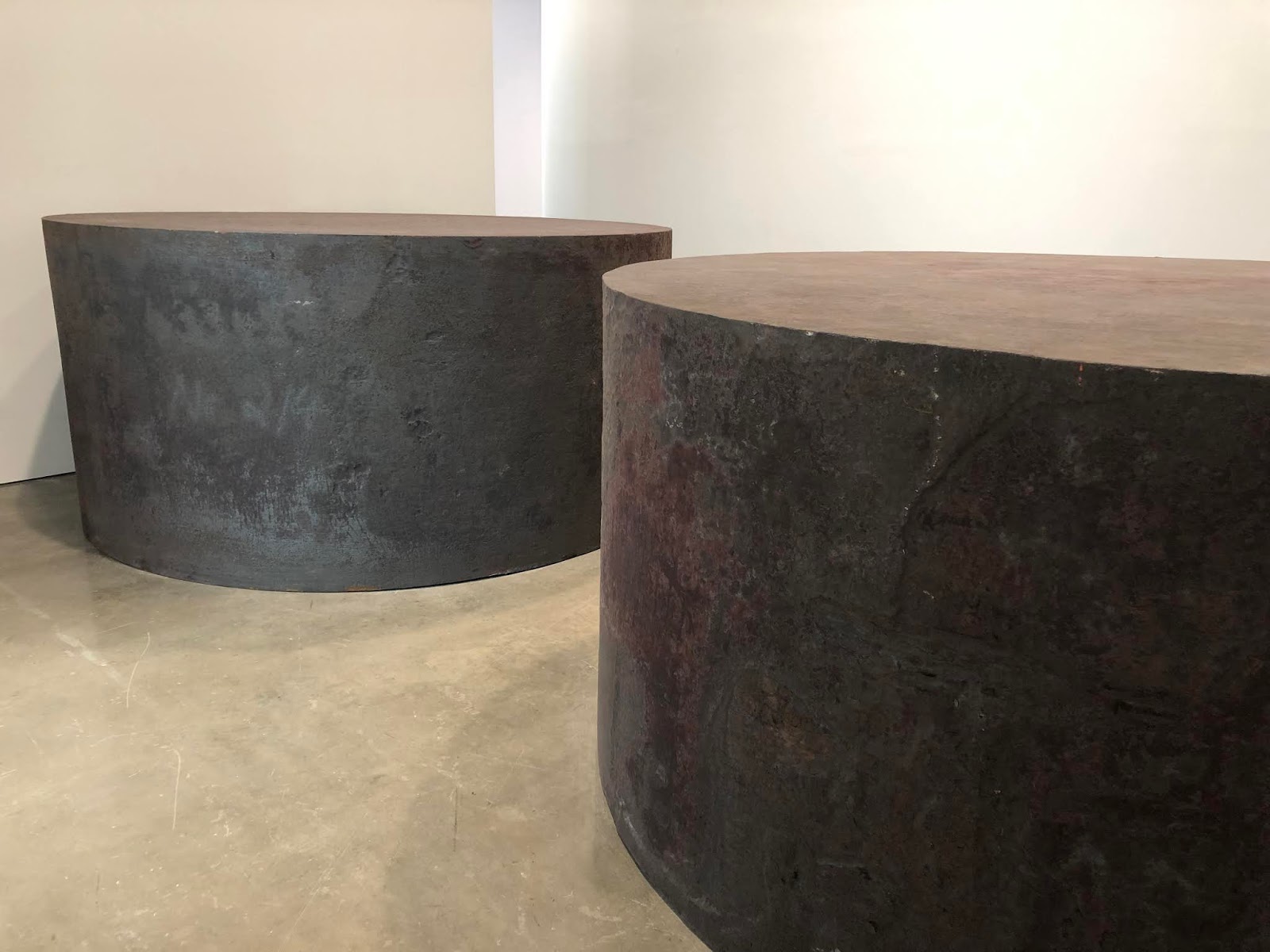
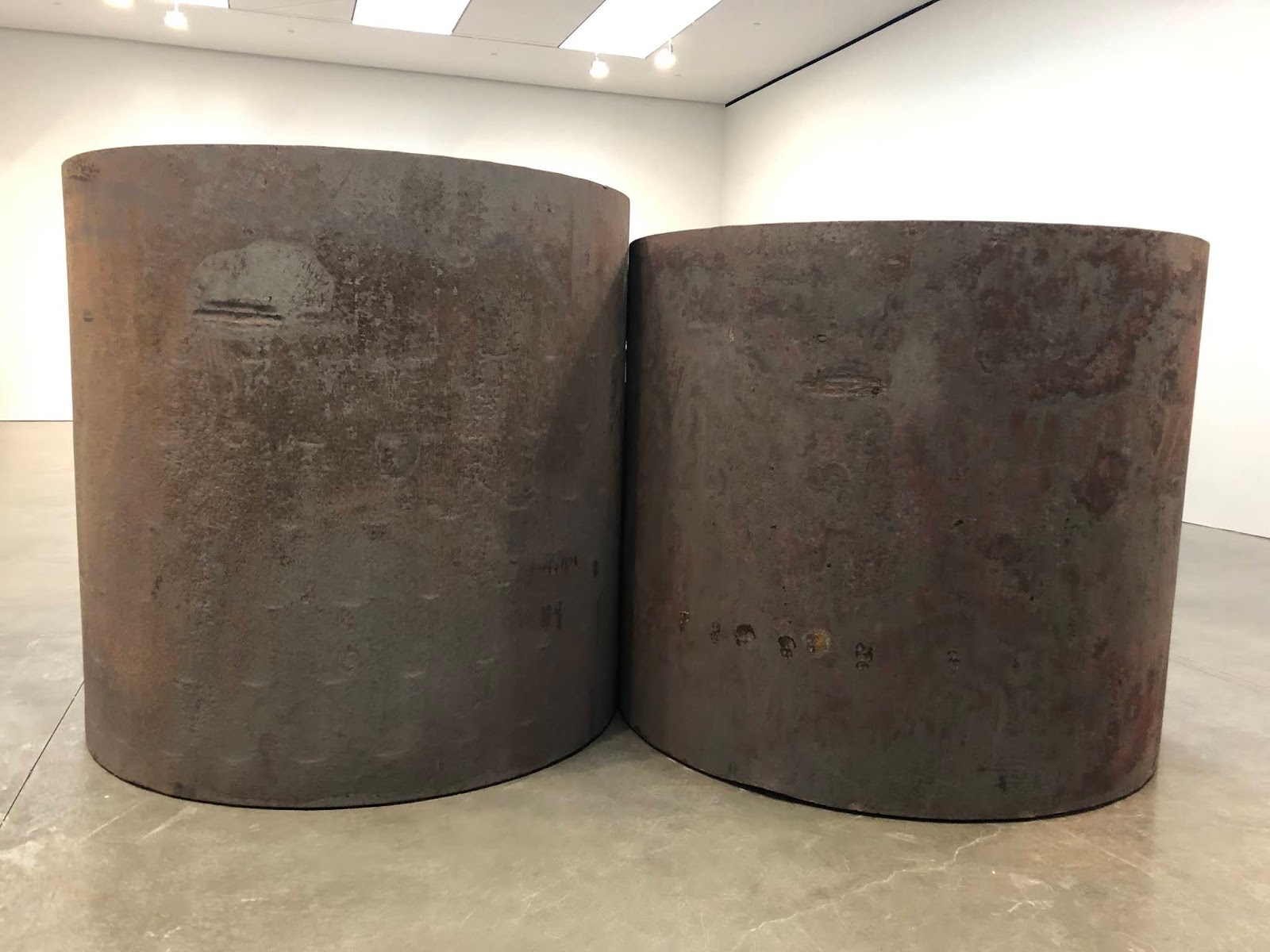
The Forged Rounds show displays 4 new works.  Together there are 21 forged steel round or cylindrical drums of varying diameters and heights, weighing 50 tons each.  They are divided among 4 rooms in diverse combinations:  nine rounds, six rounds in two groups, four rounds in two inverted stacks and two rounds that are barely contained in their allocated area.  The round's heft was dictated by the 50 ton weight limitation set by the Port Authority of New York and New Jersey for crossing over the George Washington Bridge.  Serra's pieces are produced in Germany foundries.  The round pieces of forged steel are made in Wetzlar, Germany and the corten steel ones are fabricated in Burbach, Germany.     They are then shipped to Port Newark, New Jersey where they get trucked into Manhattan. If they weighed more than 50 tons, they could not be transported over the bridge and would not get to the gallery.  


Installation view of 
Richard Serra (1938 - ), Channel, 2019,
forged steel, two rounds,
Each 48" x 102" diam. (121.9 x 259 cm)
at the exhibition "Forged Rounds,"
Gagosian, 555 West 24th Street, New York, 
September 17, 2019 - December 7, 2019
Photo:  Hillary Ganton 


The configuration and placement of  each work trigger contrasting reactions.  In the smallest room installed with Channel, the space seems confining as if the air itself were constricted.  Each round is flush against one wall leaving navigation between them tight. Although the same size rounds, 48" x 102", appear 4 times again, 2 rounds in 2 other pieces, Combined and Separated and Inverted, the Channel rounds in their setting give the impression of being much larger and heavier. 


Installation view of 
Richard Serra (1938 - ), Combined and Separated, 2019, 
forged steel, six rounds, in two groups
Two, each 78" x 79 3/4" diam. (198 x 202.6 cm)
Two, each 72" x 83" diam. (182.9 x 210.8 cm)
Two, each 48" x 102" diam. (121.9 x 259.1 cm),
at the exhibition "Forged Rounds,"
Gagosian, 555 West 24th Street, New York, 
September 17, 2019 - December 7, 2019
Photo:  Hillary Ganton 

The other pieces allow visitors to move in and around and through the arrangements.  Elements materialize and vanish depending on the viewer's chosen route.  Formations change accordingly - six components may visually become two.  This is distinctly evident in Combined and Separated and Inverted.  


Installation view of  
Richard Serra (1938 - ), Inverted, 2019,
forged steel, four rounds, in two inverted stacks
Two, each 48" x 102" diam. (121.9 x 259.1 cm)
Two, each 54" x 96" diam. (137.1 x 243.8 cm)
Each stack 102" x 102" diam. (259 x 259 cm),
at the exhibition "Forged Rounds,"
Gagosian, 555 West 24th Street, New York,
 September 17, 2019 - December 7, 2019
Photo:  Hillary Ganton   

Inverted is particularly inviting for circulation.  Differing viewpoints of the divergent stacks point out dissimilarities in their appearance. Although both have bulk and weight, the inversion with the larger round on top looks squatter and less stable than the one with the smaller round atop.  The latter appears to adhere more to the properties of gravity.  


Installation view of 
Richard Serra (1938 - ), Inverted, 2019,
forged steel, four rounds, in two inverted stacks
Two, each 48" x 102" diam. (121.9 x 259.1 cm)
Two, each 54" x 96" diam. (137.1 x 243.8 cm)
Each stack 102" x 102" diam. (259 x 259 cm)
at the exhibition  "Forged Rounds,"
Gagosian, 555 West 24th Street, New York, 
September 17, 2019 - December 7, 2019
Photo:  Hillary Ganton  


Serra's work calls forth a desire to touch.  Visitors are commonly seen placing their hands on the forged steel surface as if to confirm its substance.  Guards do not seem to mind.  Physical contact is also engendered by the sculptures' intricately textured finishes in contrast to their rugged hugeness.  

Installation view of 
Richard Serra (1938 - ), Combined and Separated, 2019, 
forged steel, six rounds, in two groups
Two, each 78" x 79 3/4" diam. (198 x 202.6 cm)
Two, each 72" x 83" diam. (182.9 x 210.8 cm)
Two, each 48" x 102" diam. (121.9 x 259.1 cm),
at the exhibition "Forged Rounds,"
Gagosian, 555 West 24th Street, New York, 
September 17, 2019 - December 7, 2019
Photo:  Hillary Ganton 

The artist uses steel in a way like no one before.  This structural and fabricated material is an alloy of iron and carbon.  Forged steel involves working with the solid form of the alloy by heating and hammering.  Surface results depend on the way steel is cooled after it is formed as well as its exposure to weather. The artist has some control over the outcome.  

Reverse Curve is made of corten steel which has additional alloying components mixed in with the iron and carbon.  This makes the steel stronger and corrosion resistant.  It is characterized by a rusty, orange patina caused by weathering.  In the case of Reverse Curve, one side of the metal was unprotected when shipped.  On this side, the elements especially sun, wind and rain produced an effect akin to a Color Field painting.  Thus, nature contributed a rich fall-like coloration and a rhythmic striation along this side's full length. Man-made and natural processes have collaborated to make art. 


Installation view of
Richard Serra (1938 - ), Reverse Curve, 2005/19,
corten steel, two plates,
Overall:  13' 1/2" x 99' 9" x 19' 7" (4 x 30.4 x 6 m)
Plates:  2" (5 cm) thick, 
at the exhibition "Reverse Curve," 
Gagosian, 522 West 21st Street, New York, 
September 17, 2019 - February 1, 2020
Photo:  Hillary Ganton   

The lyrical lightness of Reverse Curve belies its approximately 60 ton weight - about 120,000 pounds.  This work highlights Serra's use of free standing objects.  It is made up of  2 plates  together creating an object close to 100 feet long.  Nothing is bolted together or to the ground.  Where the floor is uneven, light seeps through segments of the sculpture's lower edge.  It also brings up the question of emotional effects.  Walking about and through some of Serra's sculptures may elicit contradictory feelings.  A tilt toward the viewer (a concavity) creates the anxiety that the work may fall on you.  In opposition, a segment bending away from the viewer (a convexity), creates a sense of comfort as if the piece can protect you from dangers. Rounds can seem like megaliths brought over from some prehistoric site and induce awe. Although Serra said that emotional responses were not his intention, he added that if his work had that affect, it was great but "Don't blame me."  

Richard Serra (1938 - ), Diptych #5, 2019,
paintstick, etching ink, and silica on handmade paper,
47 3/4" x 63 1/4" (121.3 x 160.7 cm)
at the exhibition "Triptychs and Diptychs," 
Gagosian, 980 Madison Avenue, New York, 
September 16, 2019 - November 2, 2019
Photo:  Hillary Ganton     


Serra's drawings are independent of his sculptures.  They are not designs for three-dimensional pieces where models are used for working out ideas.  His drawings may be based on existing sculptures but are not used in the preparation of them.  

In drawing, Serra explores the representation of weight and space in two-dimensions and considers the question of what the process of drawing is about that is making marks on a page.  He has drawn since childhood and drawing remains an almost daily practice.  He says drawing for him "...is like a language.  It's a way to think."  In fact, he was accepted to graduate school at the Yale School of Art with a submission of 12 drawings after majoring in English literature as an undergraduate.  


At Gagosian's Madison Avenue gallery, the exhibit Triptychs and Diptychs presents 20 of the artist's 2019 drawings.  They make clear Serra's habit of making up his own tools to conceive his inventions.  He had been working at a print shop in Los Angeles making a print and thought of making a drawing using etching ink and a roller like in the printing process.  In the Diptychs and Triptychs he made a drawing with paintstick - the tubes of which had been melted then formed into bricks for ease of application.  He then used a roller to apply ink then silica over the paintstick drawing which produced a thick, textured layer of black. 


Detail of Richard Serra (1938 - ), Diptych #5, 2019,
paintstick, etching ink, and silica on handmade paper,
47 3/4" x 63 1/4" (121.3 x 160.7 cm)
at the exhibition "Triptychs and Diptychs," 
Gagosian, 980 Madison Avenue, New York, 
September 16, 2019 - November 2, 2019
Photo:  Hillary Ganton     


He lets the process of creation show.  Smudges, spatters, finger marks and holes from where the handmade paper was tacked to the wall are not removed.  The deliberate and accidental fuse.  

Black is Serra's color of choice.  He sees black and white as the written medium we grew up with.  Moreover, black is used in structure and form which holds his interest.  Black absorbs light as opposed to reflecting it. Because of this property, Serra says that black has a different weight than colors such as green or yellow that reflect light. 

Although space may be the overriding subject matter of all of Serra's art, so is the individual viewing.  

Reverse Curve  
September 17, 2019 - February 1, 2020
522 West 21st Street, New York

Forged Rounds
September 17, 2019 - December 7, 2019
555 West 24th Street, New York

Triptychs and Diptychs
September 16, 2019 - November 2, 2019
980 Madison Avenue, New York  

Gallery Hours:
Monday through Saturday, 10:00 a.m. to 6:00 p.m.