Tuesday, July 23, 2019

Why Leonardo and Rembrandt Still Matter Today Part I

Leonardo da Vinci (1452-1519), Saint Jerome Praying in the Wilderness, 
begun ca. 1482-1485, reworked later by the artist, unfinished,
oil and tempera on walnut, 40.5 x 29 1/4 in. (103 x 74 cm) 
Vatican City, Musei Vaticani, Monumenti e Gallerie Pontificie
 Photo:  Courtesy of the Metropolitan Museum of Art

The year 2019 marks the 500th anniversary of the death of Leonardo da Vinci (1452-1519) and the 350th anniversary of the death of Rembrandt Harmenszoon van Rijn (1606-1669).  That both men are revered some hundreds of years after their passing attests to their achievements.*

One, Leonardo, was a polymath and genius. He was not only a person who knew about many different subjects but also excelled in them. Painting, sculpture, architecture, anatomy, math, science and botany were just some of his fields of inquiry.  He seemed to have possessed infinite curiosity and inventiveness.  

The other, Rembrandt, painter, draughtsman and printmaker, endowed his art with a deep sense of the living, capturing life in all its aspects. He rendered portraits, historical narratives, biblical scenes and landscapes with a preternatural realism. No human emotion escaped his scrutiny nor was not painted, drawn or etched by him. His contemporaries considered him the foremost painter of their time.  He left a body of work that conveys what it means to be a sentient being.

The July 2019 ArtWithHillary blog post focuses on Leonardo; the August blog post will concentrate on Rembrandt.

The Metropolitan Museum of Art commemorates Leonardo's quincentenary with the exhibition Leonardo da Vinci's St. Jerome organized by Dr. Carmen C. Bambach, Curator  in the museum's Department of Drawings and Prints. Dr. Bambach is a Leonardo da Vinci specialist whose four-volume publication, Leonardo da Vinci Rediscovered was released in the summer 2019.  The exhibit features the artist's unfinished painting Saint Jerome Praying in the Wilderness lent from the Vatican Museums.  The work represents a penitent Jerome kneeling before a cave-like setting with his right arm outstretched to the outer left edge of the panel.  In his right hand, he holds a stone.  It appears as if he were just about to beat himself in an act of religious discipline in penance.  He looks up toward a crucifix in the panel's upper-right corner - seen in profile is a sketched cross with the Christ figure next to which is a church. The body and tail of the saint's faithful lion take up the work's lower part. A landscape, which is the only part of the painting rendered in color, fills the painting's upper-left corner.  

Leonardo da Vinci (1452-1519), Detail of  Saint Jerome Praying in the Wilderness, 
begun ca. 1482-1485, reworked later by the artist, unfinished,
oil and tempera on walnut, 40.5 x 29 1/4 in. (103 x 74 cm) 
Vatican City, Musei Vaticani, Monumenti e Gallerie Pontificie
 Photo:  Artstor

Saint Jerome (347-420) was a fourth-century-early fifth-century priest, cardinal, theologian, historian, scholar, teacher and ascetic who is known for translating the Bible into Latin, the Vulgate Bible still in use today.  His writings included teachings on how to live a moral life with much focus on female devoutness and spiritual manner of living. He worked for Pope Damasus I (ca. 305-384; papacy 366-384) in Rome. He advised and taught a group of educated women on leading a monastic life.  Allegations that he had an improper relationship with one of these women led to the loss of his position. Afterward, he traveled to various holy places, retiring to a cave near Bethlehem to live the remainder of his life.   

In a letter to one of his female disciples, Saint Eustochium  (ca. 368-   ca. 419 or 420), Jerome described the tortures and temptations that he endured for Christ while doing penance in the desert.  Some visions aroused in him concupiscence which he countered with fasts and days and nights of beating his chest till his spirit was restored.  

As for his loyal lion, legend has it that a lion came to the monastery where Jerome lived.  His brethren ran away when they saw the beast but Jerome called them back to take care of the lion which had a thorn in its paw. Jerome took out the thorn and cured the lion's wound. Thereafter, the lion remained with the saint and is often depicted with him.

Leonardo da Vinci (1452-1519), Detail of  Saint Jerome Praying in the Wilderness, 
begun ca. 1482-1485, reworked later by the artist, unfinished,
oil and tempera on walnut, 40.5 x 29 1/4 in. (103 x 74 cm) 
Vatican City, Musei Vaticani, Monumenti e Gallerie Pontificie
 Photo:  Artstor

The Saint Jerome is not signed, but scholarly consensus attributes the work to Leonardo.  Detailed investigation of the panel's surface revealed the artist's fingerprints especially recognizable in the painting's upper-right landscape.  Leonardo used his fingers to spread pigments giving the area a hazy effect. At one point, probably in the early nineteenth century, the saint's head was sawn out and removed. Perhaps the owner felt it was more marketable than the incomplete whole. The two parts were found separately and reunited; the perimeter of the rectangular cut is discernible.  


Leonardo da Vinci (1452-1519), Detail of  Saint Jerome Praying in the Wilderness, 
begun ca. 1482-1485, reworked later by the artist, unfinished,
oil and tempera on walnut, 40.5 x 29 1/4 in. (103 x 74 cm) 
Vatican City, Musei Vaticani, Monumenti e Gallerie Pontificie
 Photo:  Artstor

Why or for whom Leonardo painted the work is unknown.  It may have been commissioned as a private devotional image.  The person who ordered the painting may have become frustrated with the artist's notorious lateness in completing projects and cancelled the order.
What is known is that the painting remained with Leonardo who continued to work on it until his death.  

The panel is assigned to the painter's mid-career when he moved to Milan from his native Florence.  The picture is painted on walnut, a wood which Leonardo did not use until his Milan stay, previously employing poplar for his paintings' supports.  

Leonardo left his estate to his devoted pupil Francesco Melzi (1491-1570) and, it is believed, paintings to his student Andrea Salai (1480-1524). There are, however, no records of either inheriting the Saint Jerome. After Leonardo's death, the painting's history is lost until the mid-eighteenth century when it came into the possession of the Swiss artist Angelica Kauffmann (1741-1807) who was then living in Rome. Its next account follows her death.  Tradition has it that the work was found separately in two parts in two different shops by the French cardinal and diplomat Joseph Fesch (1763-1839), an uncle of Napoleon who had appointed him ambassador to Rome in 1803.  The painting became part of the Vatican Collections in 1856.  

Leonardo da Vinci (1452-1519), Detail of  Saint Jerome Praying in the Wilderness, 
begun ca. 1482-1485, reworked later by the artist, unfinished,
oil and tempera on walnut, 40.5 x 29 1/4 in. (103 x 74 cm) 
Vatican City, Musei Vaticani, Monumenti e Gallerie Pontificie
 Photo:  Artstor

Representations of Saint Jerome usually portray him in his study engaged in theological writings or in the desert kneeling in prayer before a crucifix.  If he holds a stone, it is typically held in his hand which is down at his side or on his chest.  Physical movement is minimal even if the arm holding the stone is raised, it is not outstretched to pack the maximum wallop on his chest.  Leonardo's Saint Jerome in contrast contains motion.  The saint is in the act of a physical action - about to strike his chest - and, an inward emotional exertion as indicated by his beseeching facial expression.  

The brilliance of Leonardo's art is the ability to render simultaneously and seamlessly two distinct reactions.  The saint's body conveys the outward act of self-flagellation while his face informs of his inner emotive repentance.  Leonardo couples the means of atonement with mental agony.  

Some more points about the panel:  The sketch of the church in the upper-right may relate to church designs that Leonardo was working on or a reference to the monastery near Bethlehem where Jerome had stayed. The proportions of the saint's body reflect the artist's anatomical and proportional investigations.  The saint's head is similar to a head of Saint Jerome made in clay by the painter, sculptor and goldsmith Andrea del Verrocchio (1435-1488) with whom Leonardo apprenticed.  The sculpture is now lost but known through copies and a painting of Saint Jerome by Verrocchio in the Galleria Palatina, Palazzo Pitti, Florence.  The three-dimensionality of Leonardo's St. Jerome figure suggests it was based on the Verrocchio sculptural prototype. The cave setting and upper-left landscape link the work to Leonardo's two versions of The Virgin of the Rocks, one in the Musée du Louvre, Paris; the other in the National Gallery, London.


Rembrandt Harmensz00n van Rijn (1606 - 1669), Self-Portrait, 1658,
oil on canvas, 52 5/8 x 40 7/8 in. (133.67 x 103.82 cm)
Photo: Michael Bodycomb

More to come about Rembrandt in the August 2019 ArtWithHillary.

*The July 2019 ArtWithHillary blog post focuses on Leonardo; the August blog post will concentrate on Rembrandt.

Leonardo da Vinci's St. Jerome
July 15, 2019 - October 6, 2019
1000 Fifth Avenue, Manhattan
Open Seven Days a Week
Sunday through Thursday 10 a.m. - 5:30 p.m.
Friday and Saturday 10 a.m. - 9 p.m.
Closed Thanksgiving Day, December 25, January 1, and the first Monday in May. 

1 East 70th Street, Manhattan
Tuesday through Saturday, 
10:00 a.m. - 6:00 p.m.
Sundays, 11:00 a.m. - 5:00 p.m.
Closed Mondays and holidays.
First Fridays:  on the first Friday of the month
 (except January and September) the museum is open until 9:00 p.m. 
Check The Frick Collection Web site for holiday and limited hours schedule.

Wednesday, June 19, 2019

Slowing People Down

Edmund de Waal (1964 - ), on living in an old country I (one of a set), 2019, 
porcelain, steel, gold, alabaster, aluminum, and plexiglass, 
23 5/8 × 35 7/16 × 12 5/8 in. (65.09 x 90.01 x 32.07 cm), 
on view in the Dining Room of The Frick Collection 
in the exhibition Elective Affinities:  Edmund de Waal at The Frick Collection, 
May 30 - November 17, 2019
© Edmund de Waal. Courtesy the artist and The Frick Collection
 Photo: Christopher Burke

The British artist and writer Edmund de Waal (1964 - ) is probably best known for his successful memoir The Hare with Amber Eyes: a Hidden Inheritance.  He is, however, an acclaimed ceramicist creating fine pottery typically in porcelain with celadon glazes.  His latest work has shifted away from individual wares to a presentation of groups of vessels, containers and box-like elements made from porcelain and other materials.  He calls these installations.

De Waal has created such works for historic collections such as Chatsworth House, Derbyshire, England and the Victoria and Albert Museum in London.  For these installations, he takes into account the particular collection, the building where it is housed, the room or gallery space, the light and the objects where his art will be placed.  His work enters into a conversation with their environment.  They cause viewers to pause and engender moments of reflection.  

The artist's invitation to make works expressly for The Frick Collection mark his first site-specific installations outside of Europe. These installations, nine in all, are now on view at the Frick in the exhibition, Elective Affinities:  Edmund de Waal at 
The Frick Collection.

When de Waal speaks about Henry Clay Frick (1849 - 1919) he compares what the industrialist had accomplished to alchemy.  Frick made wealth out of steel, forming the U. S. Steel Corporation, and turned wealth into art.   De Waal performs a sort of alchemy too.  He takes clay and transforms it into porcelain which the artist refers to as "white gold." Although porcelain is by far the artist's favorite medium, valued for its durability and delicacy, he also works with gold, steel, alabaster, aluminum and plexiglass.  The artist employed steel in all the Frick installations because of its association with Frick.  De Waal's artworks are of a quiet and unobtrusive nature. They can be easily overlooked yet once noticed, they are intriguing.  


The artist had spent five months at the museum thinking about his installations.  He chose   locations near paintings that had particular meaning for him. In the Frick Dining Room filled with 18th-century aristocratic portraiture, de Waal created two pieces, on living in an old country I & II.  These he placed on the marble tops of pier tables beneath adjacent portraits by Thomas Gainsborough (1727 - 1788) of Mrs. Peter William Baker, 1781 and The Hon. Frances Duncombe, c. 1777.   Frick acquired them in 1917 and 1911 respectively.


The installation on living in an old country I & II consists of rectangle receptacles of white-painted steel and thin sheets of white and golden porcelain within a white-framed vitrine.  In the exhibition's catalogue, Charlotte Vignon, the curator of the show and the Curator of Decorative Arts at the 
Frick, notes that the thin ceramic sheets that lean on the white-painted steel receptacles give the appearance of book pages supported by closed books.  All elements rest in vitrines which have bases of thick plexiglass partially covered by a fine alabaster tablet.  Gold components pick up the gilt frames of Gainsborough's canvases while the book-like pieces reflect the paintings' rectangular shape and vertical orientation. 


Viewed from above and sideways, the marble of the tables' tops is seen through the clear installations' plinths.  Thus, the swirls and veins of the grayish-colored marble become part of the artwork.  Bending down, looking ahead through the plexiglass the room's decorative walls enter into the composition.  


In each vitrine, broken fragments of white porcelain with words on them and gold shards are placed in a small box.  The words are from the poems of Emily Dickinson (1830 - 1886) that the artist wrote on porcelain prior to breakage. He chose Dickinson, he had explained,

because of the strength of her poetry which could stand up to a "...Gainsborough girl."  The whole evokes a sense of books, writing, creating and collecting. 

De Waal called the Dining Room an "... extraordinary fantasy of the English country house...." For him, it signified entitlement, ownership and, he said, "...it makes me want to break things."  Although evoking the 18th century, the furnishings were made by a prominent English decorator about 1913 - 14.  This included the console tables on which de Waal's works sit.


Edmund de Waal (1964 - ),  steel light I-V, 2019, 
porcelain, steel, and gold, 
14 3/16 × 6 5/16 × 7 1/16 in. (36.04 x 16.03 x 17.94 cm),
on view in the West Vestibule of  The Frick Collection 
in the exhibition Elective Affinities:  Edmund de Waal at The Frick Collection, 
May 30 - November 17, 2019
© Edmund de Waal. Courtesy the artist and The Frick Collection
 Photo: Christopher Burke

The light-filled West Vestibule is hung with The Four Seasons, a series of paintings by François Boucher (1703–1770).  They were made for Madame de Pompadour (1721 - 1764),  the official mistress of Louis XV of France (1710 - 1774), in 1755.  Frick acquired them in 1916.  
Autumn and Winter flank an ornate commode, c. 1710, with later alterations, attributed to André-Charles Boulle (1642–1732), the illustrious French cabinetmaker known for his inlay craftsmanship. This chest of drawers, purchased in 1915, is the platform for de Waal's set of five sculptures, steel light I-V.  


These are heavy works of steel, porcelain and gold.  They are the only 
Frick installation without an enclosing vitrine.  Containers and flat components are colored in blacks, grays, gray-blues and gold.  As natural light comes through the western glass door leading to the Frick's Central Park facing garden, the installation's forms, tints and textures appear to change.  Black here is never true black. Cylinder-formed porcelain vessels, each differentiated and individualized, and steel strips, some gilded, are set on black steel square blocks.  The strips, cut to a sixteenth of an inch, lean against the vase-like containers that seem to await some floral arrangement from the nearby garden.  De Waal's  work holds its own and draws viewers to the substantial gilt bronze decorated commode and the Boucher oils with their golden frames.


Edmund de Waal (1964 - ), on an archaic torso of Apollo, 2019, 
porcelain, steel, gold, alabaster, aluminum, and plexiglass,  
22 7/16 × 17 5/16 × 11 13/16 in. (56.99 x 43.97 x 30.00 cm)
on view in the Fragonard Room of  The Frick Collection 
in the exhibition Elective Affinities:  Edmund de Waal at The Frick Collection, 
May 30 - November 17, 2019
© Edmund de Waal. Courtesy the artist and The Frick Collection
 Photo: Christopher Burke

The 
Frick's Fragonard Room is named after the painter Jean-Honoré Fragonard (1732 - 1806) whose series of paintings The Progress of Love now adorn the room's walls.  The Pursuit, The Meeting, The Lover Crowned and Love Letters (1771 - 72), were made for Madame du Barry (1743 - 1793), the last mistress of Louis XV.  She had rejected them for some unknown reason.  Twenty years later, Fragonard installed the turned-down panels along with additional ones in a cousin's villa in southern France.  Frick purchased all the paintings in 1915.  They form a delightful setting for the room's furnishings which include furniture embellished with a variety of woods, marble and gilded sculptural mounts as well as Sèvres and Chinese porcelains, objects of gilt-bronze and an eighteenth-century clock by Jean-Baptiste Lepaute, the clockmaker of King Louis XVI (1754 - 1793), with terra-cotta sculptures by the prominent Prix de Rome winning sculptor Clodion (French, 1738–1814).  


De Waal responded to the room with the installation, 
on an archaic torso of Apollo.  This is his first ever golden vitrine,  a gilded steel frame which rests on a deep plexiglass plinth. Inside there are two stacks of celadon porcelain bowls, one with three and the other with two dishes.  The stacks are set on two white-colored steel pedestals. Shards of gold are settled in the top bowl of the lower two-dish stack. The higher rectangular base of the three-dish stack contains pieces of porcelain which can be seen only from a side view of the installation. The five bowls could, perhaps, refer to the five main paintings of the room:  the four du Barry paintings mentioned above and Reverie.  The porcelain bowls, one on top of another, also suggest a kind of intimacy, a sort of cuddling reflecting the paintings' love theme.  

The artist placed the installation on the marble top of a grand mahogany commode attributed to Jean-Henri Riesener (German, 1734–1806).  Riesener was a renowned  cabinetmaker in Paris during the Louis XVI period.  He was cabinetmaker to the king and a favorite of Marie Antoinette (1755 - 1793), wife of King Louis XVI and the last queen of France before the revolution.  The commode was probably made to exhibit collections of precious porcelain or lacquer.  Crowning Riesener's work is the central superbly sculptured gilt-bronze head of Apollo surrounded by laurel leaves and sun rays.  The installation's coloring and clear base through which can be seen, here again, the marble surface of the furniture beneath and the wall beyond, makes the piece appear to float and vanish into its surroundings. 


Edmund de Waal (1964 - ), noontime and dawntime, 2019, 
porcelain, steel, and plexiglass,
 33 7/16 × 65 3/4 × 18 7/8 in. (84.93 x 167.00 x 47.94 cm)
Far table:  from darkness to darkness, 2019, 
porcelain, steel, and plexiglass,
 33 7/16 × 65 3/4 × 18 7/8 in. (84.93 x 167.00 x 47.94 cm)
on view in the West Gallery of The Frick Collection,
in the exhibition Elective Affinities:  Edmund de Waal at The Frick Collection, 
May 30 - November 17, 2019.
© Edmund de Waal. Courtesy the artist and The Frick Collection
 Photo: Christopher Burke

The West Gallery contains Spanish, Dutch and Flemish Old Master paintings, Renaissance furniture and bronze sculptures of the sixteenth- through eighteenth-centuries. Of much importance for de Waal is The Forge (c. 1817), by Francisco José de Goya y Lucientes (1746–1828). It shows three laborers working around an anvil on a red-hot piece of metal.  The sturdy, muscular smith with his back to viewers raises his sledgehammer above his head. He is just about to bring it down on the molten metal sheet held in place with tongs by the worker opposite him.  The image brings back the theme of steel and the meaning it holds in the context of the Frick.  

The artist related that you could hear the hammer coming down on the metal creating a forceful, rhythmic aural experience.  He said it set up the repetitive beat of his installations.  


De Waal explains that he listens to music all the time.  He talks about the interest he has in the sounds of the different materials he uses saying "...porcelain does sound incredibly beautiful as does steel...." He described something akin to a form of synesthesia.  When he is in different rooms filled with art, the room or specific works will conjure up particular musical pieces.   In the West Gallery, de Waal said he heard in his mind, among other music, the Goldberg Variations (1741) by Johann Sebastian Bach (1685 - 1750).  


Edmund de Waal (1964 - ), from darkness to darkness, 2019, 
porcelain, steel, and plexiglass,
 33 7/16 × 65 3/4 × 18 7/8 in. (84.93 x 167.00 x 47.94 cm)
on view in the West Gallery of The Frick Collection,
in the exhibition Elective Affinities:  Edmund de Waal at The Frick Collection, 
May 30 - November 17, 2019.
© Edmund de Waal. Courtesy the artist and The Frick Collection
 Photo: Christopher Burke

De Waal made two installations for the West Gallery, from darkness to darkness (near the west end of the room) and noontime and dawntime (near the east end of the room).  He installed them on two grand Renaissance-style tables across the room from one another.  They works dominated by black steel with some components in black porcelain, relate to the tones of the art in the gallery. 


Elements in the vitrines vary in height and width.  Read from left to right or right to left, they create an up and down movement of a certain pace and, as such, may be seen as some form of three-dimensional musical notation.  Depending on the angle of sight, the glass of the vitrines reflects the viewer and surroundings or appears to disappear. When it is reflective, the surroundings and viewers become part of the artworks. When it is not visible, the black metal frame sets the installations' steel and porcelain pieces apart and outlines artworks within the gallery.  It becomes another framework to view the Frick collection.  


De Waal's installations will slow you down as you connect them with the objects on view, the rooms, the lighting and space. This slowing down while observing is exactly the artist's intention.


Note:  Please do not forget to pick up the free exhibition guide available at the admission and information desks.

Elective Affinities:  Edmund de Waal at The Frick Collection
May 30 - November 17, 2019
1 East 70th Street, Manhattan
Tuesday through Saturday, 
10:00 a.m. to 6:00 p.m.
Sundays, 11:00 a.m. to 5:00 p.m.

First Fridays:  
On the first Friday of the month
(except January and September)
the museum is open until 9:00 p.m. 

Closed Mondays and holidays.
Check The Frick Collection Web site for holiday and limited hours schedule.

Wednesday, May 29, 2019

Identity Politics Infringing On Art


Advertisement for the online art auction February 2006 
to aid  victims of the October 2005 Kashmir earthquake.  
Image on the advertisement is the painting by M.F. Husain (1915 - 2011), 
Bharat Mata (Mother India), 2004, oil on canvas.
Photo:  Hindu Janajagruti Samiti Web site 


Are religious, cultural and gender identities influencing the art scene? A look at the case of the renowned Indian artist Maqbool Fida Husain (1915 - 2011), known as M.F. Husain, might help put these issues into perspective.  (For more on M.F. Husain, see ArtWithHillary April 2019).  

Husain left India in 2006 in self-imposed exile.  His exhibitions had been vandalized, his home and person threatened. Hostility and controversy had followed the artist since the mid-1970s because of  his support and reverence for the then Prime Minister Indira Gandhi. Gandhi had been convicted of election violations before she declared a state of emergency that lasted from 1975 - 1977 and Husain's unwavering admiration for her caused him much condemnation. Things began to heat up in the late 1990s when certain paintings provoked the wrath of the political right.   

M.F. Husain (1915 - 2011),
 Hindu goddess Saraswati
Photo:  India Today Web site 

In the 1990s, Husain paintings of Hindu gods and goddesses in the nude began to stir up criticism.  Among the works cited as being obscene were images of the goddess of wisdom, Saraswati; Lakshmi, the goddess of wealth and well-being with the head of Ganesha, god of beginnings and remover of obstacles; the warrior goddess Durga with a tiger; and, a variety of scenes with Hanuman, one of the main characters in the Indian ancient epic the Ramayana, who was known as the Lord of Celibacy and who had perfect control of his senses.  These were works created in the 1970s but denounced some 20 years later.

M.F. Husain (1915 - 2011),
Hanuman across from Ravana with Sita sitting on his thigh 
Photo:  India Today Web site 

Many of the problematic works that caused hostility were the artist's depictions of scenes and figures from a cycle based on the Ramayana that he began in 1968.  An example is one in which Hanuman is shown confronting Ravana who had kidnapped Rama's wife Sita.  In the Husain depiction, Sita appears seated on Ravana's thigh.  All three figures are nude.  

What finally precipitated Husain's exile was the extreme antagonism raised by his painting Bharat Mata (Mother India) which was used in an advertisement for an online art auction organized to benefit victims of the devastating October 2005 earthquake in Kashmir.  

 M.F. Husain (1915 - 2011),  Bharat Mata (Mother India),
 2004, oil on canvas.
Photo:  wcdf-franceWeb site 

In the painting, an unclothed female is positioned in the shape of a map of India.  Across her body are the names of various Indian states. Her flowing hair becomes the Himalaya's peaks and valleys behind which a sun rises or sets on the horizon.  Overlapping the woman's outstretched left arm is a spoked wheel, a reference to the Ashoka Chakra*, emblem of India and depicted on the nation's flag.  On the water, to the right, a seated figure sits in the lotus pose of meditation.  To the left, a sloop with black, red and orange sails, moves toward the painting's edge.  The orange sail, white horizontal lines on the greenish water may allude to the colors of India's national flag.

What outraged Husain's opponents was the portrayal of Mother India, the traditional personification of the nation as a mother goddess, in the nude.  There were protests against the work by right-wing individuals and groups in various parts of the country. Husain claimed he had never titled the work Bharat Mata (Mother India).  He had sold the painting the year it was made in 2004 to a private collector and, at that time, the work was untitled.  The artist issued an apology as he did not intend to offend and had the painting pulled from the auction.  His 2006 press release concerning the Bharat Mata painting stated, "Whatever I have painted, I have done with complete conviction and in the process if I have hurt anyone's feelings, I apologize."


By the time of this controversy, the political climate of India had drastically changed from the nation's origins.  India and Pakistan were formed in 1947 by the partition of British India.  Although each country was dominated by a religious group, Hindus in India and Muslims in Pakistan, India was established as a secular democracy.  In the heady early period of independence, thoughts of a country united in diversity held sway.  Many non-Hindus chose to remain in the new nation as did Husain who was a Muslim.  The artist always believed in nonreligious nationalism, a form of citizenship that transcends religions.  He said, "I paint not as a Muslim but as an Indian."  The Hindu myths and religion were, for him, his own heritage.  

India's constitution emphasizes equality of all, embracing Western values.  For some 40 years, the nation was ruled by the secular Congress Party but gradually Hindu nationalism grew as right-wing Hindus pushed for an increasingly Hindu dominated state.  This, of course, has culminated in the recent re-election of Prime Minister Narendra Modi who is committed to giving Hindus, the religious majority, more power.  Thus, as a Muslim whose paintings often portray Hindu myths, gods, goddesses and other beings, Husain became a target for Hindu nationalists.  He was described as "...a Muslim trespassing on Hindu symbolic ground."  Critics claimed his religious identity restricted his access to Hindu iconography and it was a sacrilege for Husain to borrow subjects from Hindu epics and depict goddesses in the nude.  The artist's fame and fortune may have contributed to his censure. 

India's long history - both literary and artistic - encompasses many manifestations of the divine and semi-divine in nude or half-clothed states.  Gestures and postures of a sexual nature are common.  Female and male sculptures and temple decorations often are rendered with explicit delineation of the sexes.  In paintings and sculptures one finds clear representations of the nude form which, in the case of women, include the rima vulvae.  Ancient texts, such as the Kama Sutra, which is based on love coupled with moral responsibility, reflect the Hindu belief in fulfillment of the senses as one of the four main goals in life. The imagery of what in the West may be called erotic and sexual permeates Hindu iconography and tradition.  Such was Husain's milieu.  He absorbed Indian culture and conventions and took from it for his work. Husain said, "You cannot reinvent the wheel - your individuality, your creative eye lies in what you pick."  

The Bharat Mata (Mother India) painting elicited 5 criminal lawsuits filed in various parts of India against the artist.  The Supreme Court of India consolidated and transferred the suits and legal proceedings to the trial court of New Delhi in December 2006.  The complaints involved punishable violations of 4 sections of the Indian Penal Code which concerned distribution of obscene materials, obscene acts, expressions that intend to hurt religious sentiments and defamation of the national emblems or names.  The latter was a reference to the painting's inclusion of an Ashoka Chatra.  

The Delhi High Court completely exonerated the artist from all legal accusations in 2008.  In the decision, the Court remarked, "It is very unfortunate that works of any artist today who have tried to play around with nudity have come under scrutiny....Criminal justice system should not be used as an easy recourse to ventilate against a creative act." As for the work scandalizing the public, the judges ironically asked if the complainants were not scandalized "...by the large number of photographs of erotic sculptures which are in circulation....None gets scandalized looking at sculptures."  Painting, they stated, "...is an art like sculptures."  In the decision, the Court emphasized values of liberty, equality and fraternity requiring tolerance of other views.  With respect to the Ashoka Chatra, the Court concluded its placement in the painting did not show disrespect.  The Court upheld the right to free speech and freedom of expression.


Husain never returned to India.  Although the courts ruled in his favor, adversaries continued to work against him.  In 2015, on the occasion of the artist's 100 birth anniversary, a right-wing Hindu group tried to stop the exhibition, “Husain at Hundred,” September 17 - October 24, 2015, at the Aicon Gallery in New York City.  Even after his death, hostilities continue.


Dana Schutz (1976 - ), Open Casket, 2016,
oil on canvas, 38.98 x 53,15 in. (99 x 135 cm)
Collection of the artist
Photo:  Spike Art Magazine Web site
Courtesy of Petzel, New York

The Husain controversy had echoes in the 2017 protest of a painting that was shown in the Whitney Museum of American Art's 2017 Biennial.  The work in question was Open Casket, an oil on canvas by the white, American artist Dana Schutz (1976 -).  The painting depicted Emmett Till's maimed body in his casket and was based on a photograph of Till that was widely circulated at the time of his funeral.  


Till was a 14-year-old Chicagoan African-American who had been visiting his great-uncle in Money, Mississippi in August of 1955.  He and some boys went to a grocery store to buy candy.  The owners were a white couple.  The wife was 21 years old and was alone in the store. There are various versions of what happened but after the boys left, she accused Till of flirting with her which, in the South for a black male, had severe consequences.  When the husband found out what was purported to have taken place, he and his half-brother set out to find Till.  They kidnapped him, pistol-whipped and shot him, then weighted his body and threw him into a river. Till was found.  His mutilated face was unrecognizable. 


Till's body was returned to Chicago.  His mother insisted upon an open-casket funeral because she said, "There was just no way I could describe what was in that box. No way. And I just wanted the world to see."  Till's racially motivated murder attracted national attention.  The story and Till's photograph was featured in newspapers all over the world and aroused discussions about racial relations, segregation, law enforcement and more. Thousands attended his funeral.  The woman accuser subsequently rescinded her statements saying she had lied about Till's advances and had given false testimony.


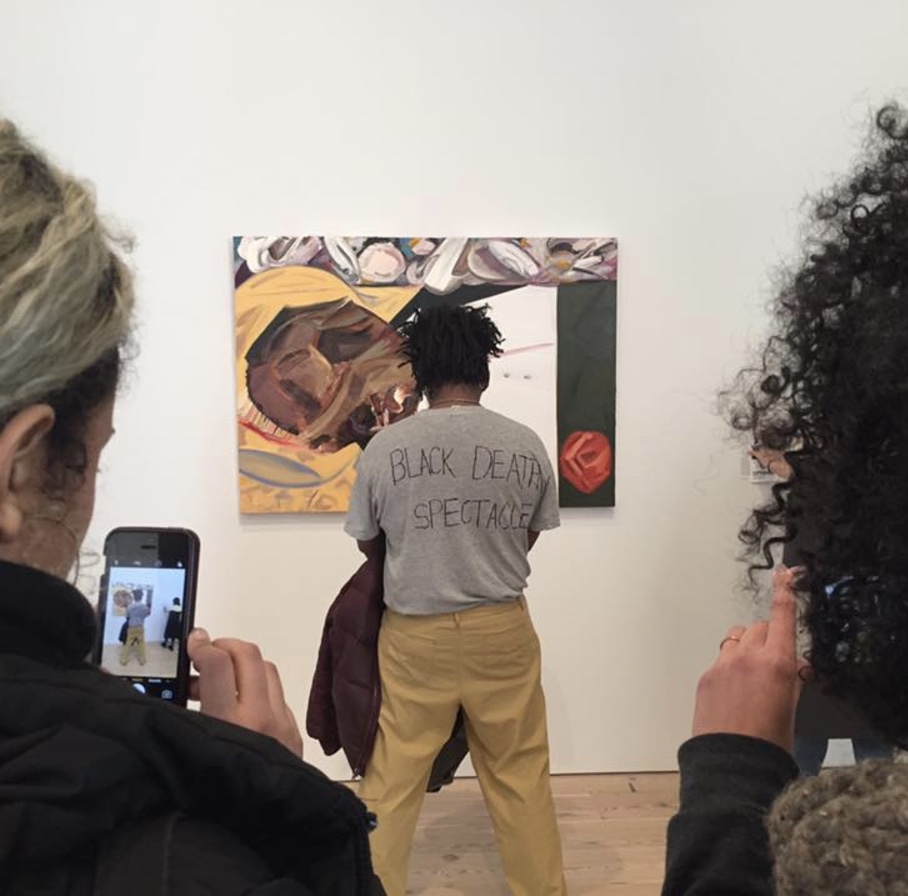
Installation view of the Whitney Museum of American Art's 2017 Biennial, 
March 17–June 11, 2017, artist Parker Bright with "Black Death Spectacle" T-shirt 
in front of Open Casket, 2016 painting by Dana Schutz (1976 -).
Photo:  Scott W. H. Young, via Twitter, Artsy Web site

The Schutz painting of Emmett Till in his coffin caused an uproar among some of the black community who felt a white woman had no business taking on the subject matter belonging to them.  At the Whitney Biennial, Parker Bright (c.1993 - ), a black artist, stood in front of the painting for 2 days wearing a T-shirt with the words "Black Death Spectacle."  The black artist and writer Hannah Black (1981 - ) wrote in an open letter to the Whitney that it "...was not appropriate for a White artist to transmute Black suffering....The subject matter is not Schutz’s; white free speech and white creative freedom have been founded on the constraint of others, and are not natural rights.” She along with others called for the painting to be destroyed.  Parker and his supporters wanted it removed from the Whitney Biennial.   


Schutz said she was motivated to paint the subject by her feelings as a mother.  She couldn't fathom the idea of a child being murdered like this and could not imagine what Till's mother went through.  The artist put out a statement in which she said, "I don't know what it is like to be black in America, but I do know what it is like to be a mother....The thought of anything happening to your child is beyond comprehension." The Whitney curators did not remove the painting.


The Schutz painting and Husain's work has a chilling effect on those who value the free exchange of ideas.  Questions arise.  Are certain subjects owned by certain groups? Can someone who is not Jewish comment on the Holocaust?  Can Christian painters be the only artists entitled to paint Christian themes?  In an interview, Bright was asked if he thought there was a way that a white artist could recreate the image of Emmett Till that he would accept?  He answered no.  


*The Ashoka Chakra is the 24 spoked wheel that appeared on many edicts issued by the Maurya Dynasty emperor Ashoka who reigned from c. 268 to 232 BC and advanced the spread of Buddhism throughout India.