Friday, March 21, 2014

Masterworks Where You Might Not Expect:


Don’t underestimate local, county or state art museums. They may offer some astounding surprises, meriting inclusion on any art lover’s destination list. A case in point is the North Carolina Museum of Art (NCMA) in Raleigh.  Long known by art world professionals for its stellar collection of Renaissance and Baroque paintings, the museum remains obscure to the general public.  The result is missing out on splendid artwork.

Sandro Botticelli (c. 1444/5 - 1510),  Adoration of the Child, c. 1500,
tempera on panel,  Diam.  49 1/2 in. (125.7 cm),
Gift of the Samuel H. Kress Foundation, 1960
Photo: Courtesy of  North Carolina Museum of Art, Raleigh, NC

The museum originated in 1947 with an unprecedented state legislature appropriation of $1 million for the sole purpose of forming a public art collection.  The allocation provided funds for an initial acquisition of 139 European and American works of art.   In 1960, these holdings were significantly enriched with the Samuel H. Kress Foundation gift of 69 paintings and 2 sculptures mainly from the Italian Renaissance and Baroque periods.  With the exclusion of the works donated to the National Gallery of Art in Washington, DC, the NCMA bequest was the largest and most important ever given by the Kress Foundation to any of the nation’s museums*.   It effectively put the NCMA in the "big league" of  museum collections.


Giotto di Bondone (c. 1266/67 - 1337) and Assistants, 
The “Peruzzi Altarpiece,”
 c. 1310 - 1315, tempera and gold leaf on panel, 
41 5/8 x 98 1/2 in. (105.7 x 250.2 cm),
Gift of the Samuel H. Kress Foundation, 1960
Photo:  Courtesy of North Carolina Museum of Art, Raleigh, NC

The Kress works include the well-known. Giotto, Veronese, Tintoretto, and Titian are present.  The Giotto is the only altarpiece by the artist outside of Italy.  There are also those less familiar such as Giovanni Antonio Boltraffio or Massimo Stanzione.   All are represented by paintings of distinction.  Each has compelling qualities which hold the viewer's attention and reward observation.  The figures of St. John and Christ in Veronese's Baptism of Christ move as if in some other-worldly ballet.  In Stanzione's Assumption of the Virgin, the upward gazing Virgin with outstretched arms soars into the sky.  Securely held aloft by an interlocked circle of muscular putti, she appears oblivious to her height.

The multitude of figures in Tintoretto's Raising of Lazarus overwhelms**.  Lazarus, supine, raises one arm towards the giver of life with whom he is engaged in a silent communion.

Domenico Tintoretto (c. 1560-1635), The Raising of Lazarus, 1585-90, 
oil on canvas, 47 7/8 x 77 1/4 in. (121.6 x 196.2 cm),
Gift of the Samuel H. Kress Foundation, 1960
North Carolina Museum of Art, Raleigh, NC
Photo:  Courtesy of North Carolina Museum of Art, Raleigh, NC

Domenico Tintoretto (c. 1560-1635), Detail of The Raising of Lazarus, 
1585-90, oil on canvas,
 47 7/8 x 77 1/4 in. (121.6 x 196.2 cm),
Gift of the Samuel H. Kress Foundation, 1960
North Carolina Museum of Art, Raleigh, NC
Photo:  Hillary Ganton

In the 1950s, the museum acquired some impressive acquisitions. Using state funds presciently, NCMA bought seventeenth-century and eighteen-century paintings. These included paintings by Bernardo Strozzi, Canaletto, Bernardo Bellotto, Peter Paul Rubens, Jacob Jordaens and Jan Lievens.  At the time of purchase, such works were not highly valued.  Today they are among the highlights of the museum's holdings.

Jan Lievens (1607-1674), The Feast of Esther,
c. 1625, oil on canvas, 
51 1/2 x 64 1/2 in. (130.8 x 163.8 cm),
Purchased with funds from the State of North Carolina
Photo:  Courtesy North Carolina Museum of Art, Raleigh, NC

One digression:  I have heard the remark, "I do not like religious painting."  Subsequently, a wealth of visual and intellectual joys are passed over.  For those so inclined, I urge looking beyond the religiosity.  Think of biblical scenes as stories and the different possibilities of representing the same tale.  Ask yourself, "What is going on?"  What feelings does the work elicit?  What ideas come to mind? Look upon the Madonna (Virgin) and Child (Christ)  imagery as depictions of a mother and child.  Consider the variety of ways the subject may be portrayed.  A comparison might be a popular tune interpreted by singers in their own distinct manner.  One might prefer a particular rendition over another but the melody remains the same. 

Peter Paul Rubens  (1577 - 1640) and Workshop, 
The Holy Family with St. Anne , 1630-35,
oil on canvas, 68 3/4 x 56 in. (174.6 x 142.2 cm),
Purchased with funds from the State of North Carolina
Photo:  Courtesy of North Carolina Museum of Art, Raleigh, NC

Take a look at Peter Paul Rubens's The Holy Family with St. Anne.  A loving scene of a child asleep on his mother's lap.  His maternal grandmother seated alongside the pair.  Her left arm draped about her daughter's shoulder.  The three generations are compositionally contained within a triangular form.  This serves to further their connectedness as well as  to separate them from the painting's sole male figure.  He looks at the ancestral trio from behind a parapet.  So isolated, his relationship to the main group is questioned.  He is part of them yet apart.  Thus, without the theological explanations which are surely the artist's intent, the work enthralls.  

Having said that, the NCMA has many works of a non-religous nature. The collection covers a wide range of artifacts from ancient Greece through contemporary works.  Of special note is American paintings with three works by John Singleton Copley.

John Singleton Copley (1738 - 1815), 
Sir William Pepperrell (1746-1816) and His Family,
1778, oil on canvas,
90 x 108 in. (228.6 x 274.3 cm)
Purchased with funds from the State of North Carolina
Photo:  Courtesy of North Carolina Museum of Art, Raleigh, NC

The museum's 2010 award winning building is set in a 160 acre museum park.  Glass-curtained walls, skylights, high-ceiling galleries, flooring that reduces walking fatigue, acoustically quieting techniques and well-positioned seating contribute to an outstanding viewing experience.  Make a visit.

*The Kress Foundation has distributed over 3,000 artworks from the Kress Collection to academic and regional museums in the United States.  Their excellent Web site, www.kressfoundation.org, allows viewers to look through the collection by map, repository or artist.

**Tintoretto's painting shows the strong influence of Titian's Martyrdom of Saint Lawrence.  Titian completed two versions of the painting one in 1558 for the Church of I Gesuiti, Venice and another in 1567 for the Monasterio de San Lorenzo, El Escorial, Madrid. Tintoretto's Lazarus appears to be variation of Titian's figures of St. Lawrence in reverse as if inspired by prints of the Titian works.  Prints render the original image designed on the printing plate in the opposite position.  Furthermore, the dark setting, crowd and turmoil of Tintoretto's Raising of Lazarus also link it to Titian's canvases. 

Titian (c. 1488/90 - 1576), Martyrdom of St. Lawrence, c. 1558,
oil on canvas, 196.9 × 110.2 in. (500 × 280 cm) 
I Gesuiti, Venice,
Photo:  Wikipedia

Titian (c. 1488/90 - 1576), Martyrdom of St. Lawrence, 1567,
oil on canvas, 173.2 x 126 in. (440 x 320 cm),
Monasterio de San Lorenzo, El Escorial

Disorder and confusion which surround  momentous happenings such as resurrection or martyrdom, bring to mind critical real-life events. Recall the photographs from the Robert F. Kennedy assassination.  An acknowledgement to Robert Schwarz for pointing this out.

A mortally wounded Robert Kennedy on the floor of the kitchen at the Ambassador Hotel, June 1968.
Photo:  Bill Eppridge — Time & Life Pictures/Getty Images -  

2110 Blue Ridge Road, Raleigh, North Carolina 
Hours: 
Tuesday – Thursday 10 a.m. – 5 p.m.

Friday 10 a.m. – 9 p.m.

Saturday – Sunday 10 a.m. – 5 p.m.

Closed Mondays 
The Museum is closed on July 4, Thanksgiving, Christmas Eve, and Christmas Day. 
 The Museum Park is open daily, including holidays, from dawn to dusk.

Monday, February 24, 2014

The Dying Gaul: Everlasting

Dignity in Defeat
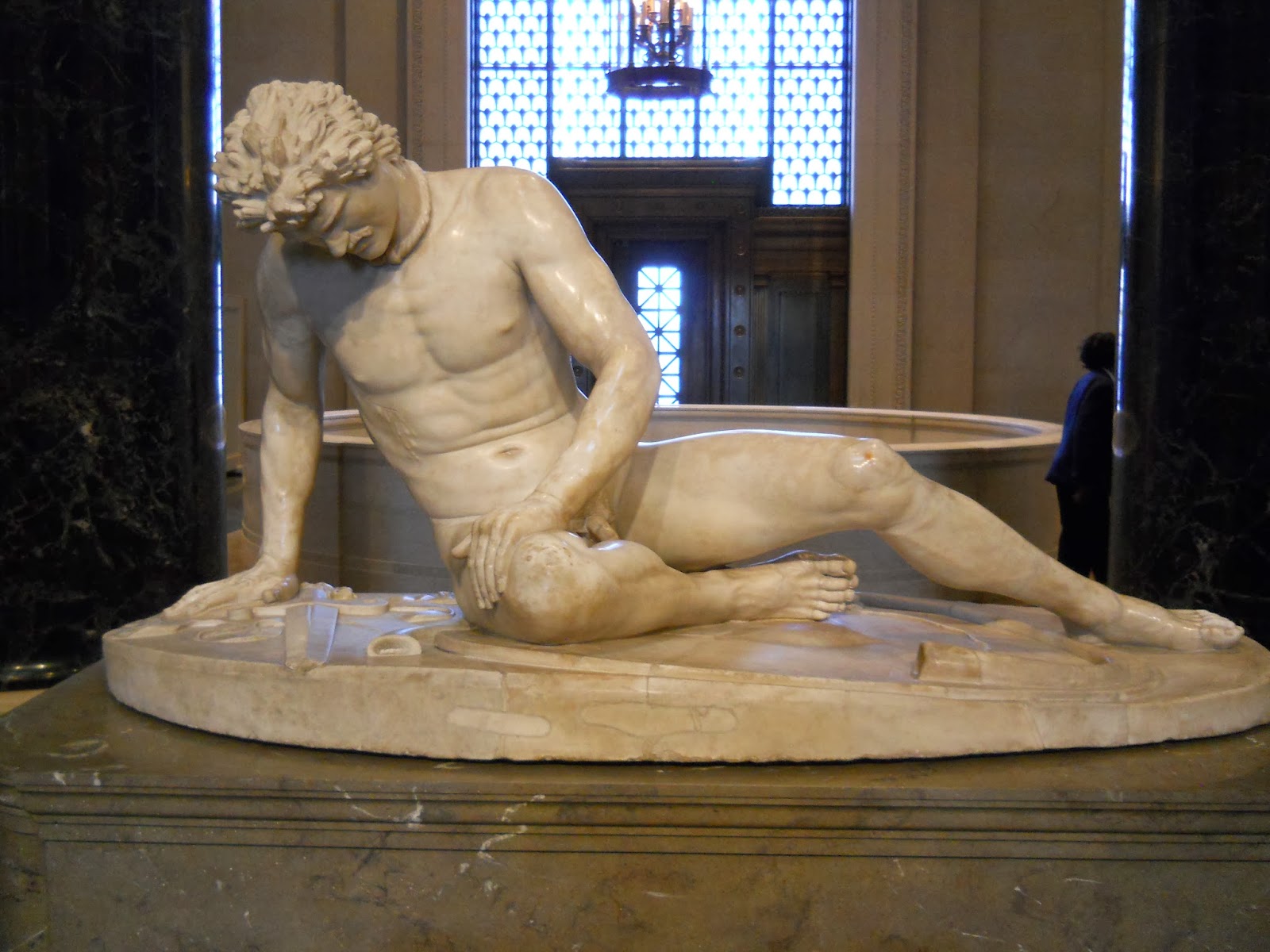
Dying Gaul, Roman, 1st or 2nd century AD, marble, 
37 x 73 7/16 x 35 1/16 in. (94 × 186.5 × 89 cm), *
Sovrintendenza Capitolina - Musei Capitolini, Rome, Italy 
Photo: Hillary Ganton

Certain figurative images last. Often emblematic of a universally valued quality, they are held in high esteem by different cultures over long periods of time. Such is the case of the Dying Gaul, a Greek 3rd century BC bronze sculpture known only through copies.

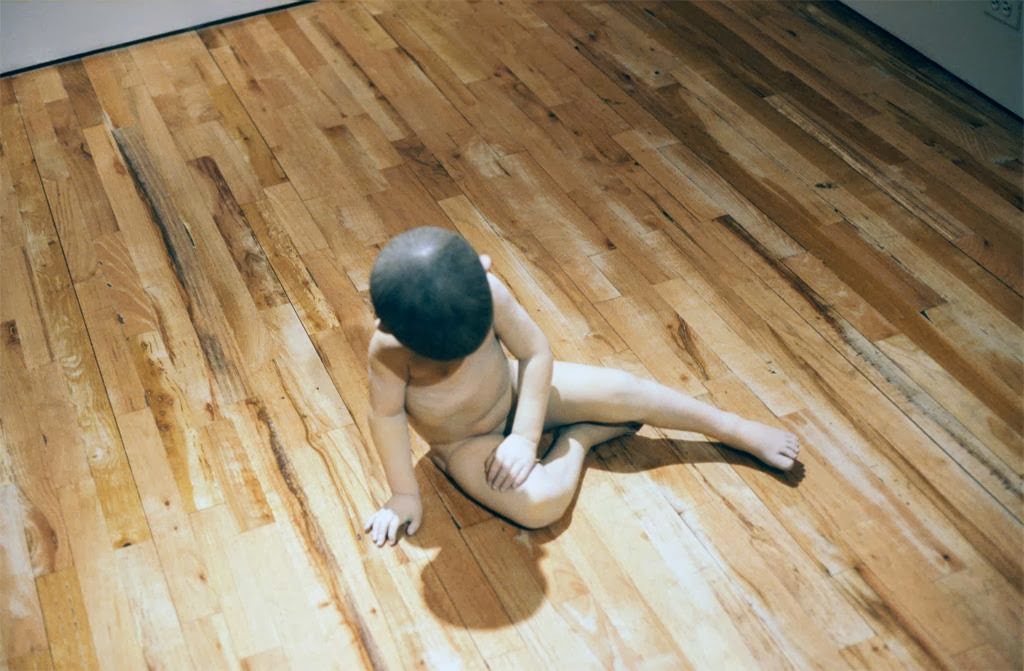
I was reminded of this on a visit to Oregon's Portland Museum of Art, this past summer.   Coming out of a gallery devoted to Renaissance and Baroque paintings,  I came across John DeAndrea's hyperrealistic life-size sculpture, Dying Gaul. 

John De Andrea (b. 1941), Dying Gaul, 1984,
polyvinyl and polychrome with pigment
29 ½ x 31 x 62 in. (74.9 x 78.7 x 157.5 cm)
Portland Art Museum, Portland, Oregon
Photo:  Hillary Ganton

So real was the rendering, it might have been a performance piece. Subject to no idealism, this soulful contemporary reveals all wrinkles and flaws.  Although the artist set his model in the famed Hellenistic pose, tragic heroism has been replaced by emotional reflection.  The figure's import would suffer without the ancient warrior allusion. 

Thoughts turned to the marble Dying Gaul in the Capitoline Museum, Rome.  This superb 1st or 2nd century AD Roman copy of a Greek bronze original is considered one of the masterpieces of ancient art. The sculpture is presently on view at the National Gallery of Art, Washington, DC, in the exhibition, The Dying Gaul: An Ancient Roman Masterpiece from the Capitoline Museum, Rome.

The sculpture was most likely discovered in Rome in the early 1620s during the construction of Cardinal Ludovico Ludovisi's villa and gardens. The first reference to the work is found in the 1623 inventory of the Cardinal's collection.  Acclaimed immediately, its renown  spread across Europe helped no doubt by a French artist's etching published in Rome in 1638.  Pope Clement  XII purchased the sculpture in 1737 and placed it in the Musei Capitolini.  Until the mid-nineteenth century, the well-educated were expected to be familiar with the work, stopping to see it on their Grand Tour.

Napoleonic troops took the treasured marble to France in 1797.  The work was returned to Rome in 1816 after Napoleon's final defeat.  It remained in Italy for some 200 years until its present visit to the National Gallery.

The sculpture has been drawn, painted, etched and engraved, cast in a variety of sizes and materials including plaster as well as bronze and noted in prose and poems.  The Marble Faun by  Nathaniel Hawthorne (1804-1864) opens with a description of the main characters looking at the Dying Gaul in the Musei Capitolini's sculpture gallery.  In the novel, Hawthorne described the marble as that "... noble and most pathetic figure.... just sinking into his death-swoon."

Francesco Faraone Aquila (1676-1740), Dying Gladiator (Dying Gaul), 
plate LXV, 1704,
engraving, 13.4 x 9.8 in. (34 x 24.8 cm)
Photo:  ARTstor

Giovanni Paolo Panini (1691 - 1765), Ancient Rome , 1757,
67 3/4 x 90 1/2 in. (172.1 x 229.9 cm), oil on canvas,
Photo:  Metropolitan Museum of Art, New York

The sculpture was initially thought to represent a dying gladiator.  In the eighteenth century, the figure was identified as a Gaul, a member of the fierce fighting Celtic tribes.  The Gauls invaded much of Western Europe and Asia Minor.  Ancient texts described them as mustached warriors with thick, long, matted hair.**  They fought in the nude and wore tight-fitting necklaces as a symbol of rank and a reward for bravery.  Their power peaked in the 3rd century BC. and were eventually conquered by Julius Caesar. The Greeks and Romans considered them barbarians.*** 

Dying Gaul (Detail), Roman, 1st or 2nd century AD, marble, 
37 x 73 7/16 x 35 1/16 in. (94 × 186.5 × 89 cm), 
Sovrintendenza Capitolina - Musei Capitolini, Rome, Italy 
Photo: McClatchy DC, December 12, 2013

About 220 BC, the Gauls attacked Pergamon but were repelled by the Pergamon king, Attalus I.  As a tribute to his victory and an acknowledgement of the opponent's valor, Attalus I erected a monument with bronze statues by Greek artists at the sanctuary of Athena.  The Dying Gaul is thought to have come from that memorial. Scholars believe the Greek bronze was brought to Rome either by Julius Caesar in the first century BC or by Emporer Nero in the first century AD.  Both rulers wanted to celebrate Rome's victory over Gallic uprisings.  Romans had marble copies made of Greek bronzes as the metal sculptures were usually melted down to supply weapon material. Caesar was more likely to have taken the bronze original since the Capitoline Museum's marble copy was unearthed on property that once belonged to him.  

The Dying Gaul has long been praised as the embodiment of stoic heroism, eliciting feelings of compassion for the defeated.  No matter what pain the Gaul suffers, his face expresses no outward cry. Triumphs over such brave fighters flatter the victors.  Mighty must the winners be to overcome such valiant foes.

The work does not photograph well.  The visceral impact of confronting a life-size figure, over six feet tall, is lost in two-dimensional reproductions.  A single vantage point misses details.  In the case of the Dying Gaul, one view can not encompass all the warrior's belongings which are clues to his character. The statue must be approached in the round.  Having said this, what follows is this writer's attempt to overcome photographic  constraints. 

The warrior reclines on his shield on which also lies a large trumpet and part of a broken smaller one. 


Dying Gaul (Detail), Roman, 1st or 2nd century AD, marble, 
37 x 73 7/16 x 35 1/16 in. (94 × 186.5 × 89 cm), 
Sovrintendenza Capitolina - Musei Capitolini, Rome, Italy 
Photo: Hillary Ganton

His right arm supports the weight of his torso.  His left hand rests on his right thigh.  Blood drips down his side from a chest wound.

Dying Gaul (Detail), Roman, 1st or 2nd century AD, marble, 
37 x 73 7/16 x 35 1/16 in. (94 × 186.5 × 89 cm), 
Sovrintendenza Capitolina - Musei Capitolini, Rome, Italy 
Photo: Hillary Ganton

On the ground to his right are his sword, belt and part of the broken small trumpet. The pommel of the sword is carved with a lion's head whose mane recalls the warrior's own leonine locks.

Dying Gaul (Detail), Roman, 1st or 2nd century AD, marble, 
37 x 73 7/16 x 35 1/16 in. (94 × 186.5 × 89 cm), 
Sovrintendenza Capitolina - Musei Capitolini, Rome, Italy 
Photo: Hillary Ganton
Dying Gaul (Detail), Roman, 1st or 2nd century AD, marble, 
37 x 73 7/16 x 35 1/16 in. (94 × 186.5 × 89 cm), 
Sovrintendenza Capitolina - Musei Capitolini, Rome, Italy 
Photo: Hillary Ganton
Dying Gaul (Detail), Roman, 1st or 2nd century AD, marble, 
37 x 73 7/16 x 35 1/16 in. (94 × 186.5 × 89 cm), 
Sovrintendenza Capitolina - Musei Capitolini, Rome, Italy 
Photo: Hillary Ganton

At one time the statue was identified as a herald - trumpeter.  During battles, trumpets were used to communicate orders to troops. This warrior's two trumpets - the smaller, high pitched, the larger, low pitched - could have conveyed a variety of commands.  The smaller one appears to have been split in two:  its top, mouthpiece part, is still fastened by cord to a loop attachment near the bell section of the larger horn.  The remainder of the smaller instrument appears on the ground near the Gaul's right thigh between the edge of his shield and his sword's blade.

From every angle, the figure's lifelike appearance astounds.

 Dying Gaul (Detail), Roman, 1st or 2nd century AD, marble, 
37 x 73 7/16 x 35 1/16 in. (94 × 186.5 × 89 cm), 
Sovrintendenza Capitolina - Musei Capitolini, Rome, Italy 
Photo: Hillary Ganton

The carving of the right foot is particularly noteworthy.

 Dying Gaul (Detail), Roman, 1st or 2nd century AD, marble, 
37 x 73 7/16 x 35 1/16 in. (94 × 186.5 × 89 cm), 
Sovrintendenza Capitolina - Musei Capitolini, Rome, Italy 
Photo: Hillary Ganton

Dying Gaul (Detail), Roman, 1st or 2nd century AD, marble, 
37 x 73 7/16 x 35 1/16 in. (94 × 186.5 × 89 cm), 
Sovrintendenza Capitolina - Musei Capitolini, Rome, Italy 
Photo: Hillary Ganton

The statue still has unknowns.  Scholars are perplexed about the circular diagram engraved on the  lower right surface of the work's base next to the shield.  It may have been an aide for the sculptor in positioning the figure.  The meaning remains unclear. 


Dying Gaul (Detail), Roman, 1st or 2nd century AD, marble, 
37 x 73 7/16 x 35 1/16 in. (94 × 186.5 × 89 cm), 
Sovrintendenza Capitolina - Musei Capitolini, Rome, Italy 
Photo: Hillary Ganton

The Dying Gaul turns up in unlikely imagery.  

 Port Jackson Painter, A Native wounded while asleep, 
between 1788 and 1797, water color and ink, 
tondo 6.8 in. (17.3 cm) in diameter,
 on laid paper 8.2 x 7.4 in. (20.8 x 18.7 cm),  
Natural History Museum, London, UK 
Photo:  ARTstor

It continues to be quoted by contemporary artists.

Judy Fox (b. 1957), Dying Gaul , 1995, 
hydrostone, casein, original terra cotta, casein,
18 1/2 x 24 1/2 x 16 1/2 in. (47 x 62.2 x 41.9 cm)
Photo:  Larry Qualls/ARTstor

The Dying Gaul may very well be everlasting.    

*All photographs of the Dying Gaul which appear in this blog post were taken in the National Gallery of Art, Washington, DC at the exhibition, The Dying Gaul: An Ancient Roman Masterpiece from the Capitoline Museum, Rome.
**Scholars have concluded that the Dying Gaul's hair was trimmed in the seventeenth century.  His thick locks may have been a foot longer than they appear at present.
***Greeks and Romans were clean shaven and wore their hair short as distinguished from barbarians who wore their hair long and were not clean shaven.  In addition, barbarians were depicted with large genitalia.  The manhood of a Greek or Roman was not as prominent.  

The Dying Gaul: An Ancient Roman Masterpiece from the Capitoline Museum, Rome 
December 12, 2013 – March 16, 2014
West Building Rotunda 
National Gallery of Art, Washington, DC
Hours:
Monday-Saturday: 10 a.m. - 5 p.m.
Sunday: 11 a.m. - 6 p.m.
Closed:
December 25 and January 1


Wednesday, January 29, 2014

The Art of the Book

Taschen's Treasures

Taschen Store New York 
107 Greene Street, Manhattan
Photo:  Hillary Ganton

Think about those small, independent bookstores before chain megastores.  These stand-alone shops were inviting and cozy, conducive to browsing. Discoveries were everywhere. Time spent was uplifting, even restorative.  Taschen on Greene Street in Manhattan is such a place.  

Taschen Store New York, Interior
107 Greene Street, Manhattan
Photo:  Hillary Ganton

For some fourteen years, the German publishing house Taschen, has been opening stylish bookstores in major cities worldwide.  Filled with their own publications, the stores seem more like art galleries than book retailers.  Tomes on painting, architecture, photography, design, décor, film, typology, and fashion mix with those on travel, style, pop culture and erotica.  The conventional coexists with the controversial.  

Phillip Starck, the internationally esteemed French designer, is the publisher's "go to" store deviser.  In New York, Starck created a contemporary two-level space with ingeniously angled “floating” bookshelves that seem to sprout from industrial flooring. Floor-to-ceiling murals by the Brazilian artist Beatriz Milhazes enliven the area with color, movement and sensuality. A back skylight illuminates the lower level where original photography published by Taschen is displayed with art and collector’s editions.

Detail of Mural by Beatriz Milhazes,
Taschen Store New York
107 Greene Street, Manhattan
Photo:  Hillary Ganton

Taschen Store New York, Interior,
View of Lower Level
107 Greene Street, Manhattan
Photo:  Hillary Ganton

Taschen’s books, of course, are the stars.  Known for their quality and beauty, many of the publications can be described as simply gorgeous.  They are books you want to open, touch and spend time with. Remarkably, these well-made products are reasonably priced.  

Taschen Store New York, Book Display
107 Greene Street, Manhattan
Photo:  Hillary Ganton

There are books for every level of buyer.  The monograph series on art and architecture (Basic Art and Basic Architects) with fine reproductions are $9.99 in paperback (size 7.3 x 9.1 inches) and $14.99 in hardcover (size 9.4 x 11.8 inches).  As art books go, these are a steal.  Compare them to the price of a movie ticket.  

Specially produced collector’s and art editions are significantly more costly.  As an example, take a look at the Genesis, the much acclaimed black-and-white photography book by the Brazilian photographer and MacArthur Foundation "Genius" awardee, Sebastião Salgado.  

Sebastião Salgado, from Genesis,
Two black-browed albatrosses nestle while overlooking the Willis Islands
 near South Georgia, in the far South Atlantic.
Photo:  Sebastião Salgado—Amazonas/Contact Press Images

Genesis is the result of eight years of over thirty expeditions to areas untouched by modernity.  Salgado's photographs capture what remains pristine on earth and what deserves protection.  The pictures are exquisite in deep blacks, subtle tonal variations and dramatic contrasts of light and dark.  The 520 page trade edition, measuring 9.6 x 14 inches, is priced at $69.99.  The two volume collector's and art editions are "sumo size", 18.4 x 27.6 inches.  They come with a cherry wood book stand designed by the renown Japanese architect Tadao Ando.  The collector’s edition, limited to 2,500, sells for $4,000. It is numbered, signed and bound in quarter-leather and cloth.  The art edition, also numbered and signed but bound in full leather, costs $10,000.  It includes one signed photograph print out of a choice of five.  Each is published in an edition of 100.  One selection is already sold out.  The collector’s edition and the art edition combined limit the signed and numbered sets to 3,000.  Given the care and artistry of these books, their pricing does not seem extravagant. Others obviously agree for Taschen's books sell.  On this writer's visits to the New York store, there was a steady stream of customers who not only looked but purchased. 

The publishing house is the brainchild of Benedikt Taschen.  In 1980, he began selling comic books in Cologne Germany.  A few years later, he purchased and successfully resold remainder copies of a book on René Magritte.  Before long, he was producing his own art books.  He had an idea:  make beautiful art books at affordable prices.  This is what he has done.


Taschen's tastes keep his books alive, CBS News, uploaded on Mar 20, 2011
Video:  YouTube

The publisher's Hieronymus Bosch. The Complete Works by Stefan Fischer is due out in April, 2014.  Judging from the book's press release and selected photos, expect another Taschen visual delight. Visit the store and be on the look out for the Bosch book. 

Taschen Store New York
107 Greene Street, Manhattan
Hours:  
Tuesday - Saturday,
11:00 a.m. - 7:00 p.m.
Sunday, 12 noon - 7:00 p.m.